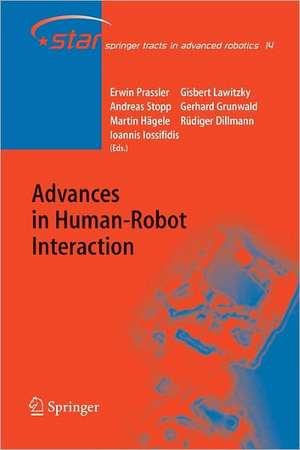
Advances in Human-Robot Interaction: Springer Tracts in Advanced Robotics, cartea 14
Editat de Erwin Prassler, Gisbert Lawitzky, Andreas Stopp, Gerhard Grunwald, Martin Hägele, Rüdiger Dillmann, Ioannis Iossifidisen Limba Engleză Paperback – 22 oct 2010
Din seria Springer Tracts in Advanced Robotics
- 17%
 Preț: 429.18 lei
 - 15%
 Preț: 430.39 lei
 - 18%
 Preț: 915.87 lei
 - 18%
 Preț: 895.87 lei
 -
 Preț: 460.34 lei
 -
 Preț: 434.53 lei
 - 15%
 Preț: 612.01 lei
 - 18%
 Preț: 762.73 lei
 - 15%
 Preț: 611.32 lei
 - 18%
 Preț: 946.89 lei
 - 18%
 Preț: 702.09 lei
 - 18%
 Preț: 1185.81 lei
 - 18%
 Preț: 914.52 lei
 - 15%
 Preț: 615.35 lei
 - 18%
 Preț: 1772.67 lei
 - 18%
 Preț: 748.16 lei
 - 18%
 Preț: 856.49 lei
 - 20%
 Preț: 1006.30 lei
 - 15%
 Preț: 619.75 lei
 - 18%
 Preț: 960.16 lei
 - 20%
 Preț: 598.05 lei
 - 15%
 Preț: 661.64 lei
 - 18%
 Preț: 946.97 lei
 - 15%
 Preț: 687.45 lei
 - 18%
 Preț: 951.08 lei
 - 15%
 Preț: 643.28 lei
 - 18%
 Preț: 781.94 lei
 - 18%
 Preț: 966.61 lei
 - 15%
 Preț: 662.56 lei
 - 15%
 Preț: 629.66 lei
 - 18%
 Preț: 928.33 lei
 - 15%
 Preț: 675.49 lei
 - 18%
 Preț: 984.44 lei
 - 18%
 Preț: 982.36 lei
 - 15%
 Preț: 611.02 lei
 - 15%
 Preț: 657.02 lei
Preț: 955.51 lei
Preț vechi: 1165.26 lei
-18%
Puncte Express: 1433
Carte tipărită la comandă
Livrare economică 20 noiembrie-04 decembrie
Livrare prin curier în România Termenul estimat este afișat lângă disponibilitate.
Transport gratuit pentru acest produs Plată online sau ramburs, în funcție de opțiunile comenzii.
Retur gratuit în 14 zile Comandă securizată și suport în română.
Specificații
ISBN-13: 9783642062209
ISBN-10: 3642062202
Pagini: 432
Ilustrații: XIII, 414 p.
Dimensiuni: 155 x 235 x 24 mm
Greutate: 0.65 kg
Ediția:Softcover reprint of hardcover 1st ed. 2005
Editura: Springer
Colecția Springer Tracts in Advanced Robotics
Seria Springer Tracts in Advanced Robotics
Locul publicării:Berlin, Heidelberg, Germany
ISBN-10: 3642062202
Pagini: 432
Ilustrații: XIII, 414 p.
Dimensiuni: 155 x 235 x 24 mm
Greutate: 0.65 kg
Ediția:Softcover reprint of hardcover 1st ed. 2005
Editura: Springer
Colecția Springer Tracts in Advanced Robotics
Seria Springer Tracts in Advanced Robotics
Locul publicării:Berlin, Heidelberg, Germany
V-ar putea interesa
-
 Quality Control 3E SMMitraPreț: 274.33 lei
 -
 Optimal Design of Experiments - A Case Study ApproachBradley Jones-19%Preț: 516.64 lei637.83 lei
 -
 A User's Manual to the PMBOK Guide, 2nd EditionCynthia Stackpole Snyder-11%Preț: 565.39 lei635.26 lei
 -
 -23%Preț: 826.55 lei1073.45 lei
 -
 Patient Safety: A Human Factors ApproachSidney DekkerPreț: 474.99 lei
 -
 Intelligent Robotics and ApplicationsHonghai Liu-20%Preț: 351.22 lei439.02 lei
 -
 Functional Safety for Road VehiclesHans-Leo Ross-18%Preț: 707.41 lei862.70 lei
 -
 Autonome Mobile Systeme 2003Rüdiger Dillmann-20%Preț: 538.02 lei672.52 lei
 -
 Field and Service RoboticsShin'ichi Yuta-18%Preț: 1282.29 lei1563.78 lei
 -
 Autonome Mobile Systeme 2000Rüdiger Dillmann-18%Preț: 843.02 lei1028.07 lei
 -
 Informationsverarbeitung in der RobotikRüdiger Dillmann-20%Preț: 312.21 lei390.26 lei
 -
 Preț: 415.65 lei
 -
 Preț: 398.30 lei
 -
 -15%Preț: 472.56 lei555.95 lei
 -
 Preț: 397.19 lei
 -
 -15%Preț: 470.34 lei553.35 lei
 -
 Preț: 396.61 lei
 -
 Preț: 395.52 lei
 -
 Preț: 396.46 lei
 -
 -18%Preț: 923.48 lei1126.19 lei
 -
 Distributed Autonomous Robotic Systems 3Tim Lueth-15%Preț: 650.84 lei765.69 lei
Public țintă
ResearchCuprins
Multi-modal Robot Interfaces.- Perception, Interpretation and Interaction.- Learning, Programming and Instructing.- Co-existence: Physical Interaction and Coordinated Motion.- Safety and Dependability.- Architecture.- Systems and Applications.
Textul de pe ultima copertă
"Advances in Human-Robot Interaction" provides a unique collection of recent research in human-robot interaction. It covers the basic important research areas ranging from multi-modal interfaces, interpretation, interaction, learning, or motion coordination to topics such as physical interaction, systems, and architectures. The book addresses key issues of human-robot interaction concerned with perception, modelling, control, planning and cognition, covering a wide spectrum of applications. This includes interaction and communication with robots in manufacturing environments and the collaboration and co-existence with assistive robots in domestic environments. Among the presented examples are a robotic bartender, a new programming paradigm for a cleaning robot, or an approach to interactive teaching of a robot assistant in manufacturing environment. This carefully edited book reports on contributions from leading German academic institutions and industrial companies brought together within MORPHA, a 4 year project on interaction and communication between humans and anthropomorphic robot assistants.
Caracteristici
Thorough collection of articles in the field of human-robot interaction Includes the main results of the German Leitproject MORPHA over a period of 4 years, consisting of a total of 16 partners, amongst them industrial partners such as DaimlerChrysler and Siemens and five leading research institutes in the field of robotics and assistive robotics Includes supplementary material: sn.pub/extras