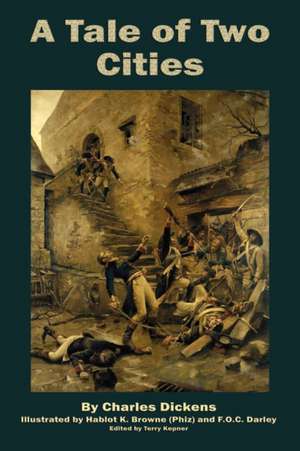
A Tale of Two Cities
Autor Charles Dickens Editat de Terry Kepneren Limba Engleză Paperback – 20 oct 2008 – vârsta până la 12 ani
Recomandăm părinților să introducă tinerii cititori în universul complex al istoriei prin A Tale of Two Cities, o lucrare ce abordează teme fundamentale precum nedreptatea socială, sacrificiul de sine și dualitatea naturii umane. La o vârstă la care adolescenții încep să își formeze propriile busole morale, acest text clasic oferă o perspectivă profundă asupra modului în care evenimentele politice mari influențează destinele individuale. Credem că forța acestui roman rezidă în capacitatea sa de a umaniza istoria, transformând Revoluția Franceză dintr-un simplu capitol de manual într-o experiență trăită prin ochii unor personaje memorabile precum doctorul Manette sau Sydney Carton. Elementul distinctiv al acestei ediții de la Wordsworth Editions Ltd este includerea celor 30 de ilustrații color realizate de Hablot K. Browne, care oferă un suport vizual prețios pentru a naviga prin densitatea narativă a lui Charles Dickens. Părinții care au explorat împreună cu copiii lor Tales from Dickens vor aprecia și această variantă integrală, deoarece păstrează acea atmosferă de epocă, dar adaugă un strat suplimentar de complexitate și realism istoric. Spre deosebire de alte opere ale autorului, precum Great Expectations sau David Copperfield, unde accentul cade pe maturizarea unui singur protagonist, aici Dickens construiește o frescă socială vastă, punând în balanță mizeria țărănimii franceze cu brutalitatea revoluționară. Ritmul este unul alert, marcat de suspansul specific publicării inițiale în foileton, ceea ce ajută la menținerea interesului tinerilor cititori de limbă engleză.
Preț: 232.20 lei
Carte tipărită la comandă
Livrare economică 03-17 decembrie
Specificații
ISBN-10: 160459487X
Pagini: 308
Ilustrații: 1
Dimensiuni: 152 x 229 x 19 mm
Greutate: 0.5 kg
Editura: Flying Chipmunk Publishing
Locul publicării:United States
V-ar putea interesa
-
 Murder on the Orient ExpressAgatha ChristiePreț: 64.49 lei
 -
 Pride and PrejudiceJane AustenPreț: 28.01 lei
 -
 War and PeaceLeo Tolstoy-10%Preț: 92.15 lei102.73 lei
 -
 Lady Audley's SecretMary Elizabeth Braddon-23%Preț: 56.62 lei73.98 lei
 -
 Les MiserablesVictor Hugo-11%Preț: 90.33 lei101.99 lei
 -
 Mamba Mentality: How I PlayKobe BryantPreț: 284.06 lei
 -
 Preț: 67.97 lei
 -
 The Copper GauntletCassandra Clare-18%Preț: 53.04 lei64.97 lei
 -
 Neil Gaiman & Chris Riddell Box SetNeil GaimanPreț: 136.31 lei
 -
 It: An epic thriller from the number one bestsellerStephen King-12%Preț: 79.46 lei90.03 lei
 -
 Milk and HoneyRupi Kaur-19%Preț: 75.84 lei93.11 lei
 -
 EmmaJane AustenPreț: 93.32 lei
 -
 -5%Preț: 47.33 lei49.82 lei
 -
 War and Peace (Vintage Classic Russians Series)Leo Tolstoy-9%Preț: 95.49 lei105.03 lei
 -
 A Christmas CarolCharles DickensPreț: 29.27 lei
 -
 Life on AirDavid Attenborough-35%Preț: 61.47 lei94.65 lei
 -
 Moby DickHerman MelvillePreț: 39.32 lei
 -
 Oliver TwistCharles DickensPreț: 37.41 lei
 -
 Jane EyreCharlotte BrontëPreț: 126.40 lei
 -
 The Tenant of Wildfell HallAnne BrontePreț: 149.63 lei
De ce să citești această carte
Această ediție este ideală pentru elevii de liceu care doresc să își aprofundeze cunoștințele de limba engleză și istorie universală. Cititorul câștigă o înțelegere nuanțată a conceptelor de dreptate și compasiune. Este un instrument educativ excelent datorită ilustrațiilor care facilitează lectura unui text clasic complex, oferind în același timp o bază solidă pentru discuții despre etică și schimbare socială.
Despre autor
Charles Dickens (1812–1870) este considerat cel mai important romancier al epocii victoriene și un critic social acerb. Experiența sa timpurie de muncă într-o fabrică, în timp ce tatăl său era închis pentru datorii, i-a marcat profund opera, transformându-l într-un militant neobosit pentru drepturile copiilor și reformă socială. Stilul său unic combină realismul detaliat cu un umor inegalabil și o galerie de personaje fascinante. Prin A Tale of Two Cities, Dickens și-a demonstrat geniul de a capta spiritul unei epoci, rămânând până astăzi unul dintre cei mai citiți autori la nivel mondial.
Descriere scurtă
Notă biografică
When the family fortunes improved, Charles went back to school, after which he became an office boy, a freelance reporter and finally an author. With "Pickwick Papers "(1836-7) he achieved immediate fame; in a few years he was easily the post popular and respected writer of his time. It has been estimated that one out of every ten persons in Victorian England was a Dickens reader. "Olive Twist "(1837), "Nicholas Nickleby "(1838-9) and "The Old Curiosity Shop "(1840-41) were huge successes. "Martin Chuzzlewit "(1843-4) was less so, but Dickens followed it with his unforgettable, "A Christmas Carol "(1843), "Bleak House "(1852-3), "Hard Times "(1854) and" Little Dorrit "(1855-7)" "reveal his deepening concern for the injustices of British Society. "A Tale of Two Cities "(1859), "Great Expectations "(1860-1) and "Our Mutual Friend "(1864-5) complete his major works.
Dickens s marriage to Catherine Hoggarth produced ten children but ended in separation in 1858. In that year he began a series of exhausting public readings; his health gradually declined. After putting in a full day s work at his home at Gads Hill, Kent on June 8, 1870, Dickens suffered a stroke, and he died the following day."
Descriere
Little treasures, the FLAME TREE COLLECTABLE CLASSICS are chosen to create a delightful and timeless home library. Each stunning, gift edition features deluxe cover treatments, ribbon markers, luxury endpapers and gilded edges. The unabridged text is accompanied by a Glossary of Victorian and Literary terms produced for the modern reader.
A complex and profound book, The Tale of Two Cities explores the consequences of tyranny, fate and self-sacrifice. With much of the narrative played out in Paris, during the French Revolution Dickens examines the interplay between personal action, and the flow of history. Dr Manette, having travelled to Paris finds himself imprisoned in the Bastille for 18 brutal years, unable to see his kind and loving daughter Lucy. On his eventual return to London the two of them become witnesses in a treason case against Charles Darney who is accused of giving secrets to the French. Lucy finds a way of exonerating him, Darney falls in love with her and by some strange twist of fate he finally reveals the terrible secret that his own uncle was responsible for Manette's years in the Bastille. Manette is shocked but eventually persuaded by Darney's sincerity and true love for this daughter, so he allows them to marry, bringing happiness finally to them all.
Recenzii
Textul de pe ultima copertă
Unjustly imprisoned for 18 years in the Bastille, Dr. Alexandre Manette is reunited with his daughter, Lucie, and safely transported from France to England. It would seem that they could take up the threads of their lives in peace. As fate would have it though, the pair are summoned to the Old Bailey to testify against a young Frenchman Charles Darnay falsely accused of treason. Strangely enough, Darnay bears an uncanny resemblance to another man in the courtroom, the dissolute lawyer's clerk Sydney Carton. It is a coincidence that saves Darnay from certain doom more than once. Brilliantly plotted, the novel is rich in drama, romance, and heroics that culminate in a daring prison escape in the shadow of the guillotine."