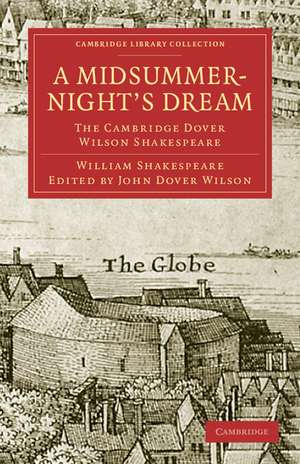
A Midsummer Night's Dream: The Cambridge Dover Wilson Shakespeare: Cambridge Library Collection - Shakespeare and Renaissance Drama
Autor William Shakespeare Editat de Sir Arthur Quiller-Couch, John Dover Wilsonen Limba Engleză Paperback – 19 iul 2009
Din seria Cambridge Library Collection - Shakespeare and Renaissance Drama
-
 Preț: 257.34 lei
 -
 Preț: 229.63 lei
 -
 Preț: 426.95 lei
 -
 Preț: 298.51 lei
 -
 Preț: 342.06 lei
 -
 Preț: 410.50 lei
 -
 Preț: 264.24 lei
 -
 Preț: 271.24 lei
 -
 Preț: 287.69 lei
 -
 Preț: 270.71 lei
 -
 Preț: 299.81 lei
 -
 Preț: 460.33 lei
 -
 Preț: 226.84 lei
 -
 Preț: 478.89 lei
 -
 Preț: 289.52 lei
 - 19%
 Preț: 441.49 lei
 - 19%
 Preț: 494.83 lei
 -
 Preț: 260.64 lei
 -
 Preț: 293.24 lei
 -
 Preț: 286.96 lei
 -
 Preț: 293.06 lei
 -
 Preț: 358.04 lei
 -
 Preț: 297.58 lei
 -
 Preț: 257.34 lei
 -
 Preț: 271.08 lei
 -
 Preț: 273.65 lei
 -
 Preț: 289.72 lei
 -
 Preț: 287.31 lei
 -
 Preț: 267.69 lei
 -
 Preț: 289.37 lei
 -
 Preț: 291.41 lei
 -
 Preț: 245.94 lei
 -
 Preț: 273.52 lei
 -
 Preț: 425.81 lei
Preț: 285.66 lei
Puncte Express: 428
Carte tipărită la comandă
Livrare economică 15-29 iulie
Livrare prin curier în România Termenul estimat este afișat lângă disponibilitate.
Transport gratuit de la 400.00 lei Plată online sau ramburs, în funcție de opțiunile comenzii.
Retur gratuit în 14 zile Comandă securizată și suport în română.
Specificații
ISBN-13: 9781108005951
ISBN-10: 1108005950
Pagini: 204
Ilustrații: black & white illustrations
Dimensiuni: 140 x 216 x 12 mm
Greutate: 0.26 kg
Editura: Cambridge University Press
Colecția Cambridge University Press
Seria Cambridge Library Collection - Shakespeare and Renaissance Drama
Locul publicării:Cambridge, United Kingdom
ISBN-10: 1108005950
Pagini: 204
Ilustrații: black & white illustrations
Dimensiuni: 140 x 216 x 12 mm
Greutate: 0.26 kg
Editura: Cambridge University Press
Colecția Cambridge University Press
Seria Cambridge Library Collection - Shakespeare and Renaissance Drama
Locul publicării:Cambridge, United Kingdom
V-ar putea interesa
-
 Twelfth NightWilliam ShakespearePreț: 28.95 lei
 -
 SylvesterGeorgette Heyer-27%Preț: 57.22 lei78.14 lei
 -
 The Good Woman of SetzuanBertolt BrechtPreț: 70.36 lei
 -
 -21%Preț: 19.52 lei24.60 lei
 -
 As You Like ItWilliam ShakespearePreț: 26.93 lei
 -
 The Tale of GenjiLady MurasakiPreț: 44.14 lei
 -
 MacbethWilliam ShakespearePreț: 39.31 lei
 -
 HamletWilliam ShakespearePreț: 41.90 lei
 -
 The Canterbury Tales: Seventeen Tales and the General PrologueGeoffrey ChaucerPreț: 116.06 lei
 -
 I Promise You (The Promises Series)Christine Roussey-22%Preț: 45.50 lei58.50 lei
 -
 A Dress with PocketsLily Murray-35%Preț: 37.26 lei56.94 lei
 -
 Romeo and JulietWilliam ShakespearePreț: 35.51 lei
 -
 Pride and PrejudiceJane AustenPreț: 31.04 lei
 -
 Sense and SensibilityJane AustenPreț: 25.31 lei
 -
 Tom JonesHenry FieldingPreț: 40.40 lei
 -
 The Scarlet LetterNathaniel HawthornePreț: 43.56 lei
 -
 The Great GatsbyF. Scott FitzgeraldPreț: 29.68 lei
 -
 Hard TimesCharles DickensPreț: 24.60 lei
Cuprins
Introduction; To the reader; Title-page of the Quarto of 1600; A Midsummer-Night's Dream; The copy for the text of 1600; Notes; A note on the Folio text; The stage-history; Glossary.
Descriere
New Shakespeare, long since out-of-print, is now reissued. Each work contains a lengthy and lively introduction, main text, and substantial notes and glossary.
Notă biografică
William Shakespeare 26 April 1564 ¿ 23 April 1616was an English poet, playwright and actor, widely regarded as the greatest writer in the English language and the world's greatest dramatist.He is often called England's national poet and the "Bard of Avon".His extant works, including collaborations, consist of approximately 39 plays,154 sonnets, two long narrative poems, and a few other verses, some of uncertain authorship. His plays have been translated into every major living language and are performed more often than those of any other playwright.[
Shakespeare was born and raised in Stratford-upon-Avon, Warwickshire. . Sometime between 1585 and 1592, he began a successful career in London as an actor, writer, and part-owner of a playing company called the Lord Chamberlain's Men, later known as the King's Men. His early plays were primarily comedies and histories and are regarded as some of the best work produced in these genres. Until about 1608, he wrote mainly tragedies, among them Hamlet, Othello, King Lear, and Macbeth, all considered to be among the finest works in the English language. In the last phase of his life, he wrote tragicomedies (also known as romances) and collaborated with other playwrights.
Throughout the 20th and 21st centuries, Shakespeare's works have been continually adapted and rediscovered by new movements in scholarship and performance. His plays remain popular and are studied, performed, and reinterpreted through various cultural and political contexts around the world.
Textul de pe ultima copertă
Perhaps the most popular of all of Shakespeare's comedies, "A Midsummer Night's Dream" humorously celebrates the vagaries of love. The approaching wedding festivities of Theseus, Duke of Athens, and his bride-to-be, Hippolyta, Queen of the Amazons, are delightfully crisscrossed with in-again, off-again romances of two young pairs of Athenian lovers; a fateful rivalry between the King and Queen of the Fairies; and the theatrical aspirations of a bumbling troupe of Athenian laborers. It all ends happily in wedding-night revelry complete with a play-within-a-play presented by the laborers to the ecstatic amusement of all. This edition, complete with explanatory footnotes, is reprinted from a standard British edition.
Recenzii
This edition of A Midsummer Night’s Dream is wonderfully lucid and thoughtful, offering supporting material that will appeal to readers from high school students to scholars. The introduction is especially thoughtful, offering, in addition to expected discussions of love, magic and imagination, an exploration of the theatrical history. The bibliography and filmography are both detailed and helpful, and the questions guide students to consider the play from many viewpoints without ever forcing an interpretation onto them.
- Annalisa Castaldo, Widener University
- Annalisa Castaldo, Widener University
Even as the New Kittredge Shakespeare series glances back to George Lyman Kittredge's student editions of the plays, it is very much of our current moment: the slim editions are targeted largely at high school and first-year college students who are more versed in visual than in print culture. Not only are the texts of the plays accompanied by photographs or stills from various stage and cinema performances: the editorial contributions are performance-oriented, offering surveys of contemporary film interpretations, essays on the plays as performance pieces, and an annotated filmography. Traditional editorial issues (competing versions of the text, cruxes, editorial emendation history) are for the most part excluded; the editions focus instead on clarifying the text with an eye to performing it. There is no disputing the pedagogic usefulness of the New Kittredge Shakespeare's performance-oriented approach. At times, however, it can run the risk of treating textual issues as impediments, rather than partners, to issues of performance. This is particularly the case with a textually vexed play such as Pericles: Prince of Tyre. In the introduction to the latter, Jeffrey Kahan notes the frequent unintelligibility of the play as originally published: "the chances of a reconstructed text matching what Shakespeare actually wrote are about 'nil'" (p. xiii) But his solution — to use a "traditional text" rather than one corrected as are the Oxford and Norton Pericles — obscures how this "traditional text," including its act and scene division, is itself a palimpsest produced through three centuries of editorial intervention. Nevertheless, the series does a service to its target audience with its emphasis on performance and dramaturgy. Kahan's own essay about his experiences as dramaturge for a college production of Pericles is very good indeed, particularly on the play's inability to purge the trace of incestuous desire that Pericles first encounters in Antioch. Other plays' cinematic histories: Annalisa Castaldo's edition of Henry V contrasts Laurence Oliver's and Branagh's film productions; Samuel Crowl's and James Wells's edition of (respectively) I and 2 Henry IV concentrate on Welle's Chimes at Midnight and Gus Van Sant's My Own Private Idaho; Patricia Lennox's edition of As You Like It offers an overview of four Hollywood and British film adaptations; and John R. Ford's edition of A Midsummer Night's Dream provides a spirited survey of the play's rich film history.
The differences between, and comparative merits of, various editorial series are suggested by the three editions of The Taming of the Shrew published this year. Laury Magnus's New Kittredge Shakespeare edition is, like the other New Kittredge volumes, a workable text for high school and first year college students interested in film and theater. The introduction elaborates on one theme — Elizabethan constructions of gender — and offers a very broad performance history, focusing on Sam Taylor's and Zeffirelli's film versions as well as adaptations such as Kiss Me Kate and Ten Things I Hate About You (accompanied by a still of ten hearthtrobs Heath Ledger and Julia Stiles). The volume is determined to eradicate any confusion that a first time reader of the play might experience: the dramatis personae page explains that "Bianca Minola" is "younger daughter to Baptista, wooed by Lucentio-in-disguise (as Cambio) and then wife to him, also wooed by the elderly Gremio and Hortensio-in-disguise (as Licio)" (p.1). Other editorial notes, based on Kittredge's own, are confined mostly to explaining individual words and phrases: additional footnotes discuss interpretive choices made by film and stage productions. Throughout, the editorial emphasis is on the play less as text than as performance piece, culminating in fifteen largely performance-oriented "study questions" on topics such as disguise, misogyny, and violence.
Studies in English Literature, Tudor and Stuart Drama, Volume 51, Spring 2011, Number 2, pages 497-499.
The differences between, and comparative merits of, various editorial series are suggested by the three editions of The Taming of the Shrew published this year. Laury Magnus's New Kittredge Shakespeare edition is, like the other New Kittredge volumes, a workable text for high school and first year college students interested in film and theater. The introduction elaborates on one theme — Elizabethan constructions of gender — and offers a very broad performance history, focusing on Sam Taylor's and Zeffirelli's film versions as well as adaptations such as Kiss Me Kate and Ten Things I Hate About You (accompanied by a still of ten hearthtrobs Heath Ledger and Julia Stiles). The volume is determined to eradicate any confusion that a first time reader of the play might experience: the dramatis personae page explains that "Bianca Minola" is "younger daughter to Baptista, wooed by Lucentio-in-disguise (as Cambio) and then wife to him, also wooed by the elderly Gremio and Hortensio-in-disguise (as Licio)" (p.1). Other editorial notes, based on Kittredge's own, are confined mostly to explaining individual words and phrases: additional footnotes discuss interpretive choices made by film and stage productions. Throughout, the editorial emphasis is on the play less as text than as performance piece, culminating in fifteen largely performance-oriented "study questions" on topics such as disguise, misogyny, and violence.
Studies in English Literature, Tudor and Stuart Drama, Volume 51, Spring 2011, Number 2, pages 497-499.
Appropriate for all level of Shakespeare courses, including courses on Shakespeare, or drama, or Renaissance drama as taught in departments of English, courses in Shakespeare or drama taught in departments of theater, Great Books programs where individual volumes might be used, or high school level courses.