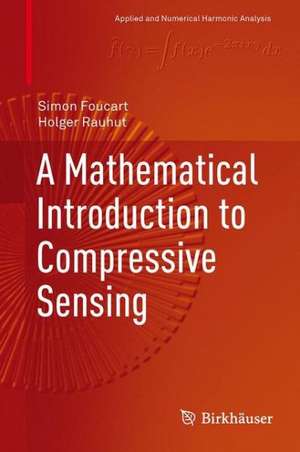
A Mathematical Introduction to Compressive Sensing: Applied and Numerical Harmonic Analysis
Autor Simon Foucart, Holger Rauhuten Limba Engleză Hardback – 8 aug 2013
Observăm în această lucrare, A Mathematical Introduction to Compressive Sensing, prima tentativă reușită de a sistematiza riguros fundamentul matematic al unui domeniu aflat la intersecția dintre inginerie și informatică. Față de literatura existentă, care adesea se concentrează pe aplicații practice imediate, această ediție publicată de birkhäuser prioritizează eleganța teoretică și demonstrațiile complete, fiind concepută special pentru curriculumul de nivel absolvent. Găsim aici o resursă care transformă intuițiile euristice în teoreme solide, oferind o claritate necesară într-un domeniu marcat de o explozie a cercetării în ultimele decenii. Lucrarea extinde cadrul propus de Compressed Sensing de Yonina C. Eldar prin accentul pus pe instrumentele de analiză funcțională și probabilități, oferind o rigoare matematică mai profundă pentru rezultatele de bază. Structura cărții urmărește o progresie logică impecabilă: începe cu soluțiile rare ale sistemelor subdeterminate și algoritmii fundamentali, trece prin analiza proprietății de izometrie restricționată (RIP) în capitolele 5 și 6, și culminează cu tehnici avansate de eșantionare aleatorie în sisteme ortonormale marginite. Această abordare teoretică este complementară cu volumul Compressed Sensing and its Applications coordonat de Holger Boche, care se apleacă mai mult spre implementările în comunicare și optică. În contextul operei autorilor, cartea reprezintă pilonul teoretic central. În timp ce Mathematical Pictures at a Data Science Exhibition oferă o panoramă mai largă asupra științei datelor, incluzând rețele neurale și optimizare, volumul de față izolează și aprofundează mecanismele eșantionării compresive. Această focalizare este continuată și în Explorations in the Mathematics of Data Science, unde Simon Foucart explorează direcții noi de cercetare sub egida CAMDA. Pentru cercetătorul care dorește să înțeleagă nu doar 'cum', ci mai ales 'de ce' funcționează recuperarea semnalelor rare, această lucrare din seria Applied and Numerical Harmonic Analysis rămâne referința standard.
Din seria Applied and Numerical Harmonic Analysis
-
 Preț: 412.83 lei
 -
 Preț: 422.34 lei
 - 15%
 Preț: 687.12 lei
 - 15%
 Preț: 648.10 lei
 - 15%
 Preț: 670.35 lei
 - 15%
 Preț: 678.37 lei
 -
 Preț: 425.06 lei
 - 17%
 Preț: 490.75 lei
 -
 Preț: 394.98 lei
 -
 Preț: 417.98 lei
 - 15%
 Preț: 668.72 lei
 - 15%
 Preț: 679.46 lei
 - 18%
 Preț: 693.76 lei
 - 15%
 Preț: 680.36 lei
 - 15%
 Preț: 669.27 lei
 - 24%
 Preț: 646.32 lei
 - 32%
 Preț: 589.01 lei
 -
 Preț: 376.97 lei
 - 15%
 Preț: 525.30 lei
 - 15%
 Preț: 672.01 lei
 -
 Preț: 390.25 lei
 - 21%
 Preț: 583.02 lei
 -
 Preț: 424.20 lei
 - 15%
 Preț: 670.03 lei
 -
 Preț: 407.65 lei
 - 24%
 Preț: 594.27 lei
 -
 Preț: 411.45 lei
 -
 Preț: 390.01 lei
 - 5%
 Preț: 1174.50 lei
 - 24%
 Preț: 597.60 lei
 -
 Preț: 401.66 lei
 - 18%
 Preț: 1147.27 lei
 - 18%
 Preț: 991.26 lei
 -
 Preț: 403.77 lei
 - 15%
 Preț: 609.75 lei
 -
 Preț: 393.95 lei
 - 18%
 Preț: 1165.29 lei
 - 18%
 Preț: 1014.41 lei
 - 15%
 Preț: 555.16 lei
 - 15%
 Preț: 680.81 lei
 - 24%
 Preț: 934.46 lei
Preț: 571.61 lei
Preț vechi: 672.48 lei
-15%
Carte disponibilă
Livrare economică 16-30 noiembrie
Specificații
ISBN-10: 0817649476
Pagini: 644
Ilustrații: XVIII, 625 p.
Dimensiuni: 160 x 241 x 40 mm
Greutate: 1.07 kg
Ediția:2013
Editura: birkhäuser
Colecția Applied and Numerical Harmonic Analysis
Seria Applied and Numerical Harmonic Analysis
Locul publicării:New York, NY, United States
V-ar putea interesa
-
 Topics on Analysis in Metric SpacesLuigi Ambrosio-32%Preț: 729.81 lei1069.87 lei
 -
 Distributions and OperatorsGerd Grubb-20%Preț: 633.94 lei792.43 lei
 -
 Fourier Analysis on Number FieldsDinakar Ramakrishnan-15%Preț: 726.78 lei855.04 lei
 -
 Introductory Functional Analysis with Applications (WSE)Erwin Kreyszig-18%Preț: 988.71 lei1205.75 lei
 -
 Convex AnalysisRalph Tyrell Rockafellar-23%Preț: 726.94 lei944.08 lei
 -
 -19%Preț: 653.68 lei807.01 lei
 -
 Fractal GeometryKenneth FalconerPreț: 426.81 lei
 -
 Exercises in Functional AnalysisC. Costara-18%Preț: 988.68 lei1205.70 lei
 -
 -18%Preț: 896.42 lei1093.19 lei
 -
 -15%Preț: 461.86 lei543.37 lei
 -
 Fractal Geometry, Complex Dimensions and Zeta FunctionsMichel L. Lapidus-18%Preț: 944.24 lei1151.51 lei
 -
 Introduction to Tensor Products of Banach SpacesRaymond A. Ryan-18%Preț: 920.90 lei1123.05 lei
 -
 Discrete Fourier AnalysisM. W. WongPreț: 385.63 lei
 -
 Neural FieldsStephen Coombes-15%Preț: 733.58 lei863.03 lei
Public țintă
GraduateDe ce să citești această carte
Această carte este esențială pentru studenții și cercetătorii care doresc o înțelegere matematică profundă a eșantionării compresive. Cititorul câștigă acces la demonstrații riguroase și la un aparat teoretic complet (analiză matriceală și convexă), trecând dincolo de simplele implementări algoritmice. Este resursa ideală pentru a stăpâni conceptele de bază din procesarea semnalelor și recuperarea datelor într-un cadru formal, academic.
Cuprins
Recenzii
Textul de pe ultima copertă
A Mathematical Introduction to Compressive Sensing gives a detailed account of the core theory upon which the field is build. Key features include:
· The first textbook completely devoted to the topic of compressive sensing
· Comprehensive treatment of the subject, including background material from probability theory, detailed proofs of the main theorems, and an outline of possible applications
· Numerous exercises designed to help students understand the material
· An extensive bibliography with over 500 references that guide researchers through the literature
With only moderate prerequisites, A Mathematical Introduction to Compressive Sensing is an excellent textbook for graduate courses in mathematics, engineering, and computer science. It also serves as a reliable resource for practitioners and researchers in these disciplines who want to acquire a careful understanding of the subject.