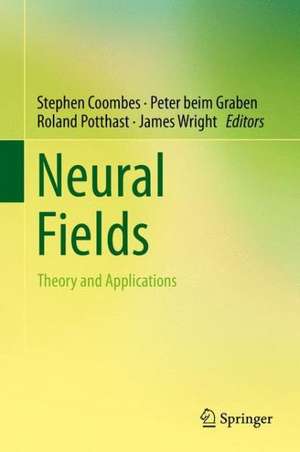
Neural Fields: Theory and Applications
Editat de Stephen Coombes, Peter beim Graben, Roland Potthast, James Wrighten Limba Engleză Hardback – 9 iul 2014
Neuroștiințele computaționale au parcurs o evoluție remarcabilă, trecând de la simulări numerice costisitoare ale rețelelor neuronale masive la eleganța analitică a teoriei câmpurilor neuronale. Această lucrare, publicată în ediția 2014 la Springer, marchează un moment de maturitate al domeniului, oferind prima sinteză de anvergură a unor cercetări care, timp de decenii, au rămas fragmentate în publicații de specialitate diverse. Ne-a atras atenția modul în care editorii Stephen Coombes și Peter beim Graben reușesc să reconcilieze rigoarea matematică a analizei funcționale cu fenomenele fiziologice observabile.
Suntem de părere că volumul Neural Fields extinde cadrul propus de Waves in Neural Media de Paul C. Bressloff cu date noi din perspectiva metodelor numerice pentru întârzieri dependente de spațiu și modele stocastice avansate. Dacă în Neurodynamics, Stephen Coombes se concentra pe aplicarea seturilor de abilități matematice în context neurobiologic, aici perspectiva este mult mai amplă, integrând contribuții de la figurile emblematice ale domeniului, precum Shun-ichi Amari și Jack Cowan. Structura cărții este didactică și progresivă: începe cu un tutorial esențial pentru unificarea terminologiei, continuă cu fundamentele teoretice ale excitației și auto-organizării și culminează cu aplicații în electrodinamica rețelelor neuronale. Această abordare permite cititorului să navigheze de la construcția inversă a nucleelor de conectivitate până la interfațarea activității neuronale cu date experimentale complexe precum EEG sau fMRI, oferind o resursă indispensabilă pentru cercetarea avansată.
Preț: 709.80 lei
Preț vechi: 835.06 lei
-15%
Carte tipărită la comandă
Livrare economică 25 septembrie-09 octombrie
Specificații
ISBN-10: 3642545920
Pagini: 497
Ilustrații: X, 487 p. 132 illus., 50 illus. in color.
Dimensiuni: 155 x 235 x 32 mm
Greutate: 0.87 kg
Ediția:2014
Editura: Springer Berlin, Heidelberg
Colecția Springer
Locul publicării:Berlin, Heidelberg, Germany
V-ar putea interesa
-
 -19%Preț: 494.58 lei610.60 lei
 -
 -23%Preț: 601.13 lei780.70 lei
 -
 Hypergeometric SummationWolfram Koepf-15%Preț: 502.35 lei591.01 lei
 -
 Decay of the Fourier TransformAlex Iosevich-15%Preț: 702.86 lei826.89 lei
 -
 -15%Preț: 606.90 lei714.01 lei
 -
 -18%Preț: 804.82 lei981.48 lei
 -
 Exercises in AnalysisLeszek Gasi¿ksi-18%Preț: 937.92 lei1143.80 lei
 -
 Geometric Aspects of Functional AnalysisBo'az KlartagPreț: 383.37 lei
 -
 Dynamic Inequalities On Time ScalesRavi AgarwalPreț: 377.53 lei
 -
 A Topological Introduction to Nonlinear AnalysisRobert F. BrownPreț: 488.13 lei
 -
 Stochastic Processes - Inference TheoryMalempati M. Rao-15%Preț: 638.62 lei751.31 lei
 -
 An Introduction to Modern AnalysisVicente Montesinos-15%Preț: 721.18 lei848.44 lei
 -
 Preț: 401.74 lei
 -
 Preț: 301.49 lei
 -
 Lineare FunktionalanalysisHans Wilhelm AltPreț: 434.74 lei
 -
 -48%Preț: 505.49 lei980.06 lei
 -
 Semigroups, Boundary Value Problems and Markov ProcessesKazuaki Taira-18%Preț: 774.49 lei944.50 lei
 -
 HILBERT-HUANG TRANSFORM AND ITS APPLICATIONS (2ND ED)Huang Norden E-18%Preț: 821.12 lei1001.38 lei
 -
 Hilbert Space and Quantum MechanicsFranco Gallone-18%Preț: 799.24 lei974.69 lei
Public țintă
ResearchDe ce să citești această carte
Recomandăm această lucrare cercetătorilor și doctoranzilor care doresc să depășească limitările computaționale ale modelelor clasice de rețele. Cititorul câștigă o înțelegere profundă a soluțiilor de tip „bump” și „wave”, esențiale pentru modelarea proceselor cognitive. Este o resursă rară care reunește expertiza fondatorilor teoriei cu tehnicile matematice moderne, fiind un instrument de referință pentru oricine lucrează la intersecția dintre analiza matematică și neuroștiințe.
Despre autor
Stephen Coombes este un cercetător de renume în cadrul Universității din Nottingham, specializat în modelarea matematică a sistemelor neuronale. Alături de co-editorii Peter beim Graben, Roland Potthast și James Wright, acesta a contribuit semnificativ la dezvoltarea teoriei câmpurilor dinamice. Lucrarea sa anterioară, Neurodynamics, a pus bazele înțelegerii dinamicii sistemelor biologice prin prisma fizicii și ingineriei. Coombes este recunoscut pentru capacitatea de a sintetiza teorii matematice abstracte în aplicații concrete pentru neuroștiințele computaționale, colaborând frecvent cu lideri mondiali din domeniu pentru a defini standardele academice în analiza activității cerebrale la scară largă.
Cuprins
Textul de pe ultima copertă
Neural field theory and its applications have a long-standing tradition in the mathematical and computational neurosciences. Beginning almost 50 years ago with seminal work by Griffiths and culminating in the 1970ties with the models of Wilson and Cowan, Nunez and Amari, this important research area experienced a renaissance during the 1990ties by the groups of Ermentrout, Bressloff, Haken, and Wright. Since then, much progress has been made in both, the development of mathematical and numerical techniques, and in physiological refinement and understanding.
In contrast to large-scale neural network models described by huge connectivity matrices that are computationally expensive in numerical simulations, neural field models described by connectivity kernels allow for analytical treatment by means of functional analysis methods. Thus, a number of rigorous results on the existence of bump and wave solutions or on inverse kernel construction problems are nowadays available. Moreover, neuralfields provide an important interface for the coupling of continuous neural activity to experimentally observable data, such as the electroencephalogram (EEG) or functional magnetic resonance imaging (fMRI). And finally, neural fields over rather abstract feature spaces, also called dynamic neural fields, found successful applications in the cognitive sciences and in robotics.