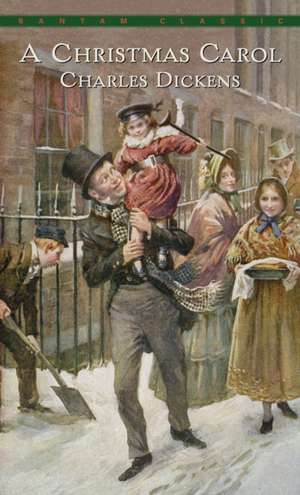
A Christmas Carol: Random House Publishing Group
Autor Charles Dickensen Limba Engleză Paperback – noi 1986
Găsim în paginile acestei ediții A Christmas Carol o atmosferă ce pendulează între frigul tăios al Londrei victoriene și căldura unei speranțe redobândite. Încă de la primele rânduri, suntem avertizați că moartea lui Marley este un fapt cert, o ancoră necesară pentru ca elementul miraculos care urmează să aibă greutate. Ne-a atras atenția modul în care Charles Dickens reușește să transforme un personaj dezolant precum Ebenezer Scrooge într-un vehicul pentru o critică socială profundă, fără a sacrifica însă farmecul unei povești despre spirite și regrete. Structura cărții, organizată în cinci „Stave-uri” (capitole muzicale), ghidează cititorul printr-o călătorie temporală precisă: de la fantoma lui Marley, la spiritele Crăciunului Trecut, Prezent și Viitor, până la rezoluția finală a transformării. Pe același raft cu A Christmas Carol - Kid Classics de Charles Dickens, această ediție Collins Classics se distinge prin păstrarea textului original, neadaptat, oferind acea bogăție a limbajului care l-a consacrat pe autor ca un maestru al prozei britanice. Față de abordările pedagogice sau simplificate, volumul de față păstrează realismul dur al epocii, reflectând preocupările constante ale lui Dickens pentru drepturile copiilor și educație, teme explorate și în Great Expectations sau David Copperfield. Este o lectură în care umorul fin se împletește cu estetica gotică, oferind o experiență mult mai complexă decât o simplă parabolă morală.
Din seria Random House Publishing Group
-
 Preț: 106.69 lei
 -
 Preț: 100.14 lei
 -
 Preț: 36.31 lei
 -
 Preț: 113.59 lei
 -
 Preț: 124.92 lei
 -
 Preț: 101.95 lei
 -
 Preț: 114.64 lei
 -
 Preț: 112.07 lei
 -
 Preț: 103.97 lei
 -
 Preț: 42.93 lei
 - 11%
 Preț: 63.31 lei
 -
 Preț: 94.55 lei
 -
 Preț: 132.80 lei
 -
 Preț: 90.75 lei
 -
 Preț: 110.61 lei
 -
 Preț: 97.77 lei
 -
 Preț: 111.22 lei
 -
 Preț: 151.67 lei
 -
 Preț: 108.67 lei
 - 5%
 Preț: 87.47 lei
 -
 Preț: 61.14 lei
 -
 Preț: 118.31 lei
 -
 Preț: 98.37 lei
 -
 Preț: 127.47 lei
 -
 Preț: 92.83 lei
 -
 Preț: 101.39 lei
 -
 Preț: 81.90 lei
 -
 Preț: 108.01 lei
 -
 Preț: 51.47 lei
 -
 Preț: 82.64 lei
 -
 Preț: 54.06 lei
 -
 Preț: 142.68 lei
 -
 Preț: 38.49 lei
 -
 Preț: 75.07 lei
 -
 Preț: 128.56 lei
 -
 Preț: 106.29 lei
 -
 Preț: 52.95 lei
 -
 Preț: 97.47 lei
 - 24%
 Preț: 115.28 lei
 -
 Preț: 110.15 lei
 -
 Preț: 106.07 lei
 -
 Preț: 100.75 lei
 -
 Preț: 110.15 lei
 -
 Preț: 122.14 lei
 -
 Preț: 143.08 lei
 -
 Preț: 105.67 lei
 - 23%
 Preț: 107.50 lei
 -
 Preț: 95.60 lei
 -
 Preț: 98.16 lei
 -
 Preț: 129.65 lei
Preț: 32.25 lei
Carte disponibilă
Livrare economică 17 noiembrie-01 decembrie
Specificații
ISBN-10: 0553212443
Pagini: 114
Dimensiuni: 170 x 102 x 10 mm
Greutate: 0.06 kg
Editura: Random House
Colecția Random House Publishing Group
Seria Random House Publishing Group
V-ar putea interesa
-
 A Tale of Two CitiesCharles DickensPreț: 28.01 lei
 -
 Charlotte's WebE. B. WhitePreț: 60.47 lei
 -
 -15%Preț: 43.97 lei51.86 lei
 -
 Call Me by Your NameAndré Aciman-30%Preț: 69.49 lei99.27 lei
 -
 Mamba Mentality: How I PlayKobe BryantPreț: 283.79 lei
 -
 Harry Potter and the Philosopher's StoneJ. K. Rowling-24%Preț: 50.41 lei66.00 lei
 -
 War and Peace (Vintage Classic Russians Series)Leo Tolstoy-8%Preț: 96.41 lei105.03 lei
 -
 The Wedding Dress MakerLeah Fleming-24%Preț: 49.61 lei65.50 lei
 -
 Great ExpectationsCharles DickensPreț: 32.41 lei
 -
 Moby DickHerman MelvillePreț: 39.32 lei
 -
 Oliver TwistCharles DickensPreț: 38.00 lei
 -
 David CopperfieldCharles DickensPreț: 40.48 lei
 -
 A Tale of Two CitiesCharles DickensPreț: 37.55 lei
 -
 The Pickwick PapersCharles DickensPreț: 40.39 lei
 -
 ShirleyCharlotte BrontëPreț: 38.92 lei
 -
 Bleak HouseCharles DickensPreț: 41.29 lei
 -
 The Wind in the WillowsKenneth GrahamePreț: 36.35 lei
 -
 Little DorritCharles DickensPreț: 41.65 lei
 -
 Our Mutual FriendCharles DickensPreț: 28.01 lei
 -
 Martin ChuzzlewitCharles DickensPreț: 41.00 lei
 -
 Hard TimesCharles DickensPreț: 28.01 lei
 -
 Old Curiosity ShopCharles DickensPreț: 40.15 lei
 -
 Dombey and SonCharles DickensPreț: 28.01 lei
 -
 Complete Ghost StoriesCharles DickensPreț: 37.46 lei
 -
 Barnaby RudgeCharles DickensPreț: 39.98 lei
De ce să citești această carte
Recomandăm această carte oricărui cititor care dorește să descopere forța narativă originală a lui Charles Dickens dincolo de adaptările cinematografice. Este o oportunitate de a experimenta ritmul autentic al limbii engleze victoriene și de a înțelege de ce această poveste a definit spiritul Crăciunului modern. Cititorul câștigă nu doar o lectură clasică, ci și o perspectivă empatică asupra condiției umane și a posibilității de schimbare.
Despre autor
Charles Dickens (1812–1870) este recunoscut drept cel mai important romancier al epocii victoriene, un observator acut al inechităților sociale din Anglia secolului al XIX-lea. Experiența sa timpurie, lucrând într-o fabrică de cremă de ghete la vârsta de 12 ani în timp ce tatăl său era închis pentru datorii, i-a marcat profund opera, transformându-l într-un apărător neobosit al celor defavorizați. Autor prolific, a scris 15 romane majore, printre care A Tale of Two Cities și Great Expectations, și a pionierat publicarea în foileton. Lucrările sale îmbină realismul social cu umorul satiric și personaje memorabile, rămânând fundamentale pentru literatura universală.
Notă biografică
When the family fortunes improved, Charles went back to school, after which he became an office boy, a freelance reporter and finally an author. With Pickwick Papers (1836-7) he achieved immediate fame; in a few years he was easily the post popular and respected writer of his time. It has been estimated that one out of every ten persons in Victorian England was a Dickens reader. Oliver Twist (1837), Nicholas Nickleby (1838-9) and The Old Curiosity Shop (1840-41) were huge successes. Martin Chuzzlewit (1843-4) was less so, but Dickens followed it with his unforgettable, A Christmas Carol (1843), Bleak House (1852-3), Hard Times (1854) and Little Dorrit (1855-7) reveal his deepening concern for the injustices of British Society. A Tale of Two Cities (1859), Great Expectations (1860-1) and Our Mutual Friend (1864-5) complete his major works.
Dickens’s marriage to Catherine Hoggarth produced ten children but ended in separation in 1858. In that year he began a series of exhausting public readings; his health gradually declined. After putting in a full day’s work at his home at Gads Hill, Kent on June 8, 1870, Dickens suffered a stroke, and he died the following day.
Extras
Mind! I don't mean to say that I know, of my own knowledge, what there is particularly dead about a door-nail. I might have been inclined, myself, to regard a coffin-nail as the deadest piece of ironmongery in the trade. But the wisdom of our ancestors is in the simile; and my unhallowed hands shall not disturb it, or the Country's done for. You will therefore permit me to repeat, emphatically, that Marley was as dead as a door-nail.
Scrooge knew he was dead? Of course he did. How could it be otherwise? Scrooge and he were partners for I don't know how many years. Scrooge was his sole executor, his sole administrator, his sole assign, his sole residuary legatee, his sole friend and sole mourner. And even Scrooge was not so dreadfully cut up by the sad event, but that he was an excellent man of business on the very day of the funeral, and solemnised it with an undoubted bargain.
The mention of Marley's funeral brings me back to the point I started from. There is no doubt that Marley was dead. This must be distinctly understood, or nothing wonderful can come of the story I am going to relate. If we were not perfectly convinced that Hamlet's Father died before the play began, there would be nothing more remarkable in his taking a stroll at night, in an easterly wind, upon his own ramparts, than there would be in any other middle-aged gentleman rashly turning out after dark in a breezy spot—say Saint Paul's Churchyard for instance—literally to astonish his son's weak mind.
Scrooge never painted out Old Marley's name. There it stood, years afterwards, above the warehouse door: Scrooge and Marley. The firm was known as Scrooge and Marley. Sometimes people new to the business called Scrooge Scrooge, and sometimes Marley, but he answered to both names: it was all the same to him.
Oh! but he was a tight-fisted hand at the grindstone, Scrooge! a squeezing, wrenching, grasping, scraping, clutching, covetous old sinner! Hard and sharp as flint, from which no steel had ever struck out generous fire; secret, and self-contained, and solitary as an oyster. The cold within him froze his old features, nipped his pointed nose, shrivelled his cheek, stiffened his gait; made his eyes red, his thin lips blue; and spoke out shrewdly in his grating voice. A frosty rime was on his head, and on his eyebrows, and his wiry chin. He carried his own low temperature always about with him; he iced his office in the dog-days; and didn't thaw it one degree at Christmas.
External heat and cold had little influence on Scrooge. No warmth could warm, nor wintry weather chill him. No wind that blew was bitterer than he, no falling snow was more intent upon its purpose, no pelting rain less open to entreaty. Foul weather didn't know where to have him. The heaviest rain, and snow, and hail, and sleet, could boast of the advantage over him in only one respect. They often 'came down' handsomely, and Scrooge never did.
Nobody ever stopped him in the street to say, with gladsome looks, 'My dear Scrooge, how are you? when will you come to see me?' No beggars implored him to bestow a trifle, no children asked him what it was 'oclock, no man or woman ever once in all his life inquired the way to such and such a place, of Scrooge. Even the blindmen's dogs appeared to know him; and when they saw him coming on, would tug their owners into doorways and up courts; and then would wag their tails as though they said, 'no eye at all is better than an evil eye, dark master!'
But what did Scrooge care? It was the very thing he liked. To edge his way along the crowded paths of life, warning all human sympathy to keep its distance, was what the knowing ones call 'nuts' to Scrooge.
Once upon a time—of all the good days in the year, on Christmas Eve—old Scrooge sat busy in his counting-house. It was cold, bleak, biting weather: foggy withal: and he could hear the people in the court outside, go wheezing up and down, beating their hands upon their breasts, and stamping their feet upon the pavement-stones to warm them. The city clocks had only just gone three, but it was quite dark already: it had not been light all day: and candles were flaring in the windows of the neighbouring offices, like ruddy smears upon the palpable brown air. The fog came pouring in at every chink and keyhole, and was so dense without, that although the court was of the narrowest, the houses opposite were mere phantoms. To see the dingy cloud come drooping down, obscuring everything, one might have thought that Nature lived hard by, and was brewing on a large scale.
The door of Scrooge's counting-house was open that he might keep his eye upon his clerk, who in a dismal little cell beyond, a sort of tank, was copying letters. Scrooge had a very small fire, but the clerk's fire was so very much smaller that it looked like one coal. But he couldn't replenish it, for Scrooge kept the coal-box in his own room; and so surely as the clerk came in with the shovel, the master predicted that it would be necessary for them to part. Wherefore the clerk put on his white comforter, and tried to warm himself at the candle; in which effort, not being a man of a strong imagination, he failed.
Descriere scurtă
“Bah!” said Scrooge. “Humbug!”
With those famous words unfolds a tale that renews the joy and caring that are Christmas. Whether we read it aloud with our family and friends or open the pages on a chill winter evening to savor the story in solitude, Charles Dickens’ A Christmas Carol is a very special holiday experience.
It is the one book that every year will warm our hearts with favorite memories of Ebenezer Scrooge, Tiny Tim, Bob Cratchit, and the Ghosts of Christmas Past, Present, and Future—and will remind us with laughter and tears that the true Christmas spirit comes from giving with love.
With a heartwarming account of Dickens’ first reading of the Carol, and a biographical sketch.