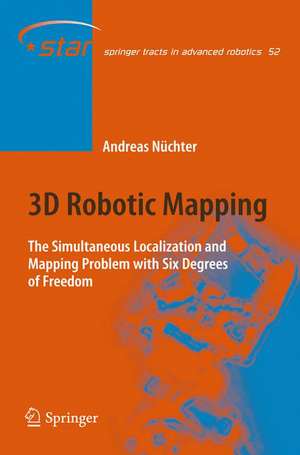
3D Robotic Mapping: Springer Tracts in Advanced Robotics, cartea 52
Autor Andreas Nüchteren Limba Engleză Hardback – 17 ian 2009
The robotic mapping problem is commonly referred to as SLAM (simultaneous localization and mapping).
3D maps are necessary to avoid collisions with complex obstacles and to self-localize in six degrees of freedom (x-, y-, z-position, roll, yaw and pitch angle)
New solutions to the 6D SLAM problem for 3D laser scans are proposed and a wide variety of applications are presented
Din seria Springer Tracts in Advanced Robotics
- 17%
 Preț: 421.73 lei
 - 15%
 Preț: 423.12 lei
 - 18%
 Preț: 915.87 lei
 - 18%
 Preț: 895.87 lei
 -
 Preț: 447.50 lei
 -
 Preț: 434.53 lei
 - 15%
 Preț: 612.01 lei
 - 18%
 Preț: 762.73 lei
 - 15%
 Preț: 611.32 lei
 - 18%
 Preț: 946.89 lei
 - 18%
 Preț: 702.09 lei
 - 18%
 Preț: 1185.81 lei
 - 18%
 Preț: 914.52 lei
 - 15%
 Preț: 615.35 lei
 - 18%
 Preț: 1772.67 lei
 - 18%
 Preț: 748.16 lei
 - 18%
 Preț: 856.49 lei
 - 20%
 Preț: 1006.30 lei
 - 15%
 Preț: 619.75 lei
 - 18%
 Preț: 960.16 lei
 - 20%
 Preț: 598.05 lei
 - 18%
 Preț: 946.97 lei
 - 15%
 Preț: 668.87 lei
 - 18%
 Preț: 951.08 lei
 - 15%
 Preț: 643.28 lei
 - 18%
 Preț: 781.94 lei
 - 18%
 Preț: 966.61 lei
 - 15%
 Preț: 662.56 lei
 - 15%
 Preț: 629.66 lei
 - 18%
 Preț: 928.33 lei
 - 15%
 Preț: 619.87 lei
 - 18%
 Preț: 984.44 lei
 - 18%
 Preț: 956.53 lei
 - 15%
 Preț: 611.02 lei
 - 15%
 Preț: 657.02 lei
 - 24%
 Preț: 913.67 lei
Preț: 1071.31 lei
Preț vechi: 1306.47 lei
-18%
Puncte Express: 1607
Carte tipărită la comandă
Livrare economică 14-28 noiembrie
Livrare prin curier în România Termenul estimat este afișat lângă disponibilitate.
Transport gratuit pentru acest produs Plată online sau ramburs, în funcție de opțiunile comenzii.
Retur gratuit în 14 zile Comandă securizată și suport în română.
Specificații
ISBN-13: 9783540898832
ISBN-10: 3540898832
Pagini: 228
Ilustrații: XIX, 204 p.
Dimensiuni: 160 x 241 x 18 mm
Greutate: 0.51 kg
Ediția:2009
Editura: Springer
Colecția Springer Tracts in Advanced Robotics
Seria Springer Tracts in Advanced Robotics
Locul publicării:Berlin, Heidelberg, Germany
ISBN-10: 3540898832
Pagini: 228
Ilustrații: XIX, 204 p.
Dimensiuni: 160 x 241 x 18 mm
Greutate: 0.51 kg
Ediția:2009
Editura: Springer
Colecția Springer Tracts in Advanced Robotics
Seria Springer Tracts in Advanced Robotics
Locul publicării:Berlin, Heidelberg, Germany
V-ar putea interesa
-
 Introduction to Autonomous Mobile Robots, second editionDavide Scaramuzza-14%Preț: 577.74 lei671.79 lei
 -
 Principles of Robot MotionGeorge A. Kantor-14%Preț: 582.58 lei677.42 lei
 -
 Probabilistic RoboticsDieter Fox-27%Preț: 646.06 lei882.68 lei
 -
 -20%Preț: 330.03 lei412.53 lei
 -
 Remote Sensing and Image InterpretationThomas Lillesand-18%Preț: 1345.99 lei1641.45 lei
 -
 Kalman Filtering: Theory and Practice with MATLABMohinder S. Grewal-5%Preț: 616.46 lei648.91 lei
 -
 Preț: 480.73 lei
 -
 Introduction to Robotics, Global EditionJohn Craig-9%Preț: 588.54 lei646.75 lei
 -
 -8%Preț: 591.74 lei643.20 lei
 -
 The LEGO MINDSTORMS EV3 Discovery BookLaurens Valk-19%Preț: 211.08 lei261.29 lei
 -
 The LEGO MINDSTORMS EV3 LaboratoryDaniele Benedettelli-19%Preț: 210.51 lei260.00 lei
 -
 Unmanned Vehicle Systems for GeomaticsCostas Armenakis-23%Preț: 604.66 lei785.27 lei
 -
 The Strength of the FewJames Islington-15%Preț: 127.29 lei149.73 lei
 -
 -18%Preț: 895.87 lei1092.53 lei
 -
 -5%Preț: 1045.02 lei1100.02 lei
 -
 Walking Robots into Real WorldKarsten Berns-18%Preț: 1177.33 lei1435.77 lei
 -
 -15%Preț: 615.35 lei723.94 lei
 -
 Field and Service RoboticsAlonzo Kelly-18%Preț: 1233.64 lei1504.44 lei
 -
 -24%Preț: 1166.40 lei1534.74 lei
 -
 AI Methods and Applications in 3D TechnologiesRoumen Kountchev (Deceased)-18%Preț: 1179.57 lei1438.50 lei
Public țintă
ResearchCuprins
Perceiving 3D Range Data.- State of the Art.- 3D Range Image Registration.- Globally Consistent Range Image Registration.- Experiments and Results.- 3D Maps with Semantics.- Conclusions and Outlook.
Recenzii
From the reviews:
“The book 3D Robotic Mapping by Andreas Nüchter represents an excellent reference for any roboticist working in the area of Simultaneous Localization and Mapping, especially those interested in 3D map building. … The book’s intended target audience is large, ranging from undergraduate students to postdoctoral researchers keen on learning or working on this topic. … I strongly recommend this book as a good introduction and reference material for 3D perception and mapping with mobile robots.” (Radu Bogdan Rusu, Künstliche Intelligenz, Vol. 24, June, 2010)
“The book 3D Robotic Mapping by Andreas Nüchter represents an excellent reference for any roboticist working in the area of Simultaneous Localization and Mapping, especially those interested in 3D map building. … The book’s intended target audience is large, ranging from undergraduate students to postdoctoral researchers keen on learning or working on this topic. … I strongly recommend this book as a good introduction and reference material for 3D perception and mapping with mobile robots.” (Radu Bogdan Rusu, Künstliche Intelligenz, Vol. 24, June, 2010)
Textul de pe ultima copertă
The monograph written by Andreas Nüchter is focused on acquiring spatial models of physical environments through mobile robots. The robotic mapping problem is commonly referred to as SLAM (simultaneous localization and mapping). 3D maps are necessary to avoid collisions with complex obstacles and to self-localize in six degrees of freedom
(x-, y-, z-position, roll, yaw and pitch angle). New solutions to the 6D SLAM problem for 3D laser scans are proposed and a wide variety of applications are presented.
(x-, y-, z-position, roll, yaw and pitch angle). New solutions to the 6D SLAM problem for 3D laser scans are proposed and a wide variety of applications are presented.
Caracteristici
Complete treatment of 3 dimensional robotic mapping Presents the Simultaneous Localization and Mapping Problem with Six Degrees of Freedom Presents the algorithms needed for automatic semantic 3D map building using a 3D laser range finder and the mobile robot Kurt3D Includes supplementary material: sn.pub/extras