Cantitate/Preț
Produs

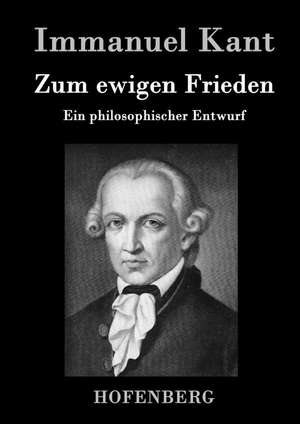
Zum ewigen Frieden

Autor Immanuel Kant
de Limba Germană Hardback – aug 2013
Immanuel Kant: Zum ewigen Frieden. Ein philosophischer Entwurf In seiner Altersschrift entwickelt Kant seinen Gedanken des kategorischen Imperativs zu einem politischen Modell zwischen den Staaten der Welt weiter. Von der Vernunft geleitete Entscheidungen, die nach Gerechtigkeit trachten konnen der Menschheit den Frieden stiften, der fur Kant ausdrucklich kein Naturzustand ist, sondern Ergebnis vorantwortungsvoller Politik. Der Text spielte eine wesentliche Rolle fur die Ausgestaltung der sogenannten Atlantik Charter, die Franklin D. Roosevelt und Winston S. Churchill im August 1941 verfassten und auf deren Grundlage sich die Vereinten Nationen grundeten. Erstdruck: Konigsberg (Friedrich Nicolovius) 1795. Der Text folgt der neuen, vermehrten Auflage, Konigsberg (Friedrich Nicolovius) 1796. Vollstandige Neuausgabe mit einer Biographie des Autors. Herausgegeben von Karl-Maria Guth. Berlin 2013. Textgrundlage ist die Ausgabe: Immanuel Kant: Werke in zwolf Banden. Herausgegeben von Wilhelm Weischedel. Frankfurt am Main: Suhrkamp, 1977. Die Paginierung obiger Ausgabe wird in dieser Neuausgabe als Marginalie zeilengenau mitgefuhrt. Umschlaggestaltung von Thomas Schultz-Overhage. Gesetzt aus Minion Pro, 11 pt."
Citește tot Restrânge

Carte disponibilă

Livrare economică 30 septembrie-14 octombrie

Livrare prin curier în România Termenul estimat este afișat lângă disponibilitate.
Transport gratuit de la 40000 lei Plată online sau ramburs, în funcție de opțiunile comenzii.
Retur gratuit în 14 zile Comandă securizată și suport în română.

Specificații

ISBN-13: 9783843021173
ISBN-10: 3843021171
Pagini: 56
Dimensiuni: 160 x 226 x 10 mm
Greutate: 0.25 kg
Editura: Henricus - Edition Deutsche Klassik GmbH, Berlin

Notă biografică

Immanuel Kant ( 22 April 1724 - 12 February 1804) was an influential German philosopher[23] in the Age of Enlightenment. In his doctrine of transcendental idealism, he argued that space, time, and causation are mere sensibilities; "things-in-themselves" exist, but their nature is unknowable.[24][25] In his view, the mind shapes and structures experience, with all human experience sharing certain structural features. In one of his major works, the Critique of Pure Reason (1781; second edition 1787),[26] he drew a parallel to the Copernican revolution in his proposition that worldly objects can be intuited a priori ('beforehand'), and that intuition is therefore independent from objective reality.[b] Kant believed that reason is also the source of morality, and that aesthetics arise from a faculty of disinterested judgment. Kant's views continue to have a major influence on contemporary philosophy, especially the fields of epistemology, ethics, political theory, and post-modern aesthetics. He attempted to explain the relationship between reason and human experience and to move beyond the failures of traditional philosophy and metaphysics. He wanted to put an end to what he saw as an era of futile and speculative theories of human experience, while resisting the skepticism of thinkers such as David Hume. He regarded himself as showing the way past the impasse between rationalists and empiricists,[28] and is widely held to have synthesized both traditions in his thought.[29] Kant was an exponent of the idea that perpetual peace could be secured through universal democracy and international cooperation. He believed that this would be the eventual outcome of universal history, although it is not rationally planned.[30] The nature of Kant's religious ideas continues to be the subject of philosophical dispute, with viewpoints ranging from the impression that he was an initial advocate of atheism who at some point developed an ontological argument for God, to more critical treatments epitomized by Schopenhauer, who criticized the imperative form of Kantian ethics as "theological morals" and the "Mosaic Decalogue in disguise",[31] and Nietzsche, who claimed that Kant had "theologian blood"[32] and was merely a sophisticated apologist for traditional Christian faith