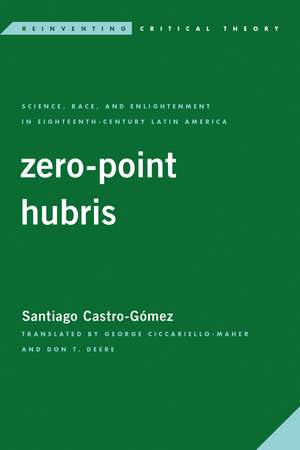
Zero-Point Hubris: Science, Race, and Enlightenment in Eighteenth-Century Latin America: Reinventing Critical Theory
Autor Santiago Castro-Gómez Traducere de George Ciccariello-Maher, Don T. Deereen Limba Engleză Paperback – 16 dec 2021









Preț: 309.31 lei
Preț vechi: 408.47 lei
-24%
Puncte Express: 464
Carte tipărită la comandă
Livrare economică 04-18 decembrie
Livrare prin curier în România Termenul estimat este afișat lângă disponibilitate.
Transport gratuit de la 400.00 lei Plată online sau ramburs, în funcție de opțiunile comenzii.
Retur gratuit în 14 zile Comandă securizată și suport în română.
Specificații
ISBN-13: 9781786613776
ISBN-10: 1786613778
Pagini: 360
Ilustrații: 6 b/w illustrations;
Dimensiuni: 148 x 226 x 20 mm
Greutate: 0.45 kg
Editura: Bloomsbury Publishing
Colecția Rowman & Littlefield
Seria Reinventing Critical Theory
Locul publicării:New York, United States
ISBN-10: 1786613778
Pagini: 360
Ilustrații: 6 b/w illustrations;
Dimensiuni: 148 x 226 x 20 mm
Greutate: 0.45 kg
Editura: Bloomsbury Publishing
Colecția Rowman & Littlefield
Seria Reinventing Critical Theory
Locul publicării:New York, United States
Cuprins
Translator's Introduction / 1. Places of Enlightenment: Colonial Discourse and Geopolitics of Knowledge in the Century of Enlightenment / 2. Purus ab omnia macula sanguinis: The colonial imaginary of whiteness in New Granada / 3. Imperial Biopolitics: Health and sickness in the framework of Bourbonic reforms / 4. Illegitimate Knowledges: The Enlightenment as mechanism of epistemic expropriation / 5. Striated Spaces: Geography, territorial politics, and population control / Epilogue / Appendix (to the 2nd edition) / Bibliography / Index
Recenzii
With its focus on bio-politics and the creation of an imperial science, Zero-Point Hubris takes decolonial theory to the next level. By focusing on the practices of coloniality in Latin America, Castro-Gómez troubles the rigidity of the binary between center and periphery. He shows how Criollo elites in Latin America fashioned a distinctive form of whiteness, naturalizing inequality and their own privilege. This is a critically important work.
Santiago Castro-Gómez is undoubtedly one of the most original Latin American philosophers of the last two decades. Through a series of brilliant books, some of which are finally appearing in English, he has carved a distinct path between the historicizing history of ideas (which gave us Latinamericanism) and an ontologizing decolonial theorizing (which gave us the coloniality of power). Provincializing and localizing the genealogical method Castro-Gómez has forged a powerful analytical method that focuses on epistemic, governmentality, and racializing practices and regimes that renders legible the dialectics between coloniality and modernity. After Zero-Point Hubris we can talk about decolonizing genealogies and we will have to read both Immanuel Kant and Michel Foucault differently.
Santiago Castro-Gómez is undoubtedly one of the most original Latin American philosophers of the last two decades. Through a series of brilliant books, some of which are finally appearing in English, he has carved a distinct path between the historicizing history of ideas (which gave us Latinamericanism) and an ontologizing decolonial theorizing (which gave us the coloniality of power). Provincializing and localizing the genealogical method Castro-Gómez has forged a powerful analytical method that focuses on epistemic, governmentality, and racializing practices and regimes that renders legible the dialectics between coloniality and modernity. After Zero-Point Hubris we can talk about decolonizing genealogies and we will have to read both Immanuel Kant and Michel Foucault differently.