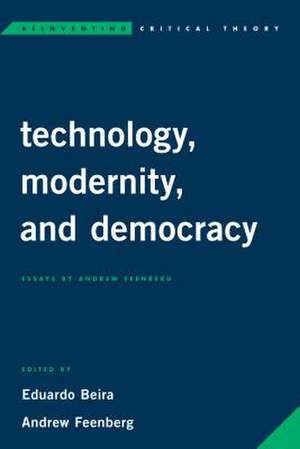
Technology, Modernity, and Democracy: Essays by Andrew Feenberg: Reinventing Critical Theory
Editat de Eduardo Beira, Andrew Feenbergen Limba Engleză Paperback – 18 mai 2018
According to critical theory of technology, technologies are neither neutral nor deterministic, but are encoded with specific socio-economic values and interests. Feenberg explores how they can be developed and adapted to more or less democratic values and institutions, and how their future is subject to social action, negotiation and reinterpretation. Technologies bring with them a particular "rationality," sets of rules and implied ways of behaving and thinking which, despite their profound influence on institutions, ideas and actions, can be transformed in a process of democratic rationalization. Feenberg argues that the emergence of human communication on the Internet and the environmental movement offer abundant examples of public interventions that have reshaped technologies originally designed for different purposes. This volume includes chapters on citizenship and critical theory of technology, philosophy of technology and modernity, and Heidegger and Marcuse, two of the most prominent philosophers of technology.








Preț: 283.18 lei
Preț vechi: 387.37 lei
-27%
Puncte Express: 425
Carte tipărită la comandă
Livrare economică 08-22 decembrie
Livrare prin curier în România Termenul estimat este afișat lângă disponibilitate.
Transport gratuit de la 400.00 lei Plată online sau ramburs, în funcție de opțiunile comenzii.
Retur gratuit în 14 zile Comandă securizată și suport în română.
Specificații
ISBN-13: 9781786607218
ISBN-10: 1786607212
Pagini: 192
Dimensiuni: 150 x 223 x 14 mm
Greutate: 0.26 kg
Editura: Bloomsbury Publishing
Colecția Rowman & Littlefield
Seria Reinventing Critical Theory
Locul publicării:New York, United States
ISBN-10: 1786607212
Pagini: 192
Dimensiuni: 150 x 223 x 14 mm
Greutate: 0.26 kg
Editura: Bloomsbury Publishing
Colecția Rowman & Littlefield
Seria Reinventing Critical Theory
Locul publicării:New York, United States
Cuprins
Introduction / Part I: Philosophy of Technology / 1. What is Philosophy of Technology? / 2. Ten Paradoxes of Technology / Part II: Citizenship and Critical Theory of Technology / 3. Technoscience at the Fork / 4. Agency and Citizenship in a Technological Society / 5. Function and Meaning: The Double Aspect of Technology / Part III: Heidegger and Marcuse / 6. The Critique of Technology / 7. On Reification and Concrete Philosophy / 8. The Politics of Meaning: Modernity, Technology and Rationality / Conclusion: Encountering Technology / Bibliography / Index
Recenzii
Part of what makes Feenberg's work philosophically significant is his style as a writer. He is able to craft sentences and paragraphs to reveal a lifetime's worth of philosophical insights presented in a way that is accessible but not patronizing. Amongst the essays found in this collection, there are a few that stand out. 'Ten paradoxes of technology' is an excellent introduction to the discipline of the philosophy of technology that would benefit undergraduate students, 'Agency and citizenship in a technological society' serves as a concise summary of Feenberg's argument for the democratization of technology and 'The politics of meaning: modernity, technology, and rationality' provides a thorough intellectual history of the critique of instrumental and technological rationality. More intriguing than these individual essays, though, are the hints towards a social theory of rationality that accounts for the ways in which technologies, organizations, forms of administration and markets share the same form of rationality.
Andrew Feenberg has done more than anyone else to develop a critical constructivism that ensures the relevance of critical theory to technology studies in the 21st century. This collection of essays is a fine crystallisation of that perspective and represents the ideal point of entry for anyone new to Feenberg's thought.
This impressive collection of essays shows why Feenberg is rightly regarded as the leading expert on science and technology studies writing today. Having participated in pioneering developments in medical research protocols, on-line education platforms, and digital information systems, he brings a profound critical awareness to the social politics informing the democratization of science and technology in the age of economic domination.
Andrew Feenberg has done more than anyone else to develop a critical constructivism that ensures the relevance of critical theory to technology studies in the 21st century. This collection of essays is a fine crystallisation of that perspective and represents the ideal point of entry for anyone new to Feenberg's thought.
This impressive collection of essays shows why Feenberg is rightly regarded as the leading expert on science and technology studies writing today. Having participated in pioneering developments in medical research protocols, on-line education platforms, and digital information systems, he brings a profound critical awareness to the social politics informing the democratization of science and technology in the age of economic domination.