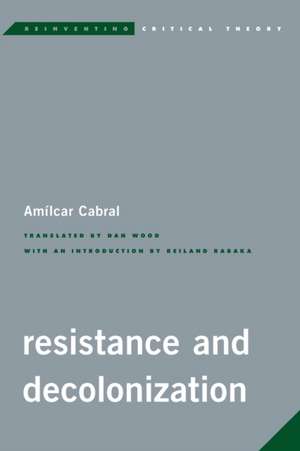
Resistance and Decolonization: Reinventing Critical Theory
Autor Amilcar Cabral Traducere de Dan Wood Introducere de Reiland Rabakaen Limba Engleză Paperback – 30 mar 2016
As one of the most important and profound African revolutionary leaders in the 20th century, and justly compared in importance to Frantz Fanon, Cabral's thoughts and instructions as articulated here help us to rethink important issues concerning nationalism, culture, vanguardism, revolution, liberation, colonialism, race, and history. The volume also includes two introductory essays: the first introduces Cabral's work within the context of Africana critical theory, and the second situates these texts in the context their historical-political context and analyzes their relevance for contemporary anti-imperialism.








Preț: 276.27 lei
Preț vechi: 360.88 lei
-23%
Puncte Express: 414
Carte tipărită la comandă
Livrare economică 08-22 decembrie
Livrare prin curier în România Termenul estimat este afișat lângă disponibilitate.
Transport gratuit de la 400.00 lei Plată online sau ramburs, în funcție de opțiunile comenzii.
Retur gratuit în 14 zile Comandă securizată și suport în română.
Specificații
ISBN-13: 9781783483754
ISBN-10: 178348375X
Pagini: 204
Dimensiuni: 148 x 226 x 16 mm
Greutate: 0.27 kg
Editura: Bloomsbury Publishing
Colecția Rowman & Littlefield
Seria Reinventing Critical Theory
Locul publicării:New York, United States
ISBN-10: 178348375X
Pagini: 204
Dimensiuni: 148 x 226 x 16 mm
Greutate: 0.27 kg
Editura: Bloomsbury Publishing
Colecția Rowman & Littlefield
Seria Reinventing Critical Theory
Locul publicării:New York, United States
V-ar putea interesa
-
 -18%Preț: 1426.31 lei1739.40 lei
 -
 On Physics and PhilosophyBernard D'EspagnatPreț: 259.63 lei
 -
 Kierkegaard and Critical TheoryMarcia Morgan-35%Preț: 560.35 lei861.62 lei
 -
 Wittgensteinian Way with ParadoxesRupert Read-33%Preț: 711.77 lei1054.78 lei
 -
 -19%Preț: 704.73 lei870.04 lei
 -
 -36%Preț: 523.14 lei814.67 lei
 -
 The Generalist Approach to Conflict Resolution: A GuidebookDr. Toran Hansen-35%Preț: 592.78 lei909.50 lei
 -
 Re-reading DerridaTony Thwaites-30%Preț: 481.61 lei684.88 lei
 -
 -33%Preț: 519.07 lei769.59 lei
 -
 Heidegger: An IntroductionJ. Jeremy Wisnewski-24%Preț: 275.77 lei360.58 lei
 -
 Research in Clinical PracticeDaron Smith-5%Preț: 345.40 lei363.58 lei
 -
 The Boy Who Never SleptDan WoodPreț: 75.54 lei
 -
 Return to the SourceAmilcar Cabral-23%Preț: 501.49 lei651.28 lei
 -
 IgnatiusDan WoodPreț: 75.06 lei
 -
 Preț: 197.64 lei
 -
 Politics and Culture in African Emancipatory ThoughtMichael Neocosmos-12%Preț: 68.44 lei77.39 lei
 -
 Politica e Cultura no Pensamento Emancipatorio AfricanoMichael Neocosmos-12%Preț: 60.84 lei69.23 lei
 -
 Transitioning Medical CareDan Wood-5%Preț: 381.37 lei401.44 lei
 -
 Wahrheit und ExistenzJean-Paul SartrePreț: 94.83 lei
 -
 Zur Philosophie der GefühleGeorg LohmannPreț: 158.95 lei
Cuprins
Acknowledgments / Part I. Amílcar Cabral and Critical Theory: Introductions, Investigations, and Interpretations / 1.The Weapon of Critical Theory: Amílcar Cabral, Cabralism, and Africana Critical Theory, Reiland Rabaka / 2. Imbrications of Coloniality: An Introduction to Cabralist Critical Theory in Relation to Contemporary Struggles, Dan Wood / Bibliography to Part I / Translator's Note / Bibliography to the Translator's Note / Part II. Analysis of a Few Types of Resistance / 3.Political Resistance / 4. Economic Resistance / 5. Cultural Resistance / 6. Armed Resistance / 7. The Role of Culture in the Struggle for Independence / Index
Recenzii
Amilcar Cabral defines African critical theory as well as radical African politics. This book shows the unfailing engagement and the rigourous thinking a concrete philosopher needs in order to decolonize a society. That's true even in contemporary struggles. This book belongs to the "postcolonial library"
Resistance and Decolonization is a tour-de-force in the bourgeoning field of Cabral studies and/or the epistemology that can be called Cabralism from the decolonial epistemic perspective. The spectre of Cabral haunts us and the fundamental questions which he raises from the positionality of being dehumanized bring about the unmasking of coloniality in the modern colonial world.Dan Wood's translation, as a decolonial testament, instils that Cabral still lives and another world is possible.
Wood has [.] performed a great service with this translation, not just to those who maintain an interest in African philosophy or Global Theory, but to philosophers, cultural critics, political scientists, and political theorists more generally.
Cabral offers rich insight into the role and importance of culture in expanding Marxism to address modern national liberation and identity movements. Cabral is then useful to a broad range of philosophers and activists in critical race theory, politics of identity, transitional justice, and decolonialism. More generally, Resistance and Decolonialization is essential and successful in rendering African critical theory and its rich insights more visible.
This is a very important and timely publication that adds to existing collections of Amílcar Cabral's revolutionary writings and is therefore a welcome addition to the works of one of the most original African thinkers of national emancipation during the 20th century.
These essays introduce us to Cabral the trans-disciplinary Africana critical social theorist, who picks up the weapon of theory not only in liberation of the wretched of the earth, but also to eradicate 'the condition of the wretchedness' and 'realise anticolonial revolution, trans-ethnic working-class struggle and revolutionary humanism'.
Resistance and Decolonization is a tour-de-force in the bourgeoning field of Cabral studies and/or the epistemology that can be called Cabralism from the decolonial epistemic perspective. The spectre of Cabral haunts us and the fundamental questions which he raises from the positionality of being dehumanized bring about the unmasking of coloniality in the modern colonial world.Dan Wood's translation, as a decolonial testament, instils that Cabral still lives and another world is possible.
Wood has [.] performed a great service with this translation, not just to those who maintain an interest in African philosophy or Global Theory, but to philosophers, cultural critics, political scientists, and political theorists more generally.
Cabral offers rich insight into the role and importance of culture in expanding Marxism to address modern national liberation and identity movements. Cabral is then useful to a broad range of philosophers and activists in critical race theory, politics of identity, transitional justice, and decolonialism. More generally, Resistance and Decolonialization is essential and successful in rendering African critical theory and its rich insights more visible.
This is a very important and timely publication that adds to existing collections of Amílcar Cabral's revolutionary writings and is therefore a welcome addition to the works of one of the most original African thinkers of national emancipation during the 20th century.
These essays introduce us to Cabral the trans-disciplinary Africana critical social theorist, who picks up the weapon of theory not only in liberation of the wretched of the earth, but also to eradicate 'the condition of the wretchedness' and 'realise anticolonial revolution, trans-ethnic working-class struggle and revolutionary humanism'.