
x64 Assembly Language Step-by-Step: Tech Today
Autor Jeff Duntemannen Limba Engleză Hardback – 23 oct 2023
Putem afirma că învățarea programării la nivel de procesor începe cel mai eficient prin exerciții de conversie a bazelor de numerație, transformând abstractul în concret. În x64 Assembly Language Step-by-Step, autorul Jeff Duntemann propune un exercițiu fundamental de „aritmetică în hexazecimal”, pregătind terenul pentru înțelegerea modului în care registrele precum RAX interacționează cu memoria în modul 64-bit pe Linux. Considerăm că această a patra ediție este un manual tehnic riguros, dar accesibil, care demistifică arhitectura Intel x64. Structura volumului reflectă o progresie logică: primele capitole așază fundația prin explicarea sistemelor binar și hexazecimal (capitolul „Alien Bases”), urmate de o analiză detaliată a tranzistorilor și a modelelor de memorie. Spre deosebire de alte manuale, Jeff Duntemann pune accent pe interfațarea cu bibliotecile C, oferind cititorului uneltele necesare pentru a scrie cod care rulează nativ în ecosistemul Linux modern. Cititorul care a aplicat ideile din Beginning x64 Assembly Programming de Jo Van Hoey va găsi aici o completare necesară prin focalizarea pe arhitectura sistemului de operare și pe utilizarea macrocomenzilor complexe. Suntem de părere că volumul excelează prin echilibrul dintre teorie și practică. Dacă în Foundations of Linux Debugging, Disassembling, and Reversing accentul cade pe analiza post-mortem, x64 Assembly Language Step-by-Step se concentrează pe construcția activă a programelor. Recomandăm acest titlu pentru modul în care explică tranziția de la arhitectura hardware la execuția software-ului, oferind un set complet de instrumente open-source pentru depanare imediată.
Din seria Tech Today
- 20%
 Preț: 476.32 lei
 - 20%
 Preț: 325.86 lei
 - 20%
 Preț: 411.97 lei
 - 20%
 Preț: 358.81 lei
 - 20%
 Preț: 356.59 lei
 - 20%
 Preț: 320.06 lei
 - 20%
 Preț: 303.45 lei
 - 20%
 Preț: 388.21 lei
 - 20%
 Preț: 366.89 lei
 - 20%
 Preț: 342.51 lei
 - 20%
 Preț: 400.70 lei
 - 20%
 Preț: 398.87 lei
 - 20%
 Preț: 387.95 lei
 - 30%
 Preț: 214.19 lei
 - 20%
 Preț: 404.77 lei
Preț: 429.61 lei
Preț vechi: 537.02 lei
-20%
Carte disponibilă
Livrare economică 16-30 noiembrie
Livrare express 31 octombrie-06 noiembrie pentru 70.89 lei
Specificații
ISBN-10: 1394155247
Pagini: 640
Dimensiuni: 188 x 238 x 39 mm
Greutate: 1.33 kg
Ediția:4. Auflage
Editura: Wiley
Seria Tech Today
Locul publicării:Hoboken, United States
V-ar putea interesa
-
 Code: The Hidden Language of Computer Hardware and SoftwareCharles Petzold-20%Preț: 189.39 lei236.74 lei
 -
 Principles of Computer HardwareAlan Clements-28%Preț: 623.58 lei861.14 lei
 -
 Hacker's DelightHenry Warren-20%Preț: 338.46 lei423.08 lei
 -
 C Primer PlusStephen Prata-20%Preț: 421.53 lei526.92 lei
 -
 Modern Assembly Language Programming with the ARM ProcessorLarry D Pyeatt-31%Preț: 467.79 lei675.11 lei
 -
 Computer Architecture: A Quantitative ApproachJohn L. Hennessy-39%Preț: 539.69 lei882.55 lei
 -
 Blue Fox - Arm Assembly Internals and Reverse EngineeringMaria Markstedter-20%Preț: 235.08 lei293.84 lei
 -
 -28%Preț: 295.73 lei411.52 lei
 -
 CompilersAlfred V. Aho-20%Preț: 637.81 lei797.26 lei
 -
 Computer Systems: A Programmer's Perspective, Global EditionRandal E. Bryant-20%Preț: 652.59 lei815.74 lei
 -
 -20%Preț: 176.97 lei221.21 lei
 -
 -35%Preț: 304.57 lei468.39 lei
 -
 -34%Preț: 410.94 lei624.64 lei
 -
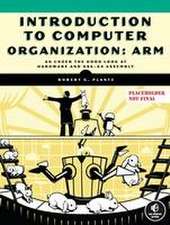 Introduction to Computer Organization: ARM EditionRobert G. Plantz-35%Preț: 303.72 lei468.10 lei
 -
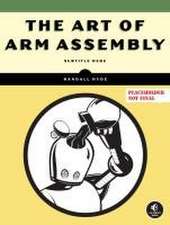 The Art of ARM Assembly Volume 1Randall Hyde-35%Preț: 433.81 lei665.69 lei
 -
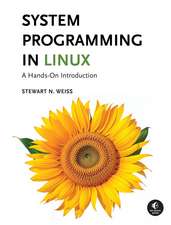 System Programming in Linux: A Hands-On IntroductionStewart Weiss-35%Preț: 481.65 lei739.15 lei
 -
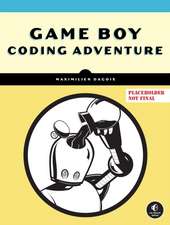 -34%Preț: 245.07 lei372.06 lei
 -
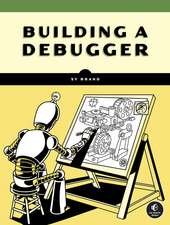 Building a DebuggerSy Brand-34%Preț: 340.95 lei518.40 lei
 -
 Heavy Wizardry 101: Shellcodes, Backdoors, Droppers and WormsDavid Martinez Oliveira-34%Preț: 291.18 lei443.89 lei
 -
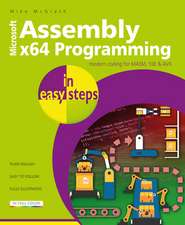 Assembly X64 in Easy StepsMike McgrathPreț: 108.69 lei
De ce să citești această carte
Recomandăm această carte oricărui programator care dorește să înțeleagă ce se întâmplă „sub capota” procesorului Intel în mediu Linux. Veți câștiga o stăpânire precisă asupra memoriei, registrelor și modului de funcționare a sistemelor pe 64 de biți. Este resursa ideală pentru trecerea de la limbaje de nivel înalt la controlul total asupra hardware-ului, oferind o bază solidă pentru securitate informatică sau optimizarea performanței.
Despre autor
Jeff Duntemann este un autor și editor tehnic american recunoscut pentru capacitatea sa de a explica subiecte complexe de informatică într-un stil accesibil și captivant. Cu o carieră de peste trei decenii în jurnalismul tehnologic și programare, a fost cofondator al revistei PC Techniques și al editurii Coriolis Group. Expertiza sa în limbaje de asamblare și arhitecturi x86 a transformat seria sa „Step-by-Step” într-un standard de referință pentru generații de programatori. În prezent, continuă să documenteze evoluția tehnologiei Intel pe blogul său personal, rămânând o voce autoritară în comunitatea de dezvoltare software.