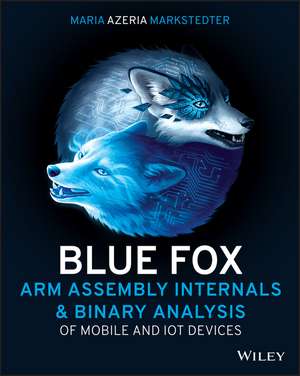
Blue Fox
Autor Maria Markstedteren Limba Engleză Paperback – 25 apr 2023
Evoluția recentă a infrastructurii computaționale, marcată de tranziția masivă a laptopurilor și a sistemelor server către arhitectura Arm, a transformat analiza binară dintr-o nișă de nișă într-o competență critică de securitate. Blue Fox de Maria Markstedter răspunde acestei schimbări de paradigmă, oferind un ghid tehnic riguros pentru înțelegerea modului în care funcționează codul la cel mai jos nivel pe dispozitivele moderne. Putem afirma că lucrarea depășește sfera unui simplu manual de programare, devenind un instrument esențial pentru cercetătorii de securitate care trebuie să navigheze între seturile de instrucțiuni A32 și A64. Considerăm că structura logică a cărții facilitează o progresie naturală a învățării. Prima parte este dedicată mecanismelor interne, de la biți și octeți la complexitatea formatului de fișier ELF și a modului în care sistemele de operare gestionează procesele. A doua parte se concentrează pe aplicabilitatea practică: configurarea mediilor de analiză, utilizarea instrumentelor de dezasamblare și depanare, culminând cu studii de caz relevante, precum analiza de malware pe arhitectura M1 de la Apple. Această abordare completează perspectiva oferită de Foundations of ARM64 Linux Debugging, Disassembling, and Reversing, adăugând detalii specifice despre mediul macOS și o analiză mai profundă a setului de instrucțiuni AArch32, nu doar a celui pe 64 de biți. De asemenea, volumul se distinge de Learning Linux Binary Analysis prin focalizarea strictă pe ecosistemul Arm, oferind detalii despre control-flow patterns și emularea firmware-ului, elemente vitale pentru securitatea IoT. Stilul autoarei este precis, ancorat în realitățile industriei, transformând Blue Fox într-o resursă de referință pentru oricine dorește să stăpânească ingineria inversă pe cele mai răspândite procesoare din lume.
Preț: 272.36 lei
Carte disponibilă
Livrare economică 16-30 octombrie
Livrare express 01-07 octombrie pentru 59.30 lei
Specificații
ISBN-10: 1119745306
Pagini: 480
Dimensiuni: 183 x 232 x 28 mm
Greutate: 0.89 kg
Ediția:1
Editura: Wiley
Locul publicării:Hoboken, United States
V-ar putea interesa
-
 Bent Functions: Results and Applications to CryptographyNatalia Tokareva-31%Preț: 327.08 lei475.31 lei
 -
 Redis CookbookTiago Macedo-20%Preț: 113.01 lei141.26 lei
 -
 Deploying OpenStackKen Pepple-20%Preț: 134.45 lei168.07 lei
 -
 Cryptography & HackingSolis Tech-20%Preț: 103.23 lei129.04 lei
 -
 Cryptography & Comptia A+Solis Tech-20%Preț: 90.13 lei112.67 lei
 -
 Cryptography & Raspberry Pi 2Solis Tech-20%Preț: 51.43 lei64.28 lei
 -
 Cryptography & RoboticsSolis Tech-20%Preț: 51.57 lei64.46 lei
 -
 Cryptography & Open SourceSolis Tech-20%Preț: 51.08 lei63.85 lei
 -
 CryptographySolis Tech-20%Preț: 51.24 lei64.05 lei
 -
 Hacking University Graduation EditionIsaac D. Cody-20%Preț: 146.91 lei183.64 lei
 -
 Exploding DataMichael Chertoff-19%Preț: 112.47 lei139.17 lei
 -
 Efficient Decision Support SystemsChiang Jao-20%Preț: 1008.71 lei1260.89 lei
 -
 Flash MemoriesIgor Stievano-20%Preț: 873.57 lei1091.96 lei
 -
 Selected Works in BioinformaticsXuhua Xia-23%Preț: 784.95 lei1019.41 lei
 -
 Numerical AnalysisJan Awrejcewicz-20%Preț: 1111.75 lei1389.70 lei
 -
 Computational Simulations and ApplicationsJianping Zhu-20%Preț: 1169.16 lei1461.45 lei
 -
 Advanced Biometric TechnologiesGirija Chetty-20%Preț: 971.17 lei1213.96 lei
 -
 Biometric SystemsZahid Riaz-20%Preț: 830.50 lei1038.13 lei
 -
 Two Phase Flow, Phase Change and Numerical ModelingAmimul Ahsan-20%Preț: 1171.27 lei1464.09 lei
 -
 Numerical Simulations of Physical and Engineering ProcessesJan Awrejcewicz-20%Preț: 1172.67 lei1465.84 lei
 -
 Computational Biology and Applied BioinformaticsHeitor Lopes-20%Preț: 965.59 lei1206.98 lei
 -
 -20%Preț: 1021.49 lei1276.86 lei
 -
 Discrete Wavelet TransformsHannu Olkkonen-20%Preț: 1012.04 lei1265.06 lei
 -
 Scientific and Engineering Applications Using MATLABEmilson Pereira Leite-20%Preț: 868.32 lei1085.40 lei
 -
 Applications of MATLAB in Science and EngineeringTadeusz Michalowski-20%Preț: 1164.78 lei1455.98 lei
 -
 Systems and Computational BiologyNing-Sun Yang-23%Preț: 914.51 lei1187.67 lei
 -
 MATLABClara Ionescu-20%Preț: 1167.96 lei1459.95 lei
 -
 MATLAB for EngineersKarel Perutka-20%Preț: 1164.98 lei1456.22 lei
De ce să citești această carte
Această lucrare este esențială pentru inginerii de securitate și dezvoltatorii care doresc să înțeleagă arhitectura Armv8-A în profunzime. Cititorul câștigă competențe practice în reverse engineering, învățând să analizeze vulnerabilități și malware pe dispozitive mobile, IoT și noile generații de laptopuri. Este un ghid tehnic actualizat care acoperă tranziția către 64 de biți, oferind instrumentele necesare pentru a securiza miliardele de dispozitive bazate pe Arm.
Despre autor
Maria Markstedter este o specialistă recunoscută la nivel mondial în securitatea arhitecturii Arm, fiind fondatoarea Azeria Labs. Expertiza sa în reverse engineering și exploatarea vulnerabilităților a ajutat numeroase organizații să își securizeze implementările pe sisteme embedded și mobile. Prin activitatea sa de instruire și cercetare, Markstedter a devenit o voce autoritară în domeniu, fiind premiată pentru contribuțiile sale la educația în securitate cibernetică. În Blue Fox, ea sintetizează ani de experiență practică în analiza binară, oferind o resursă academică și profesională de neegalat.