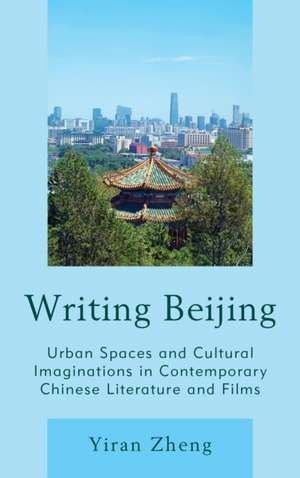
Writing Beijing: Urban Spaces and Cultural Imaginations in Contemporary Chinese Literature and Films
Autor Yiran Zhengen Limba Engleză Paperback – 11 sep 2017
Like other capitals, Beijing is much more than its physical entity. It also functions as a concept, a representation. As city planners have (and continue to) present Beijing to the world as a model, the fluctuating images of Beijing have become solidified in urban space. Today, the urban form of Beijing juxtaposes diverse spaces that span centuries, embodying the various representations of the city by its planners in different eras. These representations of space also provide possibilities for writers to rethink and rebuild the city in their literary works. Chinese writers and filmmakers often essentialize those urban spaces by making them symbols of different urban cultures, the old houses representing "traditional," "patriarchal" Chinese culture while soviet-style buildings reflect revolu-tionary culture. Finally, the more recent sprouting of apartments, condos, and townhouses stands for the invasion of western modernity and provides evidence of global capitalism in contemporary China.
Inspired by Henri Lefebvre, this study establishes a framework that connects urban spaces (representations of space) to writers and literary productions (representational space). I analyze the three major urban spatial forms of traditional, communist, and glob-alized Beijing and examine what these urban spaces mean to Chinese writers and filmmakers as well as how they use them to configure particular images of Beijing. I argue that these different configurations are actually the projections of those writers and filmmakers' own cultural imaginations; they provoke a form of emotional catharsis and also produce alternative visions of the cityscape.
Preț: 319.68 lei
Preț vechi: 415.70 lei
-23%
Puncte Express: 480
Carte tipărită la comandă
Livrare economică 02-16 decembrie
Livrare prin curier în România Termenul estimat este afișat lângă disponibilitate.
Transport gratuit de la 400.00 lei Plată online sau ramburs, în funcție de opțiunile comenzii.
Retur gratuit în 14 zile Comandă securizată și suport în română.
Specificații
ISBN-13: 9781498531030
ISBN-10: 1498531032
Pagini: 150
Ilustrații: 1 BW Illustration, 13 BW Photos
Dimensiuni: 150 x 230 x 13 mm
Greutate: 0.25 kg
Editura: Bloomsbury Publishing
Colecția Lexington Books
Locul publicării:New York, United States
ISBN-10: 1498531032
Pagini: 150
Ilustrații: 1 BW Illustration, 13 BW Photos
Dimensiuni: 150 x 230 x 13 mm
Greutate: 0.25 kg
Editura: Bloomsbury Publishing
Colecția Lexington Books
Locul publicării:New York, United States
V-ar putea interesa
-
 Preț: 228.95 lei
 -
 Art, Religion, Amnesia: The Enchantments of CredulityDonald PreziosiPreț: 389.00 lei
 -
 The Invitation in ArtAdrian Stokes-15%Preț: 445.01 lei523.54 lei
 -
 The Life of Mise-en-sceneJohn Gibbs-23%Preț: 693.36 lei900.47 lei
 -
 Critical Approaches to African Cinema DiscourseNwachukwu Frank Ukadike-33%Preț: 710.24 lei1053.85 lei
 -
 Preț: 230.84 lei
 -
 The Star Wars HeresiesPaul F. McDonaldPreț: 200.89 lei
 -
 -34%Preț: 382.73 lei576.82 lei
 -
 Twilight SagaClaudia Bucciferro-30%Preț: 506.67 lei722.62 lei
 -
 Dracula's Daughters: The Female Vampire on FilmDouglas Brode-30%Preț: 506.00 lei722.23 lei
 -
 Movies in the Age of Obama: The Era of Post-Racial and Neo-Racist CinemaDavid Garrett Izzo-27%Preț: 223.82 lei308.58 lei
 -
 Rethinking Occupied IrelandJessica ScarlataPreț: 293.14 lei
 -
 Alfred Hitchcock's Frenzy: The Last MasterpieceRaymond Foery-25%Preț: 177.86 lei238.10 lei
 -
 Selling Sex on Screen: From Weimar Cinema to Zombie PornKaren A. Ritzenhoff-32%Preț: 552.19 lei816.98 lei
 -
 Media Disparity: A Gender BattlegroundCory L. Armstrong-24%Preț: 368.26 lei484.34 lei
 -
 Beyond Free Speech and PropagandaJay Douglas Steinmetz-33%Preț: 583.67 lei867.48 lei
 -
 Preț: 351.07 lei
 -
 -23%Preț: 322.99 lei418.16 lei
 -
 Film After FilmJ. HobermanPreț: 160.01 lei
 -
 Blade RunnerJeremy Mark RobinsonPreț: 109.79 lei
 -
 Picturing ChangeBrenda SchmahmannPreț: 283.97 lei
Cuprins
Table of Contents
List of Figures
Introduction
Part I
Chapter 1 Work Unit Compound: An Emergence of a New Urban Space
Chapter 2 "Gongheguo xingui (New Aristocrats of the PRC)"
Chapter 3 Red Nostalgia in the Literature of Military Compound
Part II
Chapter 4 Siheyuan: Signifier of Traditional and Masculine City
Chapter 5 Second-generation Beijing Flavor Writers
Chapter 6 Traditional Beijing and Masculine Beijing in Second-generation Beijing Flavor Literature
Part III
Chapter 7 Modern and Postmodern Architectures: Presentations of the Global Context
Chapter 8 Beijing Floaters
Chapter 9 Cosmopolitan Metropolis as An Urban Dream in Six-generation Films
Conclusion
References
About the Author
List of Figures
Introduction
Part I
Chapter 1 Work Unit Compound: An Emergence of a New Urban Space
Chapter 2 "Gongheguo xingui (New Aristocrats of the PRC)"
Chapter 3 Red Nostalgia in the Literature of Military Compound
Part II
Chapter 4 Siheyuan: Signifier of Traditional and Masculine City
Chapter 5 Second-generation Beijing Flavor Writers
Chapter 6 Traditional Beijing and Masculine Beijing in Second-generation Beijing Flavor Literature
Part III
Chapter 7 Modern and Postmodern Architectures: Presentations of the Global Context
Chapter 8 Beijing Floaters
Chapter 9 Cosmopolitan Metropolis as An Urban Dream in Six-generation Films
Conclusion
References
About the Author
Recenzii
Writing Beijing makes a remarkable contribution to the growing cultural studies of Chinese cities. Zheng not only engages in insightful discussions of the urban spaces of Beijing, including the important yet hitherto neglected military compound, but also provides exciting new interpretations such as "gendered city." With its breath and clarity, this book would be an essential reference to anyone interested in Chinese cities, Chinese literature, film and society.
This book makes a substantial contribution both to urban study and literature and film studies. It has provided a superb model which connects city, people, and cultural production together. By exploring how urban space is reconstructed by political power and global capital, and revealing subtle relationships between reality and imagination of a city, it opens up important debates for further consideration.
This book makes a substantial contribution both to urban study and literature and film studies. It has provided a superb model which connects city, people, and cultural production together. By exploring how urban space is reconstructed by political power and global capital, and revealing subtle relationships between reality and imagination of a city, it opens up important debates for further consideration.