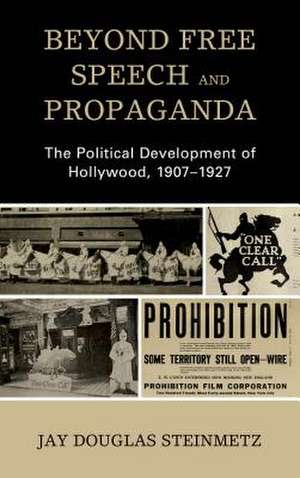
Beyond Free Speech and Propaganda
Autor Jay Douglas Steinmetzen Limba Engleză Hardback – 24 noi 2017
But the threat of censorship and economic regulation necessitated control and mastery over the social power of the cinema (its capacity to influence the public through the visualization of ideas) not an open medium of expression or an explicitly political instrument of molding public opinion. By the early 1920s, big producer-distributors based in Southern California sidelined arguments for film free speech and tamped down the propagandistic possibilities of the screen. Through their trade association, the Motion Picture Producers and Distributors of America, headed by Republican insider Will H. Hays, the emerging moguls of Hollywood negotiated government regulation, prohibition, and the insurgency of the Ku Klux Klan in the turbulent 1920s.
A complex and interconnected work of political history, this volume also uncovers key aspects in the development of modern free speech, propaganda in American political culture, the modern Republican Party, cultural developments leading up to prohibition, and the rise and fall of the Ku Klux Klan in the 1920s. This work will be of particular interest to film and political historians interested in social movements, economic development, regulation, and the evolution of consumer capitalism in the early 20th century.
Preț: 583.67 lei
Preț vechi: 867.48 lei
-33%
Puncte Express: 876
Carte tipărită la comandă
Livrare economică 04-18 decembrie
Livrare prin curier în România Termenul estimat este afișat lângă disponibilitate.
Transport gratuit pentru acest produs Plată online sau ramburs, în funcție de opțiunile comenzii.
Retur gratuit în 14 zile Comandă securizată și suport în română.
Specificații
ISBN-13: 9781498556804
ISBN-10: 1498556809
Pagini: 216
Ilustrații: 10 BW Photos
Dimensiuni: 155 x 231 x 23 mm
Greutate: 0.54 kg
Editura: Bloomsbury Publishing
Locul publicării:New York, United States
ISBN-10: 1498556809
Pagini: 216
Ilustrații: 10 BW Photos
Dimensiuni: 155 x 231 x 23 mm
Greutate: 0.54 kg
Editura: Bloomsbury Publishing
Locul publicării:New York, United States
Cuprins
Acknowledgments
Chapter 1
Chapter 2
Chapter 3
Chapter 4
Chapter 5
Chapter 6
Bibliography
About the Author
Chapter 1
Chapter 2
Chapter 3
Chapter 4
Chapter 5
Chapter 6
Bibliography
About the Author
Recenzii
Hollywood, the world over, means commercial, entertaining, nonpolitical movies, distributed by big studios to theaters where you can't get a beer. Steinmetz shows how Prohibitionists, progressives, stalwart Republicans, the KKK, and the NAACP mixed it up with the Jewish moguls and their gentile talents and political operatives to create this central site of American exceptionalism in politics and culture. Two thumbs up!
Much more than just a history of motion pictures, this extraordinarily well-written and persuasively argued book represents a significant contribution to our understanding of the American cinema's cultural context and its socio-political interactions during the silent era. Of particular note is the completely new material on prohibition and cinema as well as the political involvement of the studios and their MPPDA representative, Will H. Hays, in matters ranging from censorship to the KKK (Ku Klux Klan). Steinmetz's original thesis regarding Hollywood's de-politicization is profound and far reaching. Previous scholarship has been unable to account for Hollywood's de-politicized stance in such a way that links together institutional, industrial, textual, and socio-cultural history, but Steinmetz's research locates the thread that binds everything together. The reader is left with an understanding of the precise way in which the Hollywood studios achieved this goal and the economic context and motives that drove their actions. This highly engaging and timely work will be of interest to a broad audience, including academics and a popular readership interested in the social, political, and cultural forces that the American film industry confronted during the volatile silent era.
Much more than just a history of motion pictures, this extraordinarily well-written and persuasively argued book represents a significant contribution to our understanding of the American cinema's cultural context and its socio-political interactions during the silent era. Of particular note is the completely new material on prohibition and cinema as well as the political involvement of the studios and their MPPDA representative, Will H. Hays, in matters ranging from censorship to the KKK (Ku Klux Klan). Steinmetz's original thesis regarding Hollywood's de-politicization is profound and far reaching. Previous scholarship has been unable to account for Hollywood's de-politicized stance in such a way that links together institutional, industrial, textual, and socio-cultural history, but Steinmetz's research locates the thread that binds everything together. The reader is left with an understanding of the precise way in which the Hollywood studios achieved this goal and the economic context and motives that drove their actions. This highly engaging and timely work will be of interest to a broad audience, including academics and a popular readership interested in the social, political, and cultural forces that the American film industry confronted during the volatile silent era.