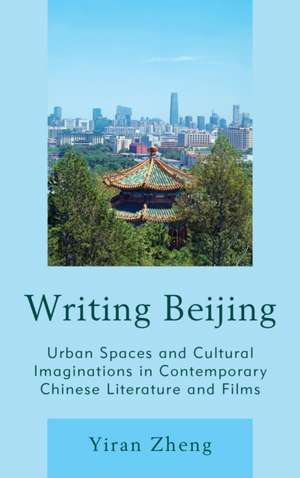
Writing Beijing
Autor Yiran Zhengen Limba Engleză Hardback – 29 apr 2016
| Toate formatele și edițiile | Preț | Express |
|---|---|---|
| Paperback (1) | 360.37 lei 6-8 săpt. | |
| Rowman & Littlefield – 31 aug 2017 | 360.37 lei 6-8 săpt. | |
| Hardback (1) | 571.85 lei 6-8 săpt. | |
| Lexington Books – 29 apr 2016 | 571.85 lei 6-8 săpt. |
Preț: 571.85 lei
Preț vechi: 672.76 lei
-15% Nou
Puncte Express: 858
Preț estimativ în valută:
101.19€ • 118.66$ • 88.87£
101.19€ • 118.66$ • 88.87£
Carte tipărită la comandă
Livrare economică 09-23 februarie 26
Preluare comenzi: 021 569.72.76
Specificații
ISBN-13: 9781498531016
ISBN-10: 1498531016
Pagini: 168
Ilustrații: 1 black & white illustrations, 13 black & white halftones
Dimensiuni: 157 x 235 x 14 mm
Greutate: 0.4 kg
Editura: Lexington Books
ISBN-10: 1498531016
Pagini: 168
Ilustrații: 1 black & white illustrations, 13 black & white halftones
Dimensiuni: 157 x 235 x 14 mm
Greutate: 0.4 kg
Editura: Lexington Books
V-ar putea interesa
-
 Preț: 228.95 lei
 -
 Art, Religion, Amnesia: The Enchantments of CredulityDonald PreziosiPreț: 352.88 lei
 -
 The Invitation in ArtAdrian Stokes-5%Preț: 416.43 lei438.34 lei
 -
 The Life of Mise-en-sceneJohn Gibbs-23%Preț: 693.36 lei900.47 lei
 -
 -18%Preț: 771.36 lei940.68 lei
 -
 Preț: 230.84 lei
 -
 Preț: 190.20 lei
 -
 Life is Beautiful, But Not for JewsKobi Niv-15%Preț: 416.93 lei490.50 lei
 -
 -15%Preț: 554.27 lei652.08 lei
 -
 -15%Preț: 553.48 lei651.15 lei
 -
 Preț: 261.86 lei
 -
 Preț: 279.84 lei
 -
 Alfred Hitchcock's FrenzyRaymond FoeryPreț: 228.01 lei
 -
 -15%Preț: 626.33 lei736.86 lei
 -
 Preț: 425.95 lei
 -
 Beyond Free Speech and PropagandaJay Douglas Steinmetz-15%Preț: 658.09 lei774.21 lei
 -
 Preț: 336.59 lei
 -
 Place, Setting, PerspectiveEleanor AndrewsPreț: 371.20 lei
 -
 Film After FilmJ. HobermanPreț: 147.87 lei
 -
 Blade RunnerJeremy Mark RobinsonPreț: 108.68 lei
 -
 Picturing Change: Curating Visual Culture at Post-Apartheid UniversitiesBrenda SchmahmannPreț: 237.18 lei
Notă biografică
Yiran Zheng is assistant professor at the Institute for Cultural Studies at Capital Normal University (CNU), Beijing.
Cuprins
Table of Contents List of Figures Introduction Part I Chapter 1 Work Unit Compound: An Emergence of a New Urban Space Chapter 2 ¿Gongheguo xingui (New Aristocrats of the PRC)¿ Chapter 3 Red Nostalgia in the Literature of Military Compound Part II Chapter 4 Siheyuan: Signifier of Traditional and Masculine City Chapter 5 Second-generation Beijing Flavor Writers Chapter 6 Traditional Beijing and Masculine Beijing in Second-generation Beijing Flavor Literature Part III Chapter 7 Modern and Postmodern Architectures: Presentations of the Global Context Chapter 8 Beijing Floaters Chapter 9 Cosmopolitan Metropolis as An Urban Dream in Six-generation Films Conclusion References About the Author
Descriere
Descriere de la o altă ediție sau format:
This study investigates some literary configurations of Beijing through contemporary Chinese literature and films. Representations of these spaces are revealed to be the projections of some writers and filmmakers' own cultural imaginations.
This study investigates some literary configurations of Beijing through contemporary Chinese literature and films. Representations of these spaces are revealed to be the projections of some writers and filmmakers' own cultural imaginations.