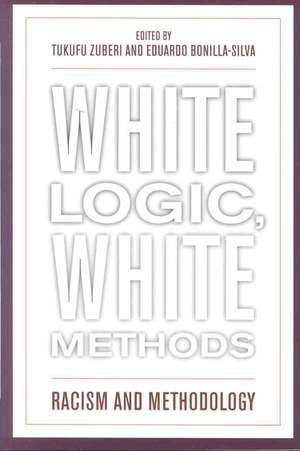
White Logic, White Methods: Racism and Methodology
Editat de Tukufu Zuberi, Eduardo Bonilla-Silvaen Limba Engleză Paperback – 2 mai 2008
Suntem de părere că White Logic, White Methods reprezintă o intervenție critică fundamentală în epistemologia științelor sociale, chestionând însăși fundamentele pe care se bazează colectarea și interpretarea datelor. Această lucrare aduce un suflu nou prin demitizarea neutralității metodologice, argumentând că practicile actuale de cercetare sunt adesea ancorate într-o „logică albă” care distorsionează realitatea socială. Ne-a atras atenția modul în care editorii Tukufu Zuberi și Eduardo Bonilla-Silva coordonează un colectiv de cercetători pentru a cere nu doar o reformă, ci o revizuire completă a modului în care „rasa” este utilizată ca variabilă statistică.
Structura volumului este riguros organizată în trei secțiuni tematice care ghidează cititorul de la definirea conceptelor de bază până la studii de caz concrete, precum statisticile populației în Africa de Sud sau experimentele de psihologie socială. Această progresie demonstrează cum ideologia rasială afectează metodologia experimentală și cuantificarea socială. Cititorii familiarizați cu Rethinking Race and Ethnicity in Research Methods de John H Stanfield II vor aprecia aici o abordare mai radicală, care nu se mulțumește doar cu descrierea metodelor, ci urmărește „detronarea” practicilor care exclud perspectivele pluraliste.
În contextul operei lui Tukufu Zuberi, acest volum rafinează temele explorate în Thicker Than Blood, unde autorul a investigat conexiunile istorice dintre nașterea statisticii și ideea de rasă. Dacă în lucrări precum The Demography of South Africa accentul era pus pe procesele demografice sub apartheid, în White Logic, White Methods miza devine una universală pentru comunitatea academică: necesitatea de a deracializa statisticile sociale pentru a obține o cunoaștere autentică.
Preț: 363.36 lei
Preț vechi: 509.61 lei
-29%
Carte tipărită la comandă
Livrare economică 08-22 decembrie
Specificații
ISBN-10: 0742542815
Pagini: 416
Dimensiuni: 146 x 226 x 24 mm
Greutate: 0.63 kg
Editura: Bloomsbury Publishing
Colecția Rowman & Littlefield
Locul publicării:New York, United States
V-ar putea interesa
-
 Methodology of Longitudinal SurveysPeter Lynn-9%Preț: 874.26 lei960.73 lei
 -
 Evaluation Methodology BasicsE. Jane Davidson-23%Preț: 618.15 lei802.80 lei
 -
 Realistic EvaluationRay Pawson-22%Preț: 476.03 lei610.30 lei
 -
 Doing Quantitative Research in the Social SciencesThomas R. BlackPreț: 451.80 lei
 -
 Developing Focus Group ResearchRosaline Barbour-18%Preț: 814.61 lei993.42 lei
 -
 Key Concepts in Social ResearchGeoff Payne-15%Preț: 525.97 lei618.79 lei
 -
 Multiple RegressionPaul D. Allison-15%Preț: 614.06 lei722.43 lei
 -
 Participatory Action ResearchWilliam Foote Whyte-15%Preț: 614.10 lei722.47 lei
 -
 Heuristic ResearchClark E. Moustakas-15%Preț: 437.47 lei514.67 lei
 -
 The Active InterviewJames A. HolsteinPreț: 326.67 lei
 -
 Researching Real-World ProblemsZina O'Leary-8%Preț: 483.22 lei525.24 lei
 -
 Understanding Social StatisticsJane L. Fielding-8%Preț: 515.48 lei560.31 lei
 -
 Evidence-Based PolicyRay Pawson-8%Preț: 489.28 lei531.82 lei
 -
 The SAGE Handbook of Public Opinion ResearchWolfgang Donsbach-27%Preț: 1232.63 lei1688.54 lei
 -
 -15%Preț: 626.77 lei737.38 lei
 -
 Writing Up Qualitative ResearchHarry F Wolcott-15%Preț: 612.43 lei720.50 lei
 -
 Contemporary social evilsJoseph RowntreePreț: 215.12 lei
 -
 Theory and Methods in Social ResearchBridget Somekh-11%Preț: 441.29 lei495.84 lei
De ce să citești această carte
Această carte este esențială pentru studenții și cercetătorii din sociologie și științe politice care doresc să înțeleagă limitele obiectivității în cercetarea cantitativă. Cititorul câștigă o perspectivă critică asupra modului în care instrumentele statistice pot perpetua prejudecăți sistemice. Este un ghid metodologic indispensabil pentru oricine dorește să practice o sociologie reflexivă și să evite capcanele interpretative ale „logicii albe” în analiza datelor contemporane.
Despre autor
Tukufu Zuberi este profesor de sociologie și director al programului de Studii Africane la University of Pennsylvania, fiind cunoscut publicului larg și ca moderator al seriei PBS „History Detectives”. Expertiza sa îmbină demografia cu istoria socială, fiind un critic acerb al utilizării eronate a statisticilor în studiile despre rasă. Eduardo Bonilla-Silva, profesor la Duke University, este o figură centrală în sociologia contemporană, renumit pentru analiza rasismului structural în societățile post-drepturi civile, lucrarea sa „Racism Without Racists” fiind un punct de reper pentru înțelegerea ideologiilor rasiale moderne.
Descriere
Cuprins
Chapter 2 Chapter One: Towards a Definition of White Logic and White Methods
Chapter 3 Section One: Race as "A Variable"
Chapter 4 Chapter Two: Making Sense of Race and Racial Classification
Chapter 5 Chapter Three: Methodically Eliminating Race and Racism
Chapter 6 Chapter Four: Race and Population Statistics in South Africa
Chapter 7 Section Two: Logic of the Method
Chapter 8 Chapter Five: Causation and Race
Part 9 Chapter Six: Swimming Upstream: Theory and Methodology in Race Research
Chapter 10 Chapter Seven: Deracializing Social Statistics: Problems in the Quantification of Race
Chapter 11 Section Three: Interpreting the Problem
Chapter 12 Chapter Eight: Anything But Racism: How Sociologists Limit the Significance of Racism
Chapter 13 Chapter Nine: Experiments in Black and White: How Racial Ideology Affects Experimental Methodology
Chapter 14 Chapter Ten: The End of Racism as the New Doxa: New Strategies for Researching Race
Chapter 15 Chapter Eleven: White Ethnographers on the Experiences of African American Men: Then and Now
Chapter 16 Section Four: Dimensions of Segregation and Inequality Typically Missed
Chapter 17 Chapter Twelve: Indices of Racial Residential Segregation: A Critical Review and Redirection
Chapter 18 Chapter Thirteen: Qui Bono?: Explaining-or Defending-Winners and Losers in the Competition for Educational Achievement
Chapter 19 Chapter Fourteen: Critical Demography and the Measurement of Racism: A Reconsideration of Wealth, Status and Power
Chapter 20 Chapter Fifteen: As Racial Boundaries "Fade": Racial Stratification and Interracial Marriage
Chapter 21 Section Five: The Practice of Social Research
Chapter 22 Chapter Sixteen:The Gospel of Feel Good Sociology of Race Relations as Pseudoscience and the Decline in the Relevance of American Sociology in the 21st Century
Chapter 23 Chapter Seventeen: To Win the War: Racial Research and the Pioneer Fund
Chapter 24 Chapter Eighteen: Being a statistician means never having to say you're certain.
Chapter 25 Chapter Nineteen: Crime Statistics, Disparate Impact Analysis, and the Economic Disenfranchisement of Minority Ex-Offenders
Chapter 26 Conclusion: Where Do We Go From Here?
Chapter 27 Chapter Twenty: Telling the Real Tale of the Hunt: Towards a Race Conscious Sociology of Racial Stratification
Recenzii
This path-breaking volume should be required reading for every graduate student and scholar engaged in research on race and ethnicity. The contributors carefully dissect and uncover the myriad ways that white supremacy is supported by conventional practices employed by social scientists to collect, analyze, and frame data on race and racial inequalities. By offering a scathing critique of the ways that social science research remains complicit in white supremacy this volume will change the ways that sociologists conceptualize and carry out studies in the sociology of race and racism.
White Logic, White Methods evokes the same urgency, excitement, and challenge to orthodoxy as Ladner's classic, The Death of White Sociology. Instead of asking the conventional question of whether the glass is half full or half empty, they dare to ask whose glass is this, who chose it, and who says we have to settle for it?