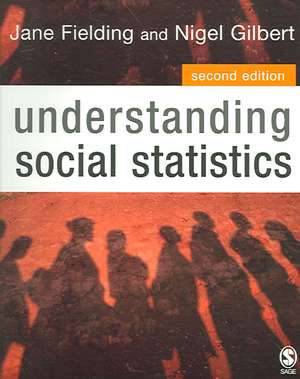
Understanding Social Statistics
Autor Jane L. Fielding, Nigel Gilberten Limba Engleză Paperback – 18 feb 2006
Observăm că Understanding Social Statistics este conceput ca un instrument fundamental pentru nivelul de licență, fiind adaptat nevoilor specifice ale studenților din sociologie și științe politice care se confruntă cu reticența față de aparatul matematic. Această a doua ediție, publicată de SAGE Publications, nu se limitează la prezentarea teoretică a conceptelor, ci integrează direct utilizarea pachetului software SPSS (versiunea 14.0) în fluxul de învățare. Descoperim aici o abordare aplicată, unde datele provenite din sondaje sociale reale sunt utilizate pentru a exemplifica analizele univariate și multivariate. Suntem de părere că structura didactică este punctul forte al lucrării: fiecare capitol debutează cu obiective clare și se încheie cu rezumate punctuale și exerciții care consolidează materia. Față de prima ediție, autorii Jane L. Fielding și Nigel Gilbert au introdus secțiuni noi despre dezvoltarea cadrelor de codare (coding frames) și utilizarea ponderilor în analiza statisticilor publicate, elemente esențiale pentru rigoarea cercetării contemporane. Cartea este comparabilă cu Statistics for Social Understanding de Nancy E. Whittier în ceea ce privește accesibilitatea limbajului, dar se diferențiază prin integrarea mult mai profundă a capturilor de ecran și a procedurilor tehnice din SPSS, oferind un ghid vizual pas cu pas. În contextul operei autorilor, lucrarea completează temele abordate în Linking Data, unde Jane L. Fielding explora intersecția dintre metodele calitative și cele cantitative. Dacă acel volum oferea o perspectivă metodologică mixtă, Understanding Social Statistics rafinează competențele tehnice necesare pentru gestionarea volumelor mari de date, transformând statistica dintr-o barieră într-un instrument de revelare a tiparelor de comportament uman.
Preț: 515.48 lei
Preț vechi: 560.31 lei
-8%
Carte tipărită la comandă
Livrare economică 30 noiembrie-14 decembrie
Specificații
ISBN-10: 1412910544
Pagini: 360
Ilustrații: Illustrations
Dimensiuni: 191 x 235 x 19 mm
Greutate: 0.65 kg
Ediția:2. Auflage
Editura: SAGE Publications Ltd
Locul publicării:London, United Kingdom
V-ar putea interesa
-
 Cartoon Guide to StatisticsLarry GonickPreț: 133.22 lei
 -
 Happiness Quantified: A Satisfaction Calculus ApproachBernard M. S. van Praag-21%Preț: 396.08 lei500.90 lei
 -
 -8%Preț: 427.82 lei465.02 lei
 -
 Doing Media ResearchSusanna Hornig Priest-27%Preț: 1088.01 lei1490.43 lei
 -
 Foundations of Factor AnalysisStanley A Mulaik-18%Preț: 729.64 lei889.80 lei
 -
 Contemporary social evilsJoseph RowntreePreț: 215.12 lei
 -
 -8%Preț: 407.07 lei442.47 lei
 -
 Social ResearchBruce Curtis-18%Preț: 698.27 lei851.55 lei
 -
 Key Concepts in Sport and Exercise Research MethodsMichael AtkinsonPreț: 371.87 lei
 -
 Theory and Methods in Social ResearchBridget Somekh-11%Preț: 441.29 lei495.84 lei
De ce să citești această carte
Recomandăm această carte studenților de la facultățile de sociologie și asistență socială care doresc să stăpânească analiza cantitativă fără a se pierde în formule matematice abstracte. Cititorul câștigă abilitatea de a naviga în SPSS și de a interpreta corect datele din sondaje. Este o resursă practică ce elimină teama de cifre prin exemple actualizate și o structură extrem de clară, ideală pentru pregătirea examenelor sau a lucrării de licență.
Despre autor
Jane L. Fielding este un cercetător cu o vastă experiență academică, deținând un doctorat în biochimie obținut în 1976. Din 1981, s-a alăturat Universității din Surrey, unde a activat în departamentele de Sociologie și Psihologie. Expertiza sa s-a concentrat pe metode cantitative și informatică aplicată în științele sociale, devenind Senior Lecturer în 2001. Alături de Nigel Gilbert, a dezvoltat metodologii care facilitează înțelegerea datelor complexe. Opera sa reflectă un interes constant pentru rigoarea analitică, fiind co-autor al lucrării Linking Data, care explorează sinergia dintre datele calitative și cele cantitative.
Descriere scurtă
This fully revised, expanded and updated Second Edition of the best-selling textbook by Jane Fielding and Nigel Gilbert provides a comprehensive yet accessible guide to quantitative data analysis. Designed to help take the fear out of the use of numbers in social research, this textbook introduces students to statistics as a powerful means of revealing patterns in human behaviour.
The textbook covers everything typically included in an introductory course on social statistics for students in the social sciences and the authors have taken the opportunity of this Second Edition to bring the data sources as current as possible. The book is full of up-to-date examples and useful and clear illustrations using the latest SPSS software.
While maintaining the student-friendly elements of the first, such as chapter summaries, exercises at the end of each chapter, and a glossary of key terms, new features to this edition include:
-Updated examples and references
SPSS coverage and screen-shots now incorporate the current version 14.0 and are used to demonstrate the latest social statistics datasets;
-Additions to content include a brand new section on developing a coding frame and an additional discussion of weighting counts as a means of analyzing published statistics;
-Enhanced design aids navigation which is further simplified by the addition of core objectives for each chapter and bullet-pointed chapter summaries;
-The updated Website at http:/www.soc.surrey.ac.uk/uss/index.html reflects changes made to the text and provides updated datasets;
A valuable and practical guide for students dealing with the large amounts of data that are typically collected in social surveys, the Second Edition of Understanding Social Statistics is an essential textbook for courses on statistics and quantitative research across the social sciences.
Cuprins
Using Computers in Statistics
Univariate Statistics
Graphics for Display
Measures of Central Tendency and Dispersion
Graphics for Analysis
The Normal Curve
Correlation and Regression
Bivariate Analysis
Categorical Data
Tables
Sampling and Inference
Testing Hypotheses
Modelling Data