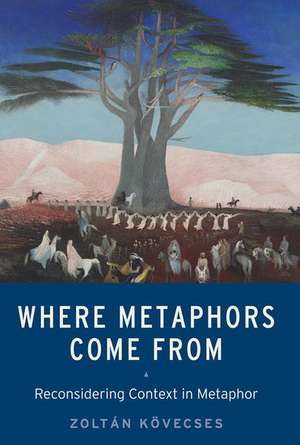
Where Metaphors Come From: Reconsidering Context in Metaphor
Autor Zoltán Kövecsesen Limba Engleză Paperback – 9 feb 2017
Preț: 362.65 lei
Preț vechi: 443.07 lei
-18%
Puncte Express: 544
Carte tipărită la comandă
Livrare economică 04-15 decembrie
Livrare prin curier în România Termenul estimat este afișat lângă disponibilitate.
Transport gratuit de la 400.00 lei Plată online sau ramburs, în funcție de opțiunile comenzii.
Retur gratuit în 14 zile Comandă securizată și suport în română.
Specificații
ISBN-13: 9780190656713
ISBN-10: 0190656719
Pagini: 232
Dimensiuni: 155 x 231 x 15 mm
Greutate: 0.34 kg
Editura: Oxford University Press
Colecția OUP USA
Locul publicării:New York, United States
ISBN-10: 0190656719
Pagini: 232
Dimensiuni: 155 x 231 x 15 mm
Greutate: 0.34 kg
Editura: Oxford University Press
Colecția OUP USA
Locul publicării:New York, United States
V-ar putea interesa
-
 Contact Linguistics: Bilingual Encounters and Grammatical OutcomesCarol Myers-Scotton-18%Preț: 381.81 lei463.97 lei
 -
 Cognitive Interfaces: Constraints on Linking Cognitive InformationEmile van der Zee-23%Preț: 222.41 lei287.57 lei
 -
 Bilingual Acquisition: Theoretical Implications of a Case StudyMargaret Deuchar-18%Preț: 338.06 lei413.85 lei
 -
 Dynamical GrammarPeter W. Culicover-17%Preț: 367.05 lei442.81 lei
 -
 Competing Motivations in Grammar and UsageBrian MacWhinney-30%Preț: 1017.83 lei1453.18 lei
 -
 -11%Preț: 342.02 lei385.87 lei
 -
 23: The Transition to LanguageAlison Wray-26%Preț: 358.40 lei487.32 lei
 -
 Knowledge and Learning in Natural LanguageCharles D. Yang-27%Preț: 410.18 lei565.38 lei
 -
 -27%Preț: 359.00 lei491.65 lei
 -
 -28%Preț: 429.43 lei598.61 lei
 -
 -9%Preț: 357.01 lei391.43 lei
 -
 Language Contact in AmazoniaAlexandra Aikhenvald-22%Preț: 449.59 lei577.98 lei
 -
 Diagnosing SyntaxLisa Lai-Shen Cheng-19%Preț: 524.25 lei650.68 lei
 -
 -14%Preț: 218.76 lei255.20 lei
 -
 The Linguistic Cycle: Language Change and the Language FacultyElly van Gelderen-24%Preț: 470.38 lei621.18 lei
 -
 Linguistic Imperialism ContinuedRobert Phillipson-15%Preț: 534.45 lei628.77 lei
 -
 Jokes and the Linguistic MindDebra Aarons-15%Preț: 425.72 lei500.84 lei
 -
 Words in the MindJean AitchisonPreț: 434.21 lei
 -
 The Cambridge Handbook of Metaphor and ThoughtRaymond W. Jr. Gibbs-11%Preț: 455.01 lei511.24 lei
 -
 New Horizons in the Study of Language and MindNoam ChomskyPreț: 232.80 lei
 -
 The Emergence of MeaningStephen CrainPreț: 289.04 lei
 -
 Speech Production and Second Language AcquisitionJudit Kormos-15%Preț: 423.18 lei497.86 lei
 -
 A Spanish Learning GrammarMike ThackerPreț: 416.42 lei
 -
 Language DevelopmentPatricia J. Brooks-19%Preț: 429.13 lei529.79 lei
 -
 Preț: 498.65 lei
 -
 English Language Teaching MattersMichael P BermanPreț: 133.27 lei
 -
 Language and Cognition in Bilinguals and Multilinguals: An IntroductionAnnette M.B. de Groot-18%Preț: 1135.75 lei1385.06 lei
Recenzii
As a discipline, linguistics has many theories about how metaphors shape and are shaped by common experiences and culture. Kövecses expands on traditional conceptual metaphor theory by adding the element of context to the mix... He provides good examples from a variety of contextual and cultural situations and includes several chapters on the cognitive aspects of linguistic humor.
This newest addition to the Kövecses canon will stand as one of his most engaging and conclusive works. Thus, it is highly recommended for all metaphor researchers and scholars. For a broader readership, the book is engaging as well as pedagogical. Thus, it is highly recommended as a fine overall introduction to the cognitive linguistics of metaphor and as an exceptional overview of the important roles of culture, history, and of course, context in figurative communication.
The cognitive theory of metaphor has certainly shown that it is a thriving framework. The many branches it has developed over the last two decades are a safe indicator of its vitality and prosperity, and Zoltan Kovecses has contributed significantly to its growth.
This newest addition to the Kövecses canon will stand as one of his most engaging and conclusive works. Thus, it is highly recommended for all metaphor researchers and scholars. For a broader readership, the book is engaging as well as pedagogical. Thus, it is highly recommended as a fine overall introduction to the cognitive linguistics of metaphor and as an exceptional overview of the important roles of culture, history, and of course, context in figurative communication.
The cognitive theory of metaphor has certainly shown that it is a thriving framework. The many branches it has developed over the last two decades are a safe indicator of its vitality and prosperity, and Zoltan Kovecses has contributed significantly to its growth.
Notă biografică
Zoltán Kövecses is Professor of Linguistics in the Department of American Studies at Eötvös Loránd University.