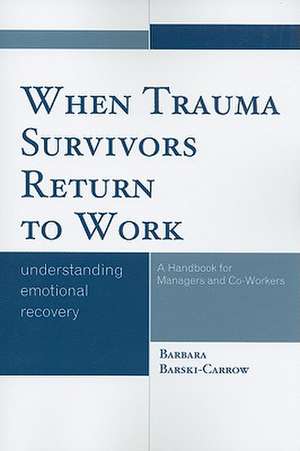
When Trauma Survivors Return to Work: Understanding Emotional Recovery
Autor Barbara Barski-Carrowen Limba Engleză Paperback – 27 apr 2010
No other source clearly and positively teaches managers and co-workers how to treat fellow workers returning to the workplace after experiencing a rape, a burglary, an armed assault, a violent accident, or witnessing a brutal crime. No one explains what to say to those who have just been told they have a terminal illness, or how to treat an employee whose close family member has committed suicide. It is not helpful for co-workers to deny such traumatic events or remain silent, which is what often happens, or for managers to avoid directly communicating with the traumatized employee. Is there something that managers and co-workers can do to be truly helpful to such sensitively wounded people? The answer is yes.
In this illuminating educational approach, Dr. Barski-Carrow shows how managers and co-workers can learn simple ways to make the workplace a better environment for emotional healing.
Barski-Carrow offers a simple, well-researched way to provide those basic practical skills and, with absorbing stories, shows how relationships in the workplace can indeed provide a healing force for traumatic experiences.
Preț: 274.30 lei
Preț vechi: 361.86 lei
-24%
Puncte Express: 411
Carte tipărită la comandă
Livrare economică 02-16 decembrie
Livrare prin curier în România Termenul estimat este afișat lângă disponibilitate.
Transport gratuit de la 400.00 lei Plată online sau ramburs, în funcție de opțiunile comenzii.
Retur gratuit în 14 zile Comandă securizată și suport în română.
Specificații
ISBN-13: 9780761850304
ISBN-10: 0761850309
Pagini: 169
Dimensiuni: 154 x 233 x 15 mm
Greutate: 0.3 kg
Editura: Bloomsbury Publishing
Colecția University Press of America
Locul publicării:New York, United States
ISBN-10: 0761850309
Pagini: 169
Dimensiuni: 154 x 233 x 15 mm
Greutate: 0.3 kg
Editura: Bloomsbury Publishing
Colecția University Press of America
Locul publicării:New York, United States
V-ar putea interesa
-
 Excommunication: Three Inquiries in Media and MediationAlexander R. GallowayPreț: 215.26 lei
 -
 Theorizing Crisis CommunicationTimothy L. SellnowPreț: 374.36 lei
 -
 The Handbook of the Psychology of Communication TechnologyS Shyam Sundar-9%Preț: 1306.26 lei1435.45 lei
 -
 Global Communication: Theories, Stakeholders and TrendsThomas L. McPhailPreț: 485.05 lei
 -
 The Handbook of Global Media ResearchIngrid VolkmerPreț: 440.27 lei
 -
 The Future of LiveKarin van EsPreț: 166.53 lei
 -
 -30%Preț: 132.83 lei190.31 lei
 -
 Advances in Communications & Media Research: Volume 11Anthony V Stavros-27%Preț: 1520.61 lei2074.12 lei
 -
 Communication and Economic TheoryBirger P. Priddat-60%Preț: 330.45 lei836.50 lei
Cuprins
Chapter 1 Acknowledgments
Chapter 2 Introduction
Part 3 Part I. Understanding the Traumatic Life Experience (TLE)
Chapter 4 Chapter 1. Why I Wrote This Book
Chapter 5 Chapter 2. What is a Traumatic Life Experience (TLE)?
Chapter 6 Chapter 3. What is it Like to Be a Returning TLE Employee?
Chapter 7 Chapter 4. What Can Managers Do?
Chapter 8 Chapter 5. What Do You Tell Co-Workers?
Chapter 9 Chapter 6. What Does Psychology Tell Us About Trauma?
Chapter 10 Chapter 7. What Can An Employee Assistance Program Do?
Part 11 Part II. Taking Practical Steps
Chapter 12 Chapter 8. What is a Study Circle?
Chapter 13 Chapter 9. How Does an Organization Set Up a Study Circle?
Chapter 14 Chapter 10. Putting Out a Welcome Mat: The First Study Circle
Chapter 15 Chapter 11. Lending a Listening Ear: The Second Study Circle
Chapter 16 Chapter 12. Offering a Helping Hand: The Third Study Circle
Part 17 Part III. Some Special Circumstances
Chapter 18 Chapter 13. When an Entire Group is Traumatized, How Do Managers and Employees Cope?
Chapter 19 Chapter 14. How Does an Employee's Trauma Affect His Children?
Chapter 20 Chapter 15. How Can You Help Yourself After a Traumatic Life Experience?
Chapter 21 Chapter 16. What Challenges Face a Facilitator?
Chapter 22 Appendix: Study Circle Handouts
Chapter 23 References
Chapter 2 Introduction
Part 3 Part I. Understanding the Traumatic Life Experience (TLE)
Chapter 4 Chapter 1. Why I Wrote This Book
Chapter 5 Chapter 2. What is a Traumatic Life Experience (TLE)?
Chapter 6 Chapter 3. What is it Like to Be a Returning TLE Employee?
Chapter 7 Chapter 4. What Can Managers Do?
Chapter 8 Chapter 5. What Do You Tell Co-Workers?
Chapter 9 Chapter 6. What Does Psychology Tell Us About Trauma?
Chapter 10 Chapter 7. What Can An Employee Assistance Program Do?
Part 11 Part II. Taking Practical Steps
Chapter 12 Chapter 8. What is a Study Circle?
Chapter 13 Chapter 9. How Does an Organization Set Up a Study Circle?
Chapter 14 Chapter 10. Putting Out a Welcome Mat: The First Study Circle
Chapter 15 Chapter 11. Lending a Listening Ear: The Second Study Circle
Chapter 16 Chapter 12. Offering a Helping Hand: The Third Study Circle
Part 17 Part III. Some Special Circumstances
Chapter 18 Chapter 13. When an Entire Group is Traumatized, How Do Managers and Employees Cope?
Chapter 19 Chapter 14. How Does an Employee's Trauma Affect His Children?
Chapter 20 Chapter 15. How Can You Help Yourself After a Traumatic Life Experience?
Chapter 21 Chapter 16. What Challenges Face a Facilitator?
Chapter 22 Appendix: Study Circle Handouts
Chapter 23 References
Recenzii
A wealth of insight and practical information. [This] book is a must read for both managers and workers aspiring to management.
An unique approach to an issue that exists in the workplace - helping individuals who have been "hurt" make a re-entry. She outlines a verbiage and behavior that can be easily adopted by organizations. Her book is enlightening, and an excellent guide for both managers and co-workers.
An unique approach to an issue that exists in the workplace - helping individuals who have been "hurt" make a re-entry. She outlines a verbiage and behavior that can be easily adopted by organizations. Her book is enlightening, and an excellent guide for both managers and co-workers.