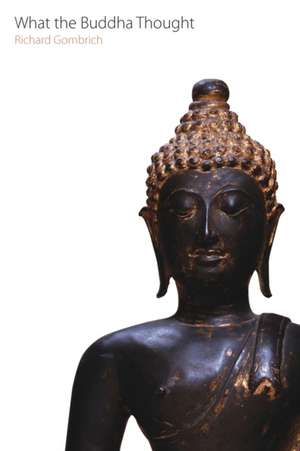
What the Buddha Thought
Autor Richard F. Gombrichen Limba Engleză Paperback – 9 feb 2009
Observăm în literatura academică recentă o tendință de a trata gândirea lui Buddha fie ca pe o filosofie abstractă, ruptă de rădăcinile sale, fie ca pe o religie ai cărei sâmburi istorici sunt imposibil de recuperat. Volumul What the Buddha Thought vine să completeze tocmai această lacună, propunând o reconstrucție coerentă a viziunii lui Buddha prin ancorarea ei fermă în contextul polemic al vremii sale. Richard F. Gombrich argumentează că nu putem înțelege profunzimea acestui sistem fără a analiza modul în care Buddha a dezbătut și satirizat conceptele contemporane lui, provenite din brahminism și jainism.
Suntem de părere că forța acestui text rezidă în capacitatea de a demonstra coerența intelectuală a lui Buddha, prezentându-l nu doar ca pe un lider spiritual, ci ca pe un gânditor original care a operat cu un grad înalt de abstracție. Comparabil cu How Buddhism Began în rigurozitate, volumul de față este actualizat pentru a include o analiză mult mai detaliată a metaforei focului și a modului în care Buddha a redefinit karma ca intenție etică. Față de The Forerunner of All Things, care se concentrează pe psihologia morală a intenției, Gombrich extinde cadrul către o analiză lingvistică și socială, subliniind importanța Canonului Pali.
Structura cărții facilitează o progresie logică, începând cu o secțiune de informații de context necesare nespecialiștilor, urmată de capitole tematice ce explorează non-sinele, cauzalitatea și nirvana. Putem afirma că lucrarea reprezintă o sinteză matură a operei autorului, rafinând temele explorate în Theravada Buddhism și Buddhist Precept & Practice, trecând de la studiul empiric al schimbării religioase către o exegeză filosofică profundă a textelor sursă.
Preț: 204.96 lei
Carte tipărită la comandă
Livrare economică 08-22 iunie
Livrare express 01-07 mai pentru 47.12 lei
Specificații
ISBN-10: 1845536142
Pagini: 256
Dimensiuni: 156 x 234 x 15 mm
Greutate: 0.4 kg
Editura: Equinox Publishing Ltd
Locul publicării:United Kingdom
V-ar putea interesa
-
 Tibetan Buddhism: A Very Short IntroductionMatthew T. KapsteinPreț: 64.78 lei
 -
 Feeding the Dead: Ancestor Worship in Ancient IndiaMatthew R. Sayers-10%Preț: 278.44 lei310.22 lei
 -
 Buddhist Poetry and Colonialism: Alagiyavanna and the Portuguese in Sri LankaStephen C. Berkwitz-8%Preț: 348.26 lei378.00 lei
 -
 Theravada Buddhism: A Social History from Ancient Benares to Modern ColomboRichard F. GombrichPreț: 384.40 lei
 -
 The Wisdom of CompassionDalai Lama-28%Preț: 54.25 lei74.96 lei
 -
 Dancing with FireJohn AmodeoPreț: 105.95 lei
 -
 How to MeditatePema ChödrönPreț: 109.83 lei
 -
 Nagarjuna's Middle WayMark Siderits-30%Preț: 116.18 lei166.74 lei
 -
 The New Meditation HandbookGeshe Kelsang GyatsoPreț: 104.12 lei
 -
 The New Guide to Dakini LandGeshe Kelsang GyatsoPreț: 120.98 lei
 -
 The Mindfulness Survival KitThich Nhat Hanh-21%Preț: 64.34 lei81.45 lei
De ce să citești această carte
Recomandăm această carte oricărui cititor interesat de istoria ideilor și de rădăcinile autentice ale budismului. Richard F. Gombrich reușește să facă accesibilă o materie densă, demonstrând cum Buddha a transformat concepte arhaice în principii de responsabilitate individuală. Veți câștiga o perspectivă clară asupra modului în care s-a format gândirea budistă în dialog cu tradițiile Indiei antice, dincolo de mituri sau interpretări moderne simpliste.
Despre autor
Richard F. Gombrich este unul dintre cei mai respectați specialiști în budismul Theravada și în limba pali la nivel mondial, fiind profesor emerit la Universitatea Oxford. Cariera sa a fost dedicată descifrării textelor canonice și înțelegerii budismului ca fenomen istoric și social viu. Prin lucrări fundamentale precum Theravada Buddhism, el a modelat standardele academice în domeniu, îmbinând rigoarea filologică cu analiza sociologică. În What the Buddha Thought, Gombrich își folosește vasta erudiție pentru a recupera vocea originală a lui Buddha, consolidându-și reputația de autoritate supremă în studiul budismului timpuriu.