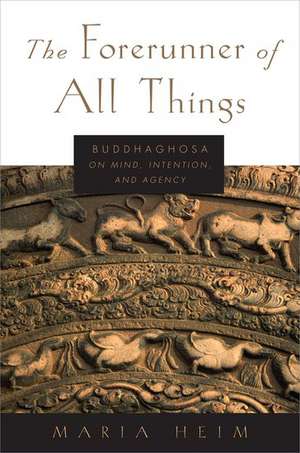
The Forerunner of All Things: Buddhaghosa on Mind, Intention, and Agency
Autor Maria Heimen Limba Engleză Paperback – 14 noi 2013
Preț: 371.67 lei
Preț vechi: 472.82 lei
-21%
Puncte Express: 558
Carte tipărită la comandă
Livrare economică 10-15 decembrie
Livrare prin curier în România Termenul estimat este afișat lângă disponibilitate.
Transport gratuit de la 400.00 lei Plată online sau ramburs, în funcție de opțiunile comenzii.
Retur gratuit în 14 zile Comandă securizată și suport în română.
Specificații
ISBN-13: 9780199331048
ISBN-10: 0199331049
Pagini: 272
Dimensiuni: 155 x 231 x 20 mm
Greutate: 0.36 kg
Editura: Oxford University Press
Colecția OUP USA
Locul publicării:New York, United States
ISBN-10: 0199331049
Pagini: 272
Dimensiuni: 155 x 231 x 20 mm
Greutate: 0.36 kg
Editura: Oxford University Press
Colecția OUP USA
Locul publicării:New York, United States
V-ar putea interesa
-
 The Art of WarSun Tzu-18%Preț: 76.58 lei93.40 lei
 -
 Indian Philosophy: A Very Short IntroductionSue Hamilton-19%Preț: 57.92 lei71.23 lei
 -
 -10%Preț: 348.55 lei387.09 lei
 -
 -16%Preț: 137.98 lei164.41 lei
 -
 Essence of the UpanishadsEknath EaswaranPreț: 101.63 lei
 -
 Secret Teachings of PadmasambhavaPadmasambhava-33%Preț: 93.92 lei139.23 lei
 -
 The Diamond in Your PocketGangajiPreț: 117.03 lei
 -
 Degrees of Excellence: A Fatimid Treatise on Leadership in IslamArzina R. Lalani-22%Preț: 350.58 lei452.28 lei
 -
 Creativity and Taoism: A Study of Chinese Philosophy, Art and PoetryChung-yuan Chang-19%Preț: 135.62 lei166.42 lei
Recenzii
This book will be a major contribution to scholarship in Buddhist Studies, as well as to the discipline of moral psychology more generally. The scholarship is impeccable, the attention to canonical material and secondary literature in Buddhist Studies as well as to relevant work in Western philosophy and social theory is meticulous. The book is rich in hermeneutical and philosophical insight, carefully argued, and written with uncommon perspicuity, grace and even humor I would not be surprised if it were to be recognized as one of the most significant recent contributions to Buddhist philosophy.
Throughout this original, humane, and often beautiful exploration of Buddhist moral thinking, Maria Heim allows herself to be taught and guided by the great Buddhist thinker Buddhaghosa about how to read Buddhist texts well and how to think reflectively about the nature of a moral person. The result is that we are introduced to a Buddhaghosa that we have not met before: an astute humanist always alert to the complexities of the moral life, and a contemporary with us, as it were, offering us fresh resources for our own efforts to make sense of ourselves as moral persons
Throughout this original, humane, and often beautiful exploration of Buddhist moral thinking, Maria Heim allows herself to be taught and guided by the great Buddhist thinker Buddhaghosa about how to read Buddhist texts well and how to think reflectively about the nature of a moral person. The result is that we are introduced to a Buddhaghosa that we have not met before: an astute humanist always alert to the complexities of the moral life, and a contemporary with us, as it were, offering us fresh resources for our own efforts to make sense of ourselves as moral persons
Cuprins
- Table of Contents
- Abbreviations
- Introduction
- Chapter One: Constructing Experience: Intention in the Suttas
- Chapter Two: The Work of Intention: Mental Life in the Abhidhamma
- Chapter Three: Culpability and Disciplinary Culture in the Vinaya
- Chapter Four: Making Actions Intelligible: Intention and Mind in Stories
- Conclusion
- Bibliography
- Notes
- Index