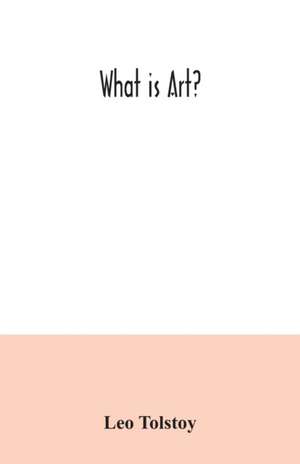
What is art?
Autor Leo Tolstoyen Limba Engleză Paperback – 3 iul 2020
Preț: 158.52 lei
Puncte Express: 238
Carte disponibilă
Livrare economică 30 noiembrie-14 decembrie
Livrare prin curier în România Termenul estimat este afișat lângă disponibilitate.
Transport gratuit de la 400.00 lei Plată online sau ramburs, în funcție de opțiunile comenzii.
Retur gratuit în 14 zile Comandă securizată și suport în română.
Specificații
ISBN-13: 9789354034763
ISBN-10: 9354034764
Pagini: 280
Dimensiuni: 140 x 216 x 17 mm
Greutate: 0.4 kg
Editura: Alpha Editions
ISBN-10: 9354034764
Pagini: 280
Dimensiuni: 140 x 216 x 17 mm
Greutate: 0.4 kg
Editura: Alpha Editions
V-ar putea interesa
-
 Art ObjectsJeanette Winterson-20%Preț: 73.68 lei92.13 lei
-
 A Confession and Other Religious WritingsLeo Tolstoy-31%Preț: 64.07 lei92.36 lei
-
 Beauty is in the StreetJoachim C. HäberlenPreț: 94.61 lei
-
 Tolstoy's War and Peace: Philosophical PerspectivesPredrag Cicovacki-24%Preț: 149.27 lei196.27 lei
-
 Leo Tolstoy: A Very Short IntroductionLiza Knapp-19%Preț: 57.36 lei70.82 lei
-
 Why Are We 'Artists'?Jessica Lack-29%Preț: 67.09 lei94.78 lei
-
 The Book of TeaKakuzo Okakura-36%Preț: 18.66 lei29.07 lei
-
 What Art IsArthur C. DantoPreț: 105.25 lei
-
 Art Is: A Journey into the LightMakoto FujimuraPreț: 187.92 lei
-
 Reclaiming Art in the Age of ArtificeJ. F. Martel-26%Preț: 101.53 lei136.33 lei
-
 The Birth of Tragedy and The Case of WagnerFriedrich NietzschePreț: 78.51 lei
-
 Tolstoy in Search of Truth and MeaningLeo Tolstoy-17%Preț: 75.84 lei90.93 lei
-
 Why I Am Not a ChristianBertrand RussellPreț: 110.38 lei
-
 The Dehumanization of Art and Other Essays on Art, Culture, and LiteratureJosé Ortega Y. GassetPreț: 93.89 lei
-
 The Abuse of BeautyArthur C. DantoPreț: 137.68 lei
-
 Robert Adams: Why People PhotographRobert AdamsPreț: 100.57 lei
-
 Nicomachean EthicsAristotlePreț: 44.60 lei
-
 Why Art?Eleanor Davis-18%Preț: 82.33 lei100.33 lei
-
 What Is Art For?Ben LukePreț: 255.84 lei
-
 Art & Beauty: Drawings by R. CrumbR. Crumb-22%Preț: 163.19 lei209.20 lei
Notă biografică
Leo Tolstoy (1828-1910) was a Russian writer and philosopher best known for his monumental novels, including War and Peace and Anna Karenina. Born into an aristocratic family, Tolstoy later embraced a simple life and a spiritual and moral philosophy that influenced his later works. His advocacy for nonviolent resistance and Christian anarchism left a lasting impact on social and political thought.
Cuprins
What Is Art? - Leo Tolstoy Translated by Richard Pevear and Larissa Volokhonsky with a Preface by Richard Pevear Preface Bibliographical Note A Note on the Text
WHAT IS ART?Appendix I Appendix II Notes
WHAT IS ART?Appendix I Appendix II Notes
Descriere
Descriere de la o altă ediție sau format:
Leo Tolstoy is one of the most celebrated novelists of all time. As well as writing literary classics such as Anna Karenina and War and Peace he was also the author of some hugely influential critical and philosophical works. First published in 1898 his book length essay What is Art? has lost none of its power to challenge our perception of art and its function in society today. In this provocative work Tolstoy famously dismisses works by Shakespeare, Dante, Wagner and even many of his own works as 'bad art' based on various criteria including sincerity, ethics, morality and accessibility. Tolstoy took art seriously at a time when western civilization toyed with it as a mere pastime during the height of the Aestheticism movement. For him, art was natural and necessary to the advancement of humankind.
In his introduction to this translation, W. Gareth Jones shows how vitally Tolstoy's personality and experiences in life were engaged in creating What is Art?. Jones shows how integral the essay was to his art and teaching, and why it continues to demand a response from us.