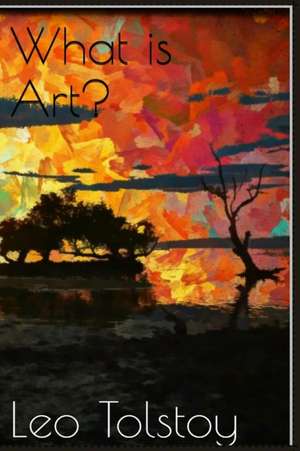
What Is Art?
Autor Leo Tolstoyen Limba Engleză Paperback – 8 ian 2019
Preț: 103.54 lei
Puncte Express: 155
Comandă specială
Livrare economică 03-09 noiembrie
Livrare prin curier în România Termenul estimat este afișat lângă disponibilitate.
Transport gratuit de la 400.00 lei Plată online sau ramburs, în funcție de opțiunile comenzii.
Retur gratuit în 14 zile Comandă securizată și suport în română.
Specificații
ISBN-13: 9781388130060
ISBN-10: 1388130068
Pagini: 278
Dimensiuni: 152 x 229 x 15 mm
Greutate: 0.38 kg
Editura: BLURB INC
ISBN-10: 1388130068
Pagini: 278
Dimensiuni: 152 x 229 x 15 mm
Greutate: 0.38 kg
Editura: BLURB INC
V-ar putea interesa
-
 Art ObjectsJeanette Winterson-20%Preț: 73.68 lei92.13 lei
 -
 A Confession and Other Religious WritingsLeo Tolstoy-31%Preț: 63.27 lei92.36 lei
 -
 Beauty is in the StreetJoachim C. HäberlenPreț: 94.61 lei
 -
 Tolstoy's War and Peace: Philosophical PerspectivesPredrag Cicovacki-21%Preț: 147.45 lei185.57 lei
 -
 Leo Tolstoy: A Very Short IntroductionLiza Knapp-20%Preț: 55.70 lei69.89 lei
 -
 Why Are We 'Artists'?Jessica Lack-29%Preț: 67.09 lei94.78 lei
 -
 The Book of TeaKakuzo Okakura-36%Preț: 18.47 lei29.07 lei
 -
 What Art IsArthur C. DantoPreț: 103.81 lei
 -
 Art Is: A Journey into the LightMakoto FujimuraPreț: 186.87 lei
 -
 Reclaiming Art in the Age of ArtificeJ. F. Martel-26%Preț: 100.29 lei136.33 lei
 -
 The Birth of Tragedy and The Case of WagnerFriedrich NietzschePreț: 78.08 lei
 -
 Tolstoy in Search of Truth and MeaningLeo Tolstoy-18%Preț: 73.13 lei89.33 lei
 -
 Why I Am Not a ChristianBertrand RussellPreț: 106.13 lei
 -
 The Dehumanization of Art and Other Essays on Art, Culture, and LiteratureJosé Ortega Y. GassetPreț: 90.47 lei
 -
 The Abuse of BeautyArthur C. DantoPreț: 135.44 lei
 -
 Preț: 97.91 lei
 -
 Nicomachean EthicsAristotlePreț: 44.60 lei
 -
 Why Art?Eleanor Davis-19%Preț: 81.25 lei100.33 lei
 -
 What Is Art For?Ben LukePreț: 255.84 lei
 -
 Art & Beauty: Drawings by R. CrumbR. Crumb-23%Preț: 161.18 lei209.20 lei
Cuprins
What Is Art? - Leo Tolstoy Translated by Richard Pevear and Larissa Volokhonsky with a Preface by Richard Pevear Preface Bibliographical Note A Note on the Text
WHAT IS ART?Appendix I Appendix II Notes
WHAT IS ART?Appendix I Appendix II Notes
Notă biografică
Count Lev Nikolayevich Tolstoy 9 September [O.S. 28 August] 1828 - 20 November 1910), usually referred to in English as Leo Tolstoy, was a Russian writer who is regarded as one of the greatest authors of all time. He received multiple nominations for the Nobel Prize in Literature every year from 1902 to 1906, and nominations for Nobel Peace Prize in 1901, 1902 and 1910, and the fact that he never won is a major Nobel prize controversy. Born to an aristocratic Russian family in 1828,[3] he is best known for the novels War and Peace (1869) and Anna Karenina (1877), often cited as pinnacles of realist fiction. He first achieved literary acclaim in his twenties with his semi-autobiographical trilogy, Childhood, Boyhood, and Youth (1852-1856), and Sevastopol Sketches (1855), based upon his experiences in the Crimean War. Tolstoy's fiction includes dozens of short stories and several novellas such as The Death of Ivan Ilyich (1886), Family Happiness (1859), and Hadji Murad (1912). He also wrote plays and numerous philosophical essays. In the 1870s Tolstoy experienced a profound moral crisis, followed by what he regarded as an equally profound spiritual awakening, as outlined in his non-fiction work A Confession (1882). His literal interpretation of the ethical teachings of Jesus, centering on the Sermon on the Mount, caused him to become a fervent Christian anarchist and pacifist.[3] Tolstoy's ideas on nonviolent resistance, expressed in such works as The Kingdom of God Is Within You (1894), had a profound impact on such pivotal 20th-century figures as Mahatma Gandhi[9] and Martin Luther King Jr.[10] Tolstoy also became a dedicated advocate of Georgism, the economic philosophy of Henry George, which he incorporated into his writing, particularly Resurrection (1899).
Descriere
Descriere de la o altă ediție sau format:
Leo Tolstoy is one of the most celebrated novelists of all time. As well as writing literary classics such as Anna Karenina and War and Peace he was also the author of some hugely influential critical and philosophical works. First published in 1898 his book length essay What is Art? has lost none of its power to challenge our perception of art and its function in society today. In this provocative work Tolstoy famously dismisses works by Shakespeare, Dante, Wagner and even many of his own works as 'bad art' based on various criteria including sincerity, ethics, morality and accessibility. Tolstoy took art seriously at a time when western civilization toyed with it as a mere pastime during the height of the Aestheticism movement. For him, art was natural and necessary to the advancement of humankind.
In his introduction to this translation, W. Gareth Jones shows how vitally Tolstoy's personality and experiences in life were engaged in creating What is Art?. Jones shows how integral the essay was to his art and teaching, and why it continues to demand a response from us.
Leo Tolstoy is one of the most celebrated novelists of all time. As well as writing literary classics such as Anna Karenina and War and Peace he was also the author of some hugely influential critical and philosophical works. First published in 1898 his book length essay What is Art? has lost none of its power to challenge our perception of art and its function in society today. In this provocative work Tolstoy famously dismisses works by Shakespeare, Dante, Wagner and even many of his own works as 'bad art' based on various criteria including sincerity, ethics, morality and accessibility. Tolstoy took art seriously at a time when western civilization toyed with it as a mere pastime during the height of the Aestheticism movement. For him, art was natural and necessary to the advancement of humankind.
In his introduction to this translation, W. Gareth Jones shows how vitally Tolstoy's personality and experiences in life were engaged in creating What is Art?. Jones shows how integral the essay was to his art and teaching, and why it continues to demand a response from us.