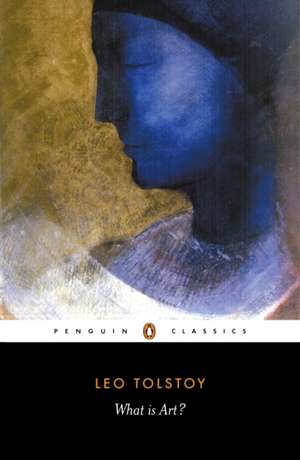
What Is Art?
Autor Leo Tolstoy Traducere de Richard Pevear, Larissa Volokhonskyen Limba Engleză Paperback – 1996
Preț: 57.75 lei
Preț vechi: 78.58 lei
-27%
Puncte Express: 87
Carte disponibilă
Livrare economică 12-18 noiembrie
Livrare express 27-31 octombrie pentru 39.52 lei
Livrare prin curier în România Termenul estimat este afișat lângă disponibilitate.
Transport gratuit de la 400.00 lei Plată online sau ramburs, în funcție de opțiunile comenzii.
Retur gratuit în 14 zile Comandă securizată și suport în română.
Specificații
ISBN-13: 9780140446425
ISBN-10: 0140446427
Pagini: 240
Dimensiuni: 127 x 196 x 14 mm
Greutate: 0.19 kg
Ediția:Revised edition
Editura: Penguin Publishing Group
Locul publicării:London, United Kingdom
ISBN-10: 0140446427
Pagini: 240
Dimensiuni: 127 x 196 x 14 mm
Greutate: 0.19 kg
Ediția:Revised edition
Editura: Penguin Publishing Group
Locul publicării:London, United Kingdom
V-ar putea interesa
-
 Art ObjectsJeanette Winterson-20%Preț: 73.68 lei92.13 lei
 -
 A Confession and Other Religious WritingsLeo Tolstoy-31%Preț: 63.27 lei92.36 lei
 -
 Beauty is in the StreetJoachim C. HäberlenPreț: 94.61 lei
 -
 Tolstoy's War and Peace: Philosophical PerspectivesPredrag Cicovacki-21%Preț: 147.45 lei185.57 lei
 -
 Leo Tolstoy: A Very Short IntroductionLiza Knapp-20%Preț: 55.70 lei69.89 lei
 -
 Why Are We 'Artists'?Jessica Lack-29%Preț: 67.09 lei94.78 lei
 -
 The Book of TeaKakuzo Okakura-36%Preț: 18.47 lei29.07 lei
 -
 What Art IsArthur C. DantoPreț: 103.81 lei
 -
 Art Is: A Journey into the LightMakoto FujimuraPreț: 186.87 lei
 -
 Reclaiming Art in the Age of ArtificeJ. F. Martel-26%Preț: 100.29 lei136.33 lei
 -
 The Birth of Tragedy and The Case of WagnerFriedrich NietzschePreț: 78.08 lei
 -
 Tolstoy in Search of Truth and MeaningLeo Tolstoy-18%Preț: 73.13 lei89.33 lei
 -
 Why I Am Not a ChristianBertrand RussellPreț: 106.13 lei
 -
 The Dehumanization of Art and Other Essays on Art, Culture, and LiteratureJosé Ortega Y. GassetPreț: 90.47 lei
 -
 The Abuse of BeautyArthur C. DantoPreț: 135.44 lei
 -
 Preț: 97.91 lei
 -
 Nicomachean EthicsAristotlePreț: 44.60 lei
 -
 Why Art?Eleanor Davis-19%Preț: 81.25 lei100.33 lei
 -
 What Is Art For?Ben LukePreț: 255.84 lei
 -
 Art & Beauty: Drawings by R. CrumbR. Crumb-23%Preț: 161.18 lei209.20 lei
Cuprins
What Is Art? - Leo Tolstoy Translated by Richard Pevear and Larissa Volokhonsky with a Preface by Richard Pevear Preface Bibliographical Note A Note on the Text
WHAT IS ART?Appendix I Appendix II Notes
WHAT IS ART?Appendix I Appendix II Notes
Descriere
During the decades of his world fame, Tolstoy wrote this series of essays and polemics on issues of morality, social justice and religion. He considered and rejected the idea that art reveals and reinvents through beauty, although he perceived the question of art to be a religious one.