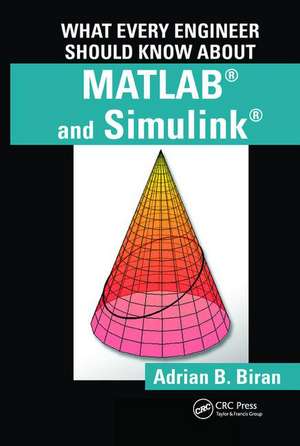
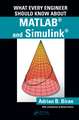
What Every Engineer Should Know about MATLAB® and Simulink®: What Every Engineer Should Know
Autor Adrian B. Biranen Limba Engleză Hardback – 27 iul 2017
Din seria What Every Engineer Should Know
- 15%
 Preț: 433.06 lei
 - 15%
 Preț: 536.60 lei
 -
 Preț: 301.19 lei
 - 15%
 Preț: 560.92 lei
 - 15%
 Preț: 446.52 lei
 - 20%
 Preț: 641.27 lei
 - 15%
 Preț: 530.47 lei
 -
 Preț: 438.89 lei
 - 20%
 Preț: 438.14 lei
 - 20%
 Preț: 386.97 lei
 - 15%
 Preț: 585.45 lei
 - 15%
 Preț: 422.47 lei
 - 20%
 Preț: 1113.53 lei
 -
 Preț: 457.90 lei
 - 20%
 Preț: 421.18 lei
 -
 Preț: 444.59 lei
 - 15%
 Preț: 423.54 lei
 -
 Preț: 327.03 lei
 -
 Preț: 474.33 lei
 - 15%
 Preț: 684.22 lei
 - 18%
 Preț: 1253.73 lei
 - 15%
 Preț: 488.94 lei
 - 15%
 Preț: 601.54 lei
 - 18%
 Preț: 928.58 lei
 - 15%
 Preț: 447.52 lei
 - 15%
 Preț: 473.20 lei
 - 20%
 Preț: 254.16 lei
 - 18%
 Preț: 744.53 lei
 - 18%
 Preț: 787.20 lei
 - 20%
 Preț: 419.80 lei
 - 20%
 Preț: 392.22 lei
 - 20%
 Preț: 745.81 lei
Preț: 1431.89 lei
Preț vechi: 1746.21 lei
-18%
Puncte Express: 2148
Carte tipărită la comandă
Livrare economică 08-22 decembrie
Livrare prin curier în România Termenul estimat este afișat lângă disponibilitate.
Transport gratuit pentru acest produs Plată online sau ramburs, în funcție de opțiunile comenzii.
Retur gratuit în 14 zile Comandă securizată și suport în română.
Specificații
ISBN-13: 9781138422124
ISBN-10: 1138422126
Pagini: 452
Dimensiuni: 156 x 234 mm
Greutate: 1 kg
Ediția:1
Editura: CRC Press
Colecția CRC Press
Seria What Every Engineer Should Know
ISBN-10: 1138422126
Pagini: 452
Dimensiuni: 156 x 234 mm
Greutate: 1 kg
Ediția:1
Editura: CRC Press
Colecția CRC Press
Seria What Every Engineer Should Know
V-ar putea interesa
-
 Applied Numerical Methods for Chemical EngineersNavid Mostoufi-16%Preț: 482.22 lei571.56 lei
 -
 Getting Started with MATLABRudra Pratap-20%Preț: 528.77 lei662.61 lei
 -
 -18%Preț: 527.45 lei646.10 lei
 -
 -28%Preț: 441.61 lei609.58 lei
 -
 MATLAB Programming for Biomedical Engineers and ScientistsAndrew P. King-27%Preț: 365.35 lei499.33 lei
 -
 MATLAB: A Practical Introduction to Programming and Problem SolvingDorothy C. Attaway-40%Preț: 323.08 lei538.16 lei
 -
 Essential MATLAB for Engineers and ScientistsDaniel T. Valentine-40%Preț: 313.12 lei522.49 lei
 -
 Signals and Systems Using MATLAB®Aydin Akan-31%Preț: 676.23 lei981.55 lei
 -
 -31%Preț: 470.25 lei676.70 lei
 -
 MATLAB For Dummies, 2nd EditionJim Sizemore-20%Preț: 165.28 lei206.60 lei
 -
 MATLAB for Engineering Applications ISEWilliam Palm-27%Preț: 363.24 lei494.60 lei
 -
 -26%Preț: 346.79 lei471.01 lei
 -
 Introduction to MATLAB, Global EditionDelores Etter-19%Preț: 423.68 lei523.05 lei
 -
 -23%Preț: 660.63 lei857.96 lei
 -
 Engineering Computations and Modeling in MATLAB/SimulinkOleg A Yakimenko-19%Preț: 628.30 lei775.69 lei
 -
 Signals and Systems with MATLAB® and Simulink®Farzin AsadiPreț: 431.01 lei
 -
 MATLAB Lessons, Examples, and ExercisesMehdi Rahmani-AndebiliPreț: 493.22 lei
 -
 MATLAB and Simulink In-DepthPriyanka Patankar Swapnil Kulkarni-20%Preț: 244.29 lei305.36 lei
Public țintă
Professional Practice & DevelopmentCuprins
I: Introducing MATLABIntroduction to MATLAB. Vectors and matrices. Equations. Processing and publishing the results.II: Programming in MATLABSome facts about numerical computing. Data types and object-oriented programming.III: Progressing in MATLABComplex numbers. Numerical integration. Ordinary differential equations. More graphics. An introduction to Simulink. Applications in the frequency domain. Answers to selected questions. Bibliography. Index.
Notă biografică
Adrian B. Biran is on the faculty of mechanical engineering at the Technion-Israel Institute of Technology. He received his MSc and DSc from that same school, as well as a Diplomat Engineer degree from the Bucharest Polytechnic Institute. He worked extensively in design in Romania at IPRONAV-The Institute of Ship Projects, the Bucharest Studios and IPA-The Institute of Automation Projects. In Israel, he worked in design at the Israel Shipyards, and in research on Naval Architectural subjects at the Technion Research and Development Foundation. In parallel, he worked as a project instructor in Romania at the Technical Military Academy, in Israel at the Beer Sheva University (now the Ben Gurion University). Since 1972, Biran has served as an adjunct teacher in the Faculty of Mechanical Engineering of the Technion, and for the last 15 years as Adjunct Associate Professor. He has taught subjects including Machine Design, Engineering Drawing, and especially Naval Architecture. He has authored several papers on subjects such as computational linguistics and computer simulations of marine systems and subjects belonging to Ship Design. He also wrote a book on ships for popular audience and a book on Ship Hydrostatics and Stability published in English and Turkish. Together with Moshe Breiner he wrote a book on MATLAB for Engineers that was published in three English, three German, two French, and two Greek editions. Moshe Breiner graduated from the Scuola Normale di Pisa and the Universita degli Studi di Pisa and obtained a Ph.D degree from the Harvard Graduate School of Arts and Sciences. He has worked in modeling and simulations and taught MATLAB.
Descriere
Using examples from mathematics, mechanical and electrical engineering, and control and signal processing, this book provides an introduction to MATLAB[registered] and Simulink and examines the advantages and limitations of both.