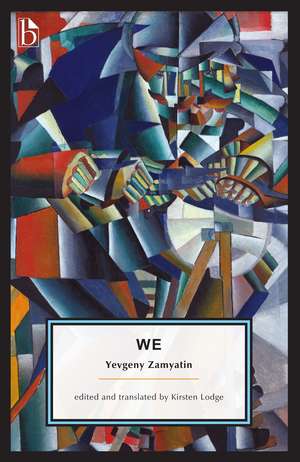
We
Autor Yevgeny Zamyatin Editat de Kirsten Lodgeen Limba Engleză Paperback – 2 dec 2019
Preț: 152.29 lei
Puncte Express: 228
Carte disponibilă
Livrare economică 09-23 noiembrie
Livrare prin curier în România Termenul estimat este afișat lângă disponibilitate.
Transport gratuit de la 400.00 lei Plată online sau ramburs, în funcție de opțiunile comenzii.
Retur gratuit în 14 zile Comandă securizată și suport în română.
Specificații
ISBN-13: 9781554814107
ISBN-10: 1554814103
Pagini: 246
Ilustrații: 12 illustrations
Dimensiuni: 140 x 216 x 12 mm
Greutate: 0.27 kg
Editura: BROADVIEW PR
Colecția Broadview Press
Locul publicării:Peterborough, Canada
ISBN-10: 1554814103
Pagini: 246
Ilustrații: 12 illustrations
Dimensiuni: 140 x 216 x 12 mm
Greutate: 0.27 kg
Editura: BROADVIEW PR
Colecția Broadview Press
Locul publicării:Peterborough, Canada
V-ar putea interesa
-
 Darkness at NoonArthur Koestler-20%Preț: 63.11 lei78.40 lei
 -
 Catch-22: 50th Anniversary EditionJoseph Heller-24%Preț: 61.65 lei80.73 lei
 -
 Weapons of Math DestructionCathy O'Neil-31%Preț: 64.05 lei92.81 lei
 -
 Super ThinkingGabriel Weinberg-23%Preț: 100.90 lei130.35 lei
 -
 The Hair Carpet WeaversAndreas Eschbach-27%Preț: 51.66 lei70.58 lei
 -
 Cat's CradleKurt Vonnegut-27%Preț: 51.87 lei71.22 lei
 -
 One Billion Years to the End of the WorldArkady Strugatsky-28%Preț: 49.88 lei69.52 lei
 -
 RobotAdam Wisniewski-Snerg-26%Preț: 53.07 lei71.92 lei
 -
 The Prime Number ConspiracyThomas Lin-32%Preț: 106.57 lei157.14 lei
 -
 Is This Anything?Jerry Seinfeld-54%Preț: 89.92 lei194.16 lei
 -
 This is Going to HurtAdam Kay-34%Preț: 52.43 lei79.10 lei
 -
 Eat a Peach: A MemoirDavid ChangPreț: 195.88 lei
 -
 She Who Became the SunShelley Parker-Chan-33%Preț: 53.79 lei79.92 lei
 -
 Botanical Art Techniques: A Comprehensive Guide to Watercolor, Graphite, Colored Pencil, Vellum, Pen and Ink, Egg Tempera, Oils, Printmaking, and MoreAmerican Society of Botanical Artists-22%Preț: 216.99 lei278.87 lei
 -
 Rape of the Mind: The Psychology of Thought Control, Menticide & BrainwashingJoost A M Meerloo MDPreț: 122.91 lei
 -
 The Age of Surveillance Capitalism: AN OBSERVER BEST BOOK OF THE CENTURYProfessor Shoshana ZuboffPreț: 91.71 lei
 -
 Ottolenghi FlavuorYotam Ottolenghi-15%Preț: 206.13 lei241.40 lei
 -
 The Ends of the WorldPeter BrannenPreț: 80.46 lei
 -
 Daisy Jones & The SixTaylor Jenkins Reid-17%Preț: 60.62 lei73.16 lei
 -
 -27%Preț: 52.26 lei71.42 lei
 -
 Total RecallArnold Schwarzenegger-14%Preț: 71.69 lei83.48 lei
 -
 Botanical ArtistryJulia TrickeyPreț: 115.15 lei
Recenzii de la cititorii Books Express
Magdalena Dumitrana a dat nota:
Cu una dintre cele mai importante lucrari in zona distopica a literaturii, predecesor al lui Huxley and Orwell, Evghenii Zamiatin, rebel din multe puncte de vedere, poate fi considerat un echivalent al lui Mihail Bulgakov, evident, raportat la tematica abordata. Ceea ce este important de precizat este ca Zamiatin, de fapt, nu a descris viitorul, ci prezentul in care traia in epoca lui Stalin, prezent care s-a continuat, cu note mai blande, in toata perioada comunista. Citit insa ca atare, de cei care nu au cunoscut acea epoca, romanul "Noi" ramane o fantastica lucrare SF care prezice in anii '20 ai secolului trecut, prezentul trait astazi
Recenzii
Yevgeny Zamyatin’s novel We is one of the great classics of dystopian fiction. Experimental and provocative in both style and content, it was the first major literary work to be banned in the Soviet Union. This critical edition features an entirely new annotated translation, as well as an introduction, contextual materials, and images related to the text.
“This new translation of Zamyatin’s We is very well done. Kirsten Lodge has managed very skilfully to produce a readable version of a novel that is in parts deliberately jerky and elliptical in the original; she has found imaginative solutions to the various tricky problems that the text presents. … The introduction and the contextual materials are also useful; this is an edition that introduces the reader to the artistic and historical context as well as to the text itself.” — J.A.E. Curtis, University of Oxford
“Kirsten Lodge’s new edition of Zamyatin’s We is ideal for the classroom: an excellent new translation accompanied by carefully chosen readings and images that place the novel within its proper context.” — Eliot Borenstein, New York University
“Kirsten Lodge has created a teacher’s dream: a definitive English-language edition of Zamyatin’s We that also includes the key texts—literary, political, philosophical, and industrial—to which Zamyatin was responding in this seminal dystopian novel. Lodge’s informative, accessible introduction provides just the right amount of context, explaining how the novel came to be, why it was so groundbreaking, and how it has inspired other dystopian authors from Orwell to Atwood. Lay readers will enjoy delving deeper into the significance of the novel, and teachers will rejoice to have these resources at their students’ fingertips in Lodge’s vivid, readable translations. I look forward to assigning this book in my classes.” — Rebecca Stanton, Barnard College
“For years I have taught these classic Russian texts [Tolstoy’s The Death of Ivan Ilyich, Dostoyevsky’s Notes from the Underground, and Zamyatin’s We] to students with little or no knowledge of Russian language or culture. In addition to providing clear, readable translations of the texts themselves, Lodge’s editions provide critical apparatus—introductions, notes, secondary texts, and images—that have made these stories much more accessible to my students. Contextual material that I have long had to put in handouts and powerpoints is now conveniently included in the text itself. These are certainly the most teachable editions of these texts currently available.” — Chad Engbers, Calvin University
“This new translation of Zamyatin’s We is very well done. Kirsten Lodge has managed very skilfully to produce a readable version of a novel that is in parts deliberately jerky and elliptical in the original; she has found imaginative solutions to the various tricky problems that the text presents. … The introduction and the contextual materials are also useful; this is an edition that introduces the reader to the artistic and historical context as well as to the text itself.” — J.A.E. Curtis, University of Oxford
“Kirsten Lodge’s new edition of Zamyatin’s We is ideal for the classroom: an excellent new translation accompanied by carefully chosen readings and images that place the novel within its proper context.” — Eliot Borenstein, New York University
“Kirsten Lodge has created a teacher’s dream: a definitive English-language edition of Zamyatin’s We that also includes the key texts—literary, political, philosophical, and industrial—to which Zamyatin was responding in this seminal dystopian novel. Lodge’s informative, accessible introduction provides just the right amount of context, explaining how the novel came to be, why it was so groundbreaking, and how it has inspired other dystopian authors from Orwell to Atwood. Lay readers will enjoy delving deeper into the significance of the novel, and teachers will rejoice to have these resources at their students’ fingertips in Lodge’s vivid, readable translations. I look forward to assigning this book in my classes.” — Rebecca Stanton, Barnard College
“For years I have taught these classic Russian texts [Tolstoy’s The Death of Ivan Ilyich, Dostoyevsky’s Notes from the Underground, and Zamyatin’s We] to students with little or no knowledge of Russian language or culture. In addition to providing clear, readable translations of the texts themselves, Lodge’s editions provide critical apparatus—introductions, notes, secondary texts, and images—that have made these stories much more accessible to my students. Contextual material that I have long had to put in handouts and powerpoints is now conveniently included in the text itself. These are certainly the most teachable editions of these texts currently available.” — Chad Engbers, Calvin University
Cuprins
Introduction
In Context
- The Context of We
- Literary Approaches to We
- A Note on the Text and Translation
In Context
- Work, Productivity, and “Scientific Management”
- from Frederick Winslow Taylor, The Principles of Scientific Management (1911)
- from Vladimir Lenin, The Immediate Tasks of the Soviet Governement (1918)
- from Aleksei Gastev, On the Tendencies of Proletarian Culture (1919)
- Proletarian Poetry
- Vladimir Kirillov, “We” (1917)
- Aleksei Gastev, “We Grow Out of Iron” (1918)
- Aleksei Gastev, “Whistles” (1918)
- Aleksei Gastev, “To a Speaker” (1919)
- Vladimir Kirillov, “The World Collective” (1918)
- Ivan Logimov, “We Are the First Peals of Thunder” (1919)
- Aleksei Mashirov-Samobytnik, “Follow Us!” (1919)
- Vasily Aleksandrovsky, “Workers’ Holiday” (1921)
- H.G. Wells
- from H.G. Wells, Anticipations of the Reaction of Mechanical and Scientific Progress upon Human Life and Thought, Chapter 9: “The Faith, Morals, and Public Policy of the New Republic” (1901)
- from H.G. Wells, “Scepticism of the Instrument” (1903)
- from H.G. Wells, A Modern Utopia (1905)
- Early Reception of We
- from Aleksandr Voronsky, “Literary Portraits: Yevgeny Zamyatin” (1922)
- Zamyatin on We
- from Yevgeny Zamyatin, “On Literature, Revolution, Entropy, Etc.” (1923)
- Images
- Early Twentieth-Century Visual Art
- Early Soviet Posters
- Images of Zamyatin
Textul de pe ultima copertă
Before Brave New World...
Before 1984...There was...
WE
In the One State of the great Benefactor, there are no individuals, only numbers. Life is an ongoing process of mathematical precision, a perfectly balanced equation. Primitive passions and instincts have been subdued. Even nature has been defeated, banished behind the Green Wall. But one frontier remains: outer space. Now, with the creation of the spaceship Integral, that frontier -- and whatever alien species are to be found there -- will be subjugated to the beneficent yoke of reason.
One number, D-503, chief architect of the Integral, decides to record his thoughts in the final days before the launch for the benefit of less advanced societies. But a chance meeting with the beautiful 1-330 results in an unexpected discovery that threatens everything D-503 believes about himself and the One State. The discovery -- or rediscovery -- of inner space...and that disease the ancients called the soul.
A page-turning SF adventure, a masterpiece of wit and black humor that accurately predicted the horrors of Stalinism, We is the classic dystopian novel. Its message of hope and warning is as timely at the end of the twentieth century as it was at the beginning.
Before 1984...There was...
WE
In the One State of the great Benefactor, there are no individuals, only numbers. Life is an ongoing process of mathematical precision, a perfectly balanced equation. Primitive passions and instincts have been subdued. Even nature has been defeated, banished behind the Green Wall. But one frontier remains: outer space. Now, with the creation of the spaceship Integral, that frontier -- and whatever alien species are to be found there -- will be subjugated to the beneficent yoke of reason.
One number, D-503, chief architect of the Integral, decides to record his thoughts in the final days before the launch for the benefit of less advanced societies. But a chance meeting with the beautiful 1-330 results in an unexpected discovery that threatens everything D-503 believes about himself and the One State. The discovery -- or rediscovery -- of inner space...and that disease the ancients called the soul.
A page-turning SF adventure, a masterpiece of wit and black humor that accurately predicted the horrors of Stalinism, We is the classic dystopian novel. Its message of hope and warning is as timely at the end of the twentieth century as it was at the beginning.
Notă biografică
Yevgeny Zamyatin (1884-1937) was a Russian author of science fiction and political satire. The son of a Russian Orthodox priest and a musician, Zamyatin studied engineering in Saint Petersburg from 1902 until 1908 in order to serve in the Russian Imperial Navy. During this time, however, he became disillusioned with Tsarist policy and Christianity, turning to Atheism and Bolshevism instead. He was arrested in 1905 during a meeting at a local revolutionary headquarters and was released after a year of torture and solitary confinement. Unable to bear life as an internal exile, Zamyatin fled to Finland before returning to St. Petersburg under an alias, at which time he began writing works of fiction. Arrested once more in 1911, Zamyatin was released and pardoned in 1913, publishing his satire of small-town Russia, A Provincial Tale, to resounding acclaim. Completing his engineering studies, he was sent by the Imperial Russian Navy to England to oversee the development of icebreakers in shipyards along the coast of the North Sea. There, he gathered source material for The Islanders (1918) a satire of English life, before returning to St. Petersburg in 1917 to embark on his literary career in earnest. As the Russian Civil War plunged the country into chaos, Zamyatin became increasingly critical of the Communist Party of the Soviet Union, leading to his eventual exile. Between 1920 and 1921, he wrote We (1924), a dystopian novel set in a futuristic totalitarian state. Thought to be influential for the works of George Orwell and Aldous Huxley, We is a groundbreaking work of science fiction that earned Zamyatin a reputation as a leading political dissident of his time. With the help of Maxim Gorky, Zamyatin obtained a passport and was permitted to leave the Soviet Union in 1931. Settling in Paris, he spent the rest of his life in exile and deep poverty.