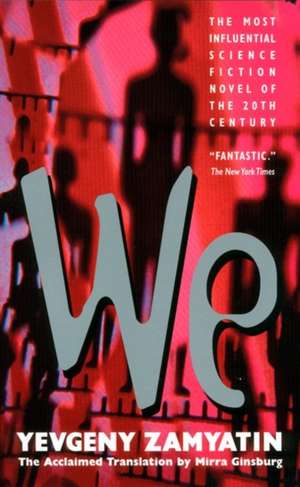
We
Autor Yevgeny Zamyatin Traducere de Mirra Ginsburgen Limba Engleză Paperback – 31 iul 1983
In the One State of the great Benefactor, there are no individuals, only numbers. Life is an ongoing process of mathematical precision, a perfectly balanced equation. Primitive passions and instincts have been subdued. Even nature has been defeated, banished behind the Green Wall. But one frontier remains: outer space. Now, with the creation of the spaceship Integral, that frontier -- and whatever alien species are to be found there -- will be subjugated to the beneficent yoke of reason.
One number, D-503, chief architect of the Integral, decides to record his thoughts in the final days before the launch for the benefit of less advanced societies. But a chance meeting with the beautiful 1-330 results in an unexpected discovery that threatens everything D-503 believes about himself and the One State. The discovery -- or rediscovery -- of inner space...and that disease the ancients called the soul.
Preț: 46.09 lei
Carte disponibilă
Livrare economică 06-20 iulie
Livrare express 19-25 iunie pentru 29.85 lei
Specificații
ISBN-10: 0380633132
Pagini: 256
Dimensiuni: 106 x 171 x 16 mm
Greutate: 0.11 kg
Ediția:Reprint
Editura: HarperCollins Publishers
Colecția HarperVoyager
V-ar putea interesa
-
 Darkness at NoonArthur Koestler-21%Preț: 60.85 lei77.18 lei
 -
 Catch-22: 50th Anniversary EditionJoseph Heller-18%Preț: 59.93 lei72.94 lei
 -
 Weapons of Math DestructionCathy O'Neil-32%Preț: 61.70 lei91.35 lei
 -
 Super ThinkingGabriel Weinberg-19%Preț: 97.98 lei121.68 lei
 -
 The Hair Carpet WeaversAndreas Eschbach-28%Preț: 49.67 lei69.00 lei
 -
 Cat's CradleKurt Vonnegut-29%Preț: 48.70 lei68.42 lei
 -
 One Billion Years to the End of the WorldArkady Strugatsky-29%Preț: 49.26 lei69.64 lei
 -
 RobotAdam Wisniewski-Snerg-28%Preț: 51.14 lei70.77 lei
 -
 The Prime Number ConspiracyThomas Lin-33%Preț: 105.21 lei157.43 lei
 -
 Is This Anything?Jerry Seinfeld-55%Preț: 86.69 lei191.12 lei
 -
 This is Going to HurtAdam Kay-35%Preț: 50.52 lei77.88 lei
 -
 Eat a Peach: A MemoirDavid ChangPreț: 193.08 lei
 -
 She Who Became the SunShelley Parker-Chan-34%Preț: 51.84 lei78.67 lei
 -
 Botanical Art Techniques: A Comprehensive Guide to Watercolor, Graphite, Colored Pencil, Vellum, Pen and Ink, Egg Tempera, Oils, Printmaking, and MoreAmerican Society of Botanical Artists-23%Preț: 199.38 lei260.34 lei
 -
 Rape of the Mind: The Psychology of Thought Control, Menticide & BrainwashingJoost A M Meerloo MDPreț: 119.82 lei
 -
 The Age of Surveillance Capitalism: AN OBSERVER BEST BOOK OF THE CENTURYProfessor Shoshana Zuboff-18%Preț: 77.89 lei94.82 lei
 -
 Ottolenghi FlavuorYotam Ottolenghi-16%Preț: 198.60 lei237.62 lei
 -
 The Ends of the WorldPeter BrannenPreț: 79.21 lei
 -
 Daisy Jones & The SixTaylor Jenkins Reid-19%Preț: 58.39 lei72.01 lei
 -
 Oates, J: PursuitJoyce Carol Oates-28%Preț: 48.83 lei68.04 lei
 -
 Total RecallArnold Schwarzenegger-16%Preț: 69.11 lei82.17 lei
 -
 Botanical ArtistryJulia TrickeyPreț: 113.34 lei
Recenzii de la cititorii Books Express
Magdalena Dumitrana a dat nota:
Cu una dintre cele mai importante lucrari in zona distopica a literaturii, predecesor al lui Huxley and Orwell, Evghenii Zamiatin, rebel din multe puncte de vedere, poate fi considerat un echivalent al lui Mihail Bulgakov, evident, raportat la tematica abordata. Ceea ce este important de precizat este ca Zamiatin, de fapt, nu a descris viitorul, ci prezentul in care traia in epoca lui Stalin, prezent care s-a continuat, cu note mai blande, in toata perioada comunista. Citit insa ca atare, de cei care nu au cunoscut acea epoca, romanul "Noi" ramane o fantastica lucrare SF care prezice in anii '20 ai secolului trecut, prezentul trait astazi
Textul de pe ultima copertă
Before 1984...There was...
WE
In the One State of the great Benefactor, there are no individuals, only numbers. Life is an ongoing process of mathematical precision, a perfectly balanced equation. Primitive passions and instincts have been subdued. Even nature has been defeated, banished behind the Green Wall. But one frontier remains: outer space. Now, with the creation of the spaceship Integral, that frontier -- and whatever alien species are to be found there -- will be subjugated to the beneficent yoke of reason.
One number, D-503, chief architect of the Integral, decides to record his thoughts in the final days before the launch for the benefit of less advanced societies. But a chance meeting with the beautiful 1-330 results in an unexpected discovery that threatens everything D-503 believes about himself and the One State. The discovery -- or rediscovery -- of inner space...and that disease the ancients called the soul.
A page-turning SF adventure, a masterpiece of wit and black humor that accurately predicted the horrors of Stalinism, We is the classic dystopian novel. Its message of hope and warning is as timely at the end of the twentieth century as it was at the beginning.
Notă biografică
Yevgeny Zamyatin was born in Russia in 1884. Arrested during the abortive 1905 revolution, he was exiled twice from St. Petersburg, then given amnesty in 1913. We, composed in 1920 and 1921, elicited attacks from party-line critics and writers. In 1929, the Russian Association of Proletarian Writers launched an all-out attack against him. Denied the right to publish his work, he requested permission to leave Russia, which Stalin granted in 1931. Zamyatin went to Paris, where he died in 1937.
Mirra Ginsburg is a distinguished translator of Russian and Yiddish works by such well-known authors as Mikhail Bulgakov, Isaac Babel, Isaac Bashevis Singer, and Fyodor Dostoevsky. Editor and translator of three anthologies of Soviet science fiction, she has also edited and translated A Soviet Heretic: Essays by Yevgeny Zamyatin, and History of Soviet Literature by Vera Alexandrova.
Recenzii
— New York Times Book Review
"The founding document of dystopian literature, written in the Soviet Union in 1921, comes in for a fresh translation. . . . Zamyatin’s all-seeing state is sufficiently chilling. . . . Translator Shayevich does a good job of preserving [Zamyatin's] affectless, sometimes nearly robotic prose, and the book is highly readable—and indeed should be read. A science-fiction classic, many of whose contours have become all too real." — Kirkus Reviews (starred review)
Descriere
The One State is the perfect society, ruled over by the enlightened Benefactor. It is a city made almost entirely of glass, where surveillance is universal and life runs according to algorithmic rules to ensure perfect happiness. And D-503, the Builder, is the ideal citizen, at least until he meets I-330, who opens his eyes to new ideas of love, sex and freedom.
A foundational work of dystopian fiction, inspiration for both Orwell's Nineteen Eighty-Four and Huxley's Brave New World, We is a book of radical imaginings - of control and rebellion, surveillance and power, machine intelligence and human inventiveness, sexuality and desire. It is both a warning and a hope for a better world.
This new edition also includes Ursula K. Le Guin's essay 'The Stalin in the Soul' on the enduring influence of Zamyatin's masterpiece, and George Orwell's 1946 review of We.