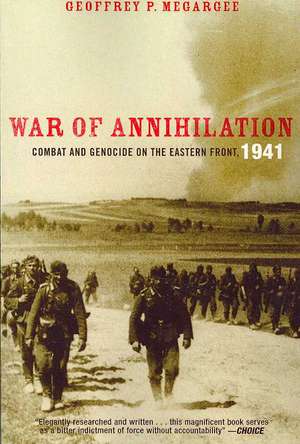
War of Annihilation: Combat and Genocide on the Eastern Front, 1941: Rowman & Littlefield Publishers
Autor Geoffrey P. Megargeeen Limba Engleză Paperback – 16 oct 2007
In War of Annihilation, noted military historian Geoffrey P. Megargee provides a clear, concise history of the Germans' opening campaign of conquest and genocide in 1941. By drawing on the best of military and Holocaust scholarship, Megargee dispels the myths that have distorted the role of Germany's military leadership in both the military operations themselves and the unthinkable crimes that were part of them.
Din seria Rowman & Littlefield Publishers
-
 Preț: 113.82 lei
 - 13%
 Preț: 155.38 lei
 -
 Preț: 109.93 lei
 - 20%
 Preț: 370.93 lei
 - 19%
 Preț: 323.76 lei
 - 26%
 Preț: 223.03 lei
 - 19%
 Preț: 321.01 lei
 - 21%
 Preț: 307.35 lei
 - 20%
 Preț: 190.98 lei
 - 24%
 Preț: 255.02 lei
 - 16%
 Preț: 109.26 lei
 - 31%
 Preț: 351.69 lei
 - 15%
 Preț: 127.13 lei
 - 23%
 Preț: 320.61 lei
 - 19%
 Preț: 324.21 lei
 - 30%
 Preț: 355.24 lei
 - 23%
 Preț: 258.39 lei
 -
 Preț: 400.51 lei
 - 23%
 Preț: 275.97 lei
 - 24%
 Preț: 275.28 lei
 - 31%
 Preț: 351.50 lei
 - 22%
 Preț: 323.28 lei
 - 32%
 Preț: 373.39 lei
 - 34%
 Preț: 842.33 lei
 - 19%
 Preț: 314.30 lei
 - 23%
 Preț: 354.68 lei
 - 21%
 Preț: 128.84 lei
 - 30%
 Preț: 774.75 lei
 - 23%
 Preț: 278.65 lei
 - 23%
 Preț: 259.97 lei
 - 19%
 Preț: 344.02 lei
 - 32%
 Preț: 594.45 lei
 - 31%
 Preț: 566.85 lei
 - 22%
 Preț: 358.54 lei
 - 19%
 Preț: 322.03 lei
 - 16%
 Preț: 148.06 lei
 - 22%
 Preț: 360.79 lei
 - 19%
 Preț: 323.37 lei
 - 31%
 Preț: 414.61 lei
 - 25%
 Preț: 344.18 lei
 - 30%
 Preț: 703.64 lei
 - 14%
 Preț: 152.49 lei
 - 30%
 Preț: 827.47 lei
 - 19%
 Preț: 316.66 lei
 - 23%
 Preț: 276.77 lei
 - 29%
 Preț: 709.89 lei
 - 23%
 Preț: 262.16 lei
 - 19%
 Preț: 335.82 lei
Preț: 147.80 lei
Preț vechi: 176.13 lei
-16%
Puncte Express: 222
Carte tipărită la comandă
Livrare economică 23 noiembrie-07 decembrie
Livrare prin curier în România Termenul estimat este afișat lângă disponibilitate.
Transport gratuit de la 400.00 lei Plată online sau ramburs, în funcție de opțiunile comenzii.
Retur gratuit în 14 zile Comandă securizată și suport în română.
Specificații
ISBN-13: 9780742544826
ISBN-10: 0742544826
Pagini: 208
Dimensiuni: 155 x 233 x 11 mm
Greutate: 0.32 kg
Editura: Bloomsbury Publishing
Colecția Rowman & Littlefield
Seria Rowman & Littlefield Publishers
Locul publicării:New York, United States
ISBN-10: 0742544826
Pagini: 208
Dimensiuni: 155 x 233 x 11 mm
Greutate: 0.32 kg
Editura: Bloomsbury Publishing
Colecția Rowman & Littlefield
Seria Rowman & Littlefield Publishers
Locul publicării:New York, United States
V-ar putea interesa
-
 The Scarlet SistersHelen Batten-19%Preț: 76.21 lei93.61 lei
 -
 The Wars of the RosesDan JonesPreț: 115.52 lei
 -
 -62%Preț: 68.65 lei182.93 lei
 -
 In These TimesJenny UglowPreț: 124.96 lei
 -
 A Street in ArnhemRobert J KershawPreț: 81.12 lei
 -
 Preț: 127.93 lei
 -
 Brunel's KingdomJohn ChristopherPreț: 139.50 lei
 -
 LionheartDouglas BoydPreț: 97.66 lei
 -
 Prince Harry: Brother. Soldier. Son. Husband.Penny Junor-25%Preț: 60.01 lei80.09 lei
 -
 JosephineAndrea Stuart-16%Preț: 117.30 lei140.39 lei
 -
 The Essential Diaz: Selections from The Conquest of New SpainBernal Diaz Del Castillo-17%Preț: 94.92 lei114.43 lei
Cuprins
Chapter 1: The Roots of the War of Annihilation
Chapter 2: Plans and Preparations, 1940-1941
Chapter 3: Initial Victories and Atrocities, June to August
Chapter 4: The Second Phase: Expanding Conquests and Genocide, August to October
Chapter 5: The Final Drive on Moscow and Systematic Killing, October to December
Chapter 6: Failure and Its Consequences, to Early 1942
Conclusion
Bibliographic Essay
Appendix 1: The Levels of Command
Appendix 2: Principal German Army Commands and Staffs on June 22, 1941
Chapter 2: Plans and Preparations, 1940-1941
Chapter 3: Initial Victories and Atrocities, June to August
Chapter 4: The Second Phase: Expanding Conquests and Genocide, August to October
Chapter 5: The Final Drive on Moscow and Systematic Killing, October to December
Chapter 6: Failure and Its Consequences, to Early 1942
Conclusion
Bibliographic Essay
Appendix 1: The Levels of Command
Appendix 2: Principal German Army Commands and Staffs on June 22, 1941
Recenzii
Balancing his presentations of the front line and the rear areas, Megargee integrates the strategic, operational, and ideological aspects of Germany's 1941 invasion of Russia into what is both an excellent introduction to, and a superior analysis of, Operation Barbarossa.
Dr. Geoffrey Megargee has written an extraordinary account of the Wehrmacht's wholehearted cooperation in the drastic radicalization of the Final Solution in the course of Operation Barbarossa, the invasion of the Soviet Union in 1941. Combining his own research and the revolution in scholars' understanding of the German Army's participation in the Third Reich's crimes, he has provided us with an account that is both gripping and grim.
Megargee has written an extremely important book, firmly linking the German army to the criminal regime it served. It is essential reading for students of World War II.
It is about time for a careful survey of the initial stage of the German invasion of the Soviet Union that combines the military and ideological aspects of the titanic conflict, deals with them in their relationship with each other, and does so on the basis of current literature that all too often treats them in isolation from each other. Here it is.
In the popular mind, German generals have often escaped responsibility for both the failure of the Blitzkrieg in the east and its criminal nature. Megargee is to be lauded for this succinctly written book. He provides a much-needed and eminently readable correction to both images. This study is an invaluable contribution to the history of Operation Barbarossa and its singular linkage between strategy and mass murder. It can be highly recommended to all those who wish to bring themselves up to date on this most important aspect of the Russo-German war.
Geoffrey Megargee provides a splendidly succinct double context for understanding the Nazi 'war of annihilation' in the east and the emergence of the Final Solution. First, he explores the relationship between the Nazi regime and the Wehrmacht, with particular attention to shared ideological values and mistaken expectations concerning the waging of war in general and the campaign against the Soviet Union in particular. Second, he demonstrates how the mass murder of Soviet Jewry was embedded in sweeping and pervasive criminal occupation policies that also victimized millions of POWs and non-Jewish civilians. In so doing, he lays waste to what he aptly terms 'the dual myth of German military genius and moral correctness.'
Elegantly researched and written . . . this magnificent book serves as a bitter indictment of force without accountability and ranks as a cautionary saga of how this war of aggression ground to a halt. Highly recommended.
Provides readers with thorough information and a good deal of up-to-date analysis, underlining popularly overlooked connections between German warfare and mass murders that belong to the most notorious in history.
An excellent synthesis . . . that manages to be both concise and yet surprisingly substantive. . . . Geoffrey Megargee has written a very fine, readable survey of the first six months of the Nazi-Soviet war, one that effectively demonstrates the relationships, on any number of levels, between the military sphere of strategy and operations and the political imperative, which encompassed ideology, economics, culture, and racial policy.
Megargee's book appears particularly useful for the college classroom. His style is clear and concise.
Combining evidence from untapped German documents and the wealth of scholarship on the Eastern Front, Geoffrey Megargee, of the Holocaust Memorial Museum, provides a concise and quite comprehensive look at the German campaign against Russia. . . . The book looks at events both at the front and behind it, providing detailed, grim evidence directly from German sources. War of Annihilation is an essential work for anyone with an interest in the Second World War.
Dr. Geoffrey Megargee has written an extraordinary account of the Wehrmacht's wholehearted cooperation in the drastic radicalization of the Final Solution in the course of Operation Barbarossa, the invasion of the Soviet Union in 1941. Combining his own research and the revolution in scholars' understanding of the German Army's participation in the Third Reich's crimes, he has provided us with an account that is both gripping and grim.
Megargee has written an extremely important book, firmly linking the German army to the criminal regime it served. It is essential reading for students of World War II.
It is about time for a careful survey of the initial stage of the German invasion of the Soviet Union that combines the military and ideological aspects of the titanic conflict, deals with them in their relationship with each other, and does so on the basis of current literature that all too often treats them in isolation from each other. Here it is.
In the popular mind, German generals have often escaped responsibility for both the failure of the Blitzkrieg in the east and its criminal nature. Megargee is to be lauded for this succinctly written book. He provides a much-needed and eminently readable correction to both images. This study is an invaluable contribution to the history of Operation Barbarossa and its singular linkage between strategy and mass murder. It can be highly recommended to all those who wish to bring themselves up to date on this most important aspect of the Russo-German war.
Geoffrey Megargee provides a splendidly succinct double context for understanding the Nazi 'war of annihilation' in the east and the emergence of the Final Solution. First, he explores the relationship between the Nazi regime and the Wehrmacht, with particular attention to shared ideological values and mistaken expectations concerning the waging of war in general and the campaign against the Soviet Union in particular. Second, he demonstrates how the mass murder of Soviet Jewry was embedded in sweeping and pervasive criminal occupation policies that also victimized millions of POWs and non-Jewish civilians. In so doing, he lays waste to what he aptly terms 'the dual myth of German military genius and moral correctness.'
Elegantly researched and written . . . this magnificent book serves as a bitter indictment of force without accountability and ranks as a cautionary saga of how this war of aggression ground to a halt. Highly recommended.
Provides readers with thorough information and a good deal of up-to-date analysis, underlining popularly overlooked connections between German warfare and mass murders that belong to the most notorious in history.
An excellent synthesis . . . that manages to be both concise and yet surprisingly substantive. . . . Geoffrey Megargee has written a very fine, readable survey of the first six months of the Nazi-Soviet war, one that effectively demonstrates the relationships, on any number of levels, between the military sphere of strategy and operations and the political imperative, which encompassed ideology, economics, culture, and racial policy.
Megargee's book appears particularly useful for the college classroom. His style is clear and concise.
Combining evidence from untapped German documents and the wealth of scholarship on the Eastern Front, Geoffrey Megargee, of the Holocaust Memorial Museum, provides a concise and quite comprehensive look at the German campaign against Russia. . . . The book looks at events both at the front and behind it, providing detailed, grim evidence directly from German sources. War of Annihilation is an essential work for anyone with an interest in the Second World War.