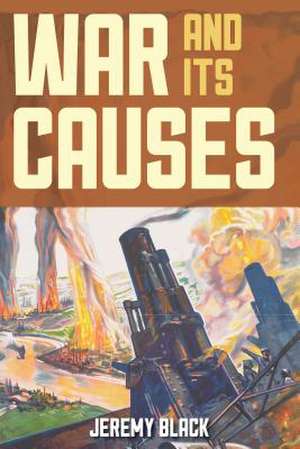
War and Its Causes
Autor Jeremy Blacken Limba Engleză Paperback – 21 ian 2019
Preț: 221.62 lei
Preț vechi: 293.60 lei
-25%
Puncte Express: 332
Carte tipărită la comandă
Livrare economică 27 noiembrie-11 decembrie
Livrare prin curier în România Termenul estimat este afișat lângă disponibilitate.
Transport gratuit de la 400.00 lei Plată online sau ramburs, în funcție de opțiunile comenzii.
Retur gratuit în 14 zile Comandă securizată și suport în română.
Specificații
ISBN-13: 9781538117910
ISBN-10: 1538117916
Pagini: 312
Dimensiuni: 154 x 232 x 15 mm
Greutate: 0.38 kg
Editura: Bloomsbury Publishing
Colecția Rowman & Littlefield
Locul publicării:New York, United States
ISBN-10: 1538117916
Pagini: 312
Dimensiuni: 154 x 232 x 15 mm
Greutate: 0.38 kg
Editura: Bloomsbury Publishing
Colecția Rowman & Littlefield
Locul publicării:New York, United States
V-ar putea interesa
-
 Forgotten Battles: Italy's War of Liberation, 1943-1945Charles T. O'Reilly-35%Preț: 806.27 lei1243.99 lei
 -
 Manipulating Images: World War II Mobilization of Women through Magazine AdvertisingTawnya J. Adkins Covert-29%Preț: 343.37 lei482.84 lei
 -
 Stalin's Other War: Soviet Grand Strategy, 1939-1941Albert L. Weeks-22%Preț: 328.37 lei423.47 lei
 -
 -30%Preț: 355.69 lei508.87 lei
 -
 Blundering to Glory: Napoleon's Military CampaignsOwen Connelly-23%Preț: 285.29 lei368.59 lei
 -
 My War Gone By, I Miss It SoAnthony LoydPreț: 107.58 lei
 -
 -36%Preț: 1383.86 lei2160.76 lei
 -
 The Jehovah's Witnesses and the NazisMichel ReynaudPreț: 229.41 lei
 -
 Preț: 170.37 lei
 -
 Preț: 164.90 lei
 -
 A Crucible of FireRichard FeltoePreț: 114.19 lei
 -
 Scream of EaglesRobert K. WilcoxPreț: 118.70 lei
 -
 Disarming DiplomatGerard C SmithPreț: 265.92 lei
 -
 New Armies from OldRoy Licklider-27%Preț: 1030.80 lei1412.06 lei
 -
 A Brass Hat in No Man's LandBrig General F. P. CrozierPreț: 149.49 lei
 -
 Memoirs of a Camp FollowerPhilip GossePreț: 156.55 lei
 -
 Preț: 160.57 lei
 -
 CROSS OF SACRIFICE.Vol. 3Sd JarvisPreț: 257.93 lei
 -
 MEMOIRS OF SIR LOWRY COLEEdited Maude Lowry ColePreț: 153.42 lei
Cuprins
Abbreviations
Preface
1 What Is War?
2 To 1500
3 War, 1500-1650
4 Limited War? 1650-1790
5 Imperialism and Revolutions, 1790-1913
6 World War I and Its Sequel, 1914-30
7 World War II and Its Origins, 1931-45
8 The Age of the Cold War, 1946-89
9 War since the Cold War, 1990-
10 Into the Future
11 Conclusions
Selected Further Reading
About the Author
Preface
1 What Is War?
2 To 1500
3 War, 1500-1650
4 Limited War? 1650-1790
5 Imperialism and Revolutions, 1790-1913
6 World War I and Its Sequel, 1914-30
7 World War II and Its Origins, 1931-45
8 The Age of the Cold War, 1946-89
9 War since the Cold War, 1990-
10 Into the Future
11 Conclusions
Selected Further Reading
About the Author
Recenzii
A fascinating account of war as an institution by one of the preeminent students of the subject. By examining wars in their evolving cultural, political, and technological settings, Black offers important insights into the current practice of the use of force by states and intelligent speculation about the future.
A wide-ranging, ambitious, and thought-provoking account of the history of war as a concept and a phenomenon. Jeremy Black sheds new light on a question of ongoing relevance, using the past to help us understand war today-and in the future.
From Thucydides to Mary Kaldor, from Ming and Qing China to Donald Trump's America, from the 'Great Mutiny' of 1857-59 to the July crisis of 1914, Jeremy Black offers the first treatment on a universal scale of a major historical problem. By one of the most accredited historians of war, this is a work rich in thoughts and information.
Jeremy Black's War and Its Causes is a sweeping and highly informed history of war from pre-history to the present with a detailed analysis of wars from 1500 on. It brings in the latest diplomatic history, as well as insights from social and cultural history. While not everyone will agree with his views, they are always thought-provoking and illustrated with many examples. Social scientists, in particular, will find this book very useful in their research and teaching. It is highly readable but well documented. Another gem!
War can range from tribal conflict to global conflagration. The benefit of such a broad definition is its explanatory power, but its lack of clarity can erode its usefulness. Jeremy Black's most recent book looks to provide some clarity and thus better understand war. He also seeks to place this understanding of war in a global context, not limited by geography or chronology.. . . . Black effectively argues that some historical models are too narrow, in terms of both geography and time.
Sherman was right: War is hell. If we accept and take Sherman's comment at face value, we should consider Black's book, War and Its Causes, as valid without being questioned. Black started his book with a blank canvas but has left us with an image that is carefully crafted and offers a needed perspective on the causes of war. And, if we substitute reality for perception, we also might have a better idea about the effects of war. No one really wins. Indeed, war is hell.
A wide-ranging, ambitious, and thought-provoking account of the history of war as a concept and a phenomenon. Jeremy Black sheds new light on a question of ongoing relevance, using the past to help us understand war today-and in the future.
From Thucydides to Mary Kaldor, from Ming and Qing China to Donald Trump's America, from the 'Great Mutiny' of 1857-59 to the July crisis of 1914, Jeremy Black offers the first treatment on a universal scale of a major historical problem. By one of the most accredited historians of war, this is a work rich in thoughts and information.
Jeremy Black's War and Its Causes is a sweeping and highly informed history of war from pre-history to the present with a detailed analysis of wars from 1500 on. It brings in the latest diplomatic history, as well as insights from social and cultural history. While not everyone will agree with his views, they are always thought-provoking and illustrated with many examples. Social scientists, in particular, will find this book very useful in their research and teaching. It is highly readable but well documented. Another gem!
War can range from tribal conflict to global conflagration. The benefit of such a broad definition is its explanatory power, but its lack of clarity can erode its usefulness. Jeremy Black's most recent book looks to provide some clarity and thus better understand war. He also seeks to place this understanding of war in a global context, not limited by geography or chronology.. . . . Black effectively argues that some historical models are too narrow, in terms of both geography and time.
Sherman was right: War is hell. If we accept and take Sherman's comment at face value, we should consider Black's book, War and Its Causes, as valid without being questioned. Black started his book with a blank canvas but has left us with an image that is carefully crafted and offers a needed perspective on the causes of war. And, if we substitute reality for perception, we also might have a better idea about the effects of war. No one really wins. Indeed, war is hell.
Notă biografică
Jeremy Black is Professor of History at the University of Exeter, UK, and a Senior Fellow at the Center for the Study of America and the West at the Foreign Policy Research Institute in Philadelphia, USA.