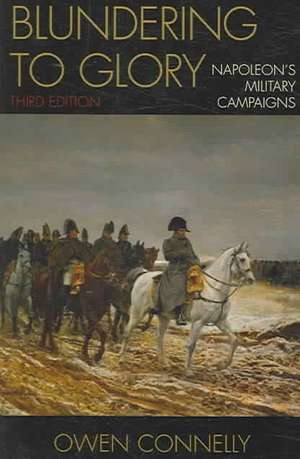
Blundering to Glory: Napoleon's Military Campaigns: Rowman & Littlefield Publishers
Autor Owen Connellyen Limba Engleză Paperback – 2 iun 2006
Din seria Rowman & Littlefield Publishers
-
 Preț: 113.89 lei
 - 13%
 Preț: 155.38 lei
 -
 Preț: 109.93 lei
 - 20%
 Preț: 370.93 lei
 - 19%
 Preț: 323.76 lei
 - 25%
 Preț: 228.52 lei
 - 19%
 Preț: 328.78 lei
 - 28%
 Preț: 148.13 lei
 - 20%
 Preț: 191.09 lei
 - 24%
 Preț: 255.02 lei
 - 16%
 Preț: 109.26 lei
 - 31%
 Preț: 351.69 lei
 - 15%
 Preț: 127.13 lei
 - 22%
 Preț: 330.19 lei
 - 19%
 Preț: 324.21 lei
 - 30%
 Preț: 355.24 lei
 - 23%
 Preț: 258.39 lei
 -
 Preț: 402.96 lei
 - 23%
 Preț: 282.77 lei
 - 24%
 Preț: 275.28 lei
 - 31%
 Preț: 351.50 lei
 - 22%
 Preț: 331.09 lei
 - 32%
 Preț: 373.39 lei
 - 34%
 Preț: 842.33 lei
 - 19%
 Preț: 314.30 lei
 - 23%
 Preț: 363.28 lei
 - 21%
 Preț: 128.84 lei
 - 30%
 Preț: 774.75 lei
 - 23%
 Preț: 278.65 lei
 - 22%
 Preț: 266.38 lei
 - 19%
 Preț: 344.02 lei
 - 32%
 Preț: 594.45 lei
 - 31%
 Preț: 566.85 lei
 - 22%
 Preț: 367.22 lei
 - 19%
 Preț: 322.03 lei
 - 16%
 Preț: 148.06 lei
 - 21%
 Preț: 369.53 lei
 - 19%
 Preț: 323.37 lei
 - 20%
 Preț: 314.77 lei
 - 30%
 Preț: 424.70 lei
 - 25%
 Preț: 344.18 lei
 - 30%
 Preț: 703.64 lei
 - 14%
 Preț: 152.49 lei
 - 30%
 Preț: 847.72 lei
 - 19%
 Preț: 316.66 lei
 - 23%
 Preț: 283.57 lei
 - 29%
 Preț: 727.24 lei
 - 23%
 Preț: 262.16 lei
 - 19%
 Preț: 343.92 lei
Preț: 285.29 lei
Preț vechi: 368.59 lei
-23%
Puncte Express: 428
Carte tipărită la comandă
Livrare economică 04-18 decembrie
Livrare prin curier în România Termenul estimat este afișat lângă disponibilitate.
Transport gratuit de la 400.00 lei Plată online sau ramburs, în funcție de opțiunile comenzii.
Retur gratuit în 14 zile Comandă securizată și suport în română.
Specificații
ISBN-13: 9780742553187
ISBN-10: 0742553183
Pagini: 269
Dimensiuni: 148 x 226 x 20 mm
Greutate: 0.37 kg
Ediția:3
Editura: Bloomsbury Publishing
Colecția Rowman & Littlefield
Seria Rowman & Littlefield Publishers
Locul publicării:New York, United States
ISBN-10: 0742553183
Pagini: 269
Dimensiuni: 148 x 226 x 20 mm
Greutate: 0.37 kg
Ediția:3
Editura: Bloomsbury Publishing
Colecția Rowman & Littlefield
Seria Rowman & Littlefield Publishers
Locul publicării:New York, United States
V-ar putea interesa
-
 Preț: 417.29 lei
 -
 Preț: 226.30 lei
 -
 The Final InvasionDavid Fitz-EnzPreț: 232.84 lei
 -
 -22%Preț: 317.97 lei409.12 lei
 -
 The Balkan Wars 1912 1913Jacob Gould SchurmanPreț: 83.85 lei
 -
 Preț: 286.67 lei
 -
 Preț: 204.17 lei
 -
 Preț: 231.15 lei
 -
 The Boys Of '76 - A History Of The Battles Of The RevolutionCharles Charleton CoffinPreț: 185.30 lei
 -
 Preț: 175.61 lei
 -
 Preț: 292.75 lei
 -
 The Industrial And Artistic Technology Of Paint And VarnishAlvah Horton SabinPreț: 262.63 lei
 -
 Preț: 292.75 lei
 -
 Preț: 268.85 lei
 -
 Preț: 325.74 lei
 -
 Life Of Commodore Thomas MacDonough U. S. NavyRodney MacdonoughPreț: 194.85 lei
 -
 Martin Heidegger and the First World War: Being and Time as Funeral OrationWilliam H. F. Altman-28%Preț: 383.96 lei532.21 lei
 -
 The Conquest of SyriaW. Lees-27%Preț: 1003.16 lei1374.20 lei
 -
 Leipzig-A Conflict of TitansFrederic ShoberlPreț: 115.80 lei
 -
 SlashersCharles CadellPreț: 117.38 lei
 -
 Battle ImperialCharles William VanePreț: 173.65 lei
 -
 The Bengal Native ArmyF. G. CardewPreț: 214.17 lei
Descriere
Renowned for its accuracy, brevity, and readability, this book has long been the gold standard of concise histories of the Napoleonic Wars. Now in an updated and revised edition, it is unique in its portrayal of one of the world's great generals as a scrambler who never had a plan, strategic or tactical, that did not break down or change of necessity in the field. Distinguished historian Owen Connelly argues that Napoleon was the master of the broken play, so confident of his ability to improvise, cover his own mistakes, and capitalize on those of the enemy that he repeatedly plunged his armies into uncertain, seemingly desperate situations, only to emerge victorious as he "blundered" to glory.
Beginning with a sketch of Napoleon's early life, the book progresses to his command of artillery at Toulon and the "whiff of grapeshot" in Paris that netted him control of the Army of Italy, where his incredible performance catapulted him to fame. The author vividly traces Napoleon's campaigns as a general of the French Revolution and emperor of the French, knowledgeably analyzing each battle's successes and failures. The author depicts Napoleon's "art of war" as a system of engaging the enemy, waiting for him to make a mistake, improvising a plan on the spot-and winning. Far from detracting from Bonaparte's reputation, his blunders rather made him a great general, a "natural" who depended on his intuition and ability to read battlefields and his enemy to win. Exploring this neglected aspect of Napoleon's battlefield genius, Connelly at the same time offers stirring and complete accounts of all the Napoleonic campaigns.
Beginning with a sketch of Napoleon's early life, the book progresses to his command of artillery at Toulon and the "whiff of grapeshot" in Paris that netted him control of the Army of Italy, where his incredible performance catapulted him to fame. The author vividly traces Napoleon's campaigns as a general of the French Revolution and emperor of the French, knowledgeably analyzing each battle's successes and failures. The author depicts Napoleon's "art of war" as a system of engaging the enemy, waiting for him to make a mistake, improvising a plan on the spot-and winning. Far from detracting from Bonaparte's reputation, his blunders rather made him a great general, a "natural" who depended on his intuition and ability to read battlefields and his enemy to win. Exploring this neglected aspect of Napoleon's battlefield genius, Connelly at the same time offers stirring and complete accounts of all the Napoleonic campaigns.
Cuprins
Chapter 1: Young Bonaparte: Character, Education, and Early Triumphs
Chapter 2: The Scrambler Emerges: The First Italian Campaign, 1796-1797
Chapter 3: Flirting with Oblivion: Egypt, 1798-1799
Chapter 4: Over the Alps: The Second Italian Campaign, 1800
Chapter 5: The Scrambler on the Danube: The Ulm-Austerlitz Campaign, 1805
Chapter 6: Overkill in the East: The Jena-Auerstadt-Friedland Campaign, 1806-1807
Chapter 7: The "Affair of Spain": The Peninsular War, 1808-1813
Chapter 8: The Wagram Campaign: The Austrian War, 1809
Chapter 9: The Fattening: Compromises with the Old Order European Empire, 1809-1812
Chapter 10: Heat, Ice, Snow, and Disaster: The Russian Campaign, 1812
Chapter 11: The Kill: From Lutzen to Elba, 1813-1814
Chapter 12: The Glorious Irrelevance: The Waterloo Campaign, 1815
Chapter 2: The Scrambler Emerges: The First Italian Campaign, 1796-1797
Chapter 3: Flirting with Oblivion: Egypt, 1798-1799
Chapter 4: Over the Alps: The Second Italian Campaign, 1800
Chapter 5: The Scrambler on the Danube: The Ulm-Austerlitz Campaign, 1805
Chapter 6: Overkill in the East: The Jena-Auerstadt-Friedland Campaign, 1806-1807
Chapter 7: The "Affair of Spain": The Peninsular War, 1808-1813
Chapter 8: The Wagram Campaign: The Austrian War, 1809
Chapter 9: The Fattening: Compromises with the Old Order European Empire, 1809-1812
Chapter 10: Heat, Ice, Snow, and Disaster: The Russian Campaign, 1812
Chapter 11: The Kill: From Lutzen to Elba, 1813-1814
Chapter 12: The Glorious Irrelevance: The Waterloo Campaign, 1815
Recenzii
Connelly's summaries of the action are clear and concise; his description of the social and political context in which Napoleon fought is exquisite; his portrayal of the personalities of Napoleon's marshals is lively and insightful; and his portrait of Napoleon's ambition and drive to win is superb.
A thoroughly stimulating and enjoyable volume. Connelly examines all the campaigns with exemplary conciseness, and the same is to be said of his treatment of the battles. . . . Whether this book entertains or (occasionally) infuriates, it makes a reader think.
This is a concise, clear, authoritative account presented in a felicitous literary style. Of the many works on Napoleon's thirty-year career, this is the best brief account.
Readers will find this book useful to have in their library. Connelly gently but surely draws the readers into questioning whether or not Napoleon ever had a strategic aim.
Owen Connelly, one of the leading American historians of the French Revolution-Napoleonic Era, has that rare gift of being able to take complex and complicated information and produce a tight, smooth-flowing narrative. What is unique about this study is that it is both scholarly, based upon excellent research with good maps and a fine bibliography, and also written in a language [students] will appreciate and understand. Highly recommended.
Owen Connelly has written a magnificent book. . . . The text moves right along, does not bog down in favorite emperor stories, and offers the most plausible explanation of Napoleon's many-sided military character that it has been my pleasure to read. . . . Students at all levels . . . will sit entwined with the fast-moving text. . . . This is a great book. All historians would do well to read it.
A thoroughly stimulating and enjoyable volume. Connelly examines all the campaigns with exemplary conciseness, and the same is to be said of his treatment of the battles. . . . Whether this book entertains or (occasionally) infuriates, it makes a reader think.
This is a concise, clear, authoritative account presented in a felicitous literary style. Of the many works on Napoleon's thirty-year career, this is the best brief account.
Readers will find this book useful to have in their library. Connelly gently but surely draws the readers into questioning whether or not Napoleon ever had a strategic aim.
Owen Connelly, one of the leading American historians of the French Revolution-Napoleonic Era, has that rare gift of being able to take complex and complicated information and produce a tight, smooth-flowing narrative. What is unique about this study is that it is both scholarly, based upon excellent research with good maps and a fine bibliography, and also written in a language [students] will appreciate and understand. Highly recommended.
Owen Connelly has written a magnificent book. . . . The text moves right along, does not bog down in favorite emperor stories, and offers the most plausible explanation of Napoleon's many-sided military character that it has been my pleasure to read. . . . Students at all levels . . . will sit entwined with the fast-moving text. . . . This is a great book. All historians would do well to read it.