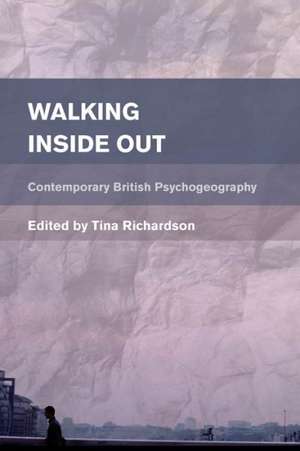
Walking Inside Out: Contemporary British Psychogeography: Place, Memory, Affect
Editat de Tina Richardsonen Limba Engleză Paperback – 7 iul 2015
Through a variety of case studies, it offers a British perspective of international spaces, from the British metropolis to the post-communist European city. By situating the current strand of psychogeography within its historical, political and creative context along with careful consideration of the challenges it faces Walking Inside Out offers a vision for the future of the discipline.



Preț: 345.71 lei
Preț vechi: 484.07 lei
-29%
Puncte Express: 519
Carte tipărită la comandă
Livrare economică 17 noiembrie-01 decembrie
Livrare express 13-17 octombrie pentru 172.40 lei
Livrare prin curier în România Termenul estimat este afișat lângă disponibilitate.
Transport gratuit de la 400.00 lei Plată online sau ramburs, în funcție de opțiunile comenzii.
Retur gratuit în 14 zile Comandă securizată și suport în română.
Specificații
ISBN-13: 9781783480869
ISBN-10: 1783480866
Pagini: 272
Ilustrații: 2 b/w illustrations;9 b/w photos;
Dimensiuni: 150 x 226 x 20 mm
Greutate: 0.43 kg
Editura: Bloomsbury Publishing
Colecția Rowman & Littlefield
Seria Place, Memory, Affect
Locul publicării:New York, United States
ISBN-10: 1783480866
Pagini: 272
Ilustrații: 2 b/w illustrations;9 b/w photos;
Dimensiuni: 150 x 226 x 20 mm
Greutate: 0.43 kg
Editura: Bloomsbury Publishing
Colecția Rowman & Littlefield
Seria Place, Memory, Affect
Locul publicării:New York, United States
V-ar putea interesa
-
 Leibniz's 'New System': and associated contemporary textsR. S. Woolhouse-19%Preț: 351.27 lei435.61 lei
 -
 What Is Philosophy?Gilles DeleuzePreț: 145.78 lei
 -
 The Hermeneutics of the SubjectMichel FoucaultPreț: 252.92 lei
 -
 Power/KnowledgeMichel FoucaultPreț: 103.76 lei
 -
 The Essential David BohmLee NicholPreț: 369.59 lei
 -
 Preț: 173.09 lei
 -
 Unended Quest: An Intellectual AutobiographyKarl PopperPreț: 156.03 lei
 -
 The Future of Hegel: Plasticity, Temporality and DialecticCatherine MalabouPreț: 381.27 lei
 -
 Reading CavellAlice CraryPreț: 412.99 lei
 -
 Deleuze & Guattari for ArchitectsAndrew BallantynePreț: 288.06 lei
 -
 The Order of ThingsMichel FoucaultPreț: 141.77 lei
 -
 Logicomix: An epic search for truthApostolos Doxiadis-22%Preț: 101.20 lei129.06 lei
 -
 The Intellectual LifeA G SertillangesPreț: 123.82 lei
 -
 The Courage of TruthM. FoucaultPreț: 187.98 lei
 -
 PowerMichel FoucaultPreț: 201.73 lei
 -
 The Chomsky-Foucault DebateNoam ChomskyPreț: 88.09 lei
 -
 Thus Spake ZarathustraFriedrich Wilhelm NietzschePreț: 90.68 lei
 -
 Agamben and Indifference: A Critical OverviewWilliam Watkin-22%Preț: 339.39 lei437.24 lei
Cuprins
Dedication / Introduction: A Wander Through the Scene of British Urban Walking / Part I: The Walker and the Urban Landscape / 1. Longshore Drift: Approaching Liverpool from Another Place by Roy Bayfield / 2. Walking the Dog by Ian Marchant / 3. Incongruous Steps Towards a Legal Psychogeography by Luke Bennett / Part II: Memory, Historicity, Time / 4. Walking Through Memory: Critical Nostalgia and the City by Alastair Bonnett / 5. Selective Amnesia and Spectral Recollection in the Bloodlands by Phil Wood / 6. The Art of Wandering: Arthur Machen's London Science by Merlin Coverley / 7. Wooden Stones by Gareth E. Rees / Part III: Power and Place / 8. Psychogeography Adrift: Negotiating Critical Inheritance in a Changed Context by Christopher Collier / 9. Confessions of an Anarcho-Flâneuse or Psychogeography the Mancunian Way by Morag Rose / Part IV Practising Psychogeography/Psychogeographical Practices/ 10. Psychogeography and Mythogeography: Currents in Radical Walking by Phil Smith / 11. Developing Schizocart
Recenzii
Academic and/or non-academic, [psychogeography] sprawls across traditional boundaries of subject matter in a way that I find delightful; I loved this book for its diversity, quirkiness, and thoughtfulness . [This book] is rich, witty, thought provoking. For any therapist who embraces a social constructionist view of the self, it is a wonderful read!
Walking Inside Out . . . [is] a diverse and lively assortment of literary and more scholarly essays that constitutes a collective intervention in debates about the continued valence of walking as a species both of politics and aesthetics. . . .[This book] open[s] up an important space for debating the political and aesthetic value of walking in cities and their fringes.
This book is full of unanticipated gems [.] it's an enlightened celebration of the breadth of the contemporary psychogeographical practice.
Richardson's book testifies to the richness and profusion of British urban walking today, by turns serious and light-hearted, intensely focussed, and freely rambling. More than armchair philosophy, these essays-by a motley rabble of loiterers, strollers, academics, writers, agitators and wastrels-make me want to depart my desk and head out into the city, leaving all maps behind.
I read this book in a single sitting, flying from Singapore to London. By the time we were over Afghanistan, I was hooked. Stumbling into the London streets from Heathrow Airport, I needed to walk into British pyschogeography, which as this collection shows, blends British grittiness and continental influences, creating something vital.
A bumper compendium, bubbling with insights and oddments, and a multiplicity of perspectives, Walking Inside Out accentuates the vibrancy of British psychogeography, its varied theories, walking styles, pathways, motivations. It will inspire you to stride out, to wallow in this weird Island, looking askance at its incongruities, vestiges, banalities, security apparatus, rural idylls, shabby seafronts, and the less trodden ways.
Walking Inside Out is more than a history of British psychogeography: it is a compelling drift through the conceptual space of the discipline as practised in the contemporary cultural and social situation. It points to psychogeography's possible futures in all their theoretical complexity, playful subversiveness, political and therapeutical potential. An essential addition to the growing corpus of psychogeographical literature.
"[A] diverse and lively assortment of literary and more scholarly essays that constitutes a collective intervention in debates about the continued valence of walking as a species both of politics and aesthetics, [Walking Inside Out] open[s] up an important space for debating the political and aesthetic value of walking in cities and their fringes in an epoch of rampant, even epidemic gentrification."
Tina Richardson is one of the key figures in contemporary British psychogeography and urban aesthetics. [F]or those of us interested in psychogeography she has provided a map of where we have come from and some pointers towards where we are going.
Editor Tina Richardson skillfully guides the reader through the diverse field of British psychogeography through a useful introduction - perfectly appropriate for both readers who are new to the subject as well as those with prior exposure to it. . . .Walking inside out is a focused, enthused, engaging and diverse resource full of memorable narratives and transferable insights. It is a book that testifies to the rich diversity of ways of walking, the multiplicity of walking styles and motivations, and the depth of a tradition that is very much alive both in and outside the British Isles. Equally theoretical and substantive, playful and serious, and balanced in its attention to methodological and counter-cultural possibilities, Walking inside out will lead readers to wonder, and wander, through the vast field of psychogeography.
[T]he strength of this collection is to offer an overview of contemporary British psychogeography while also practicing it. This means that the essays presented in the collection are not only about psychogeography, but psychogeographic in the first place, in that they embody (different conceptions of) psychogeography even before reflecting upon it.
As one of the first academic surveys of the heterogeneous field of psychogeography as it is practiced across the United Kingdom in the present day, Walking Inside Out is an ambitious undertaking . Bringing together both recognizable and established names in the field alongside contributions from emerging researchers and practitioners, Walking Inside Out demonstrates just how thoroughly the appeal of the 'toolbox'-like quality of psychogeography (Richardson 2015: 3) cuts across disciplines.
Walking Inside Out . . . [is] a diverse and lively assortment of literary and more scholarly essays that constitutes a collective intervention in debates about the continued valence of walking as a species both of politics and aesthetics. . . .[This book] open[s] up an important space for debating the political and aesthetic value of walking in cities and their fringes.
This book is full of unanticipated gems [.] it's an enlightened celebration of the breadth of the contemporary psychogeographical practice.
Richardson's book testifies to the richness and profusion of British urban walking today, by turns serious and light-hearted, intensely focussed, and freely rambling. More than armchair philosophy, these essays-by a motley rabble of loiterers, strollers, academics, writers, agitators and wastrels-make me want to depart my desk and head out into the city, leaving all maps behind.
I read this book in a single sitting, flying from Singapore to London. By the time we were over Afghanistan, I was hooked. Stumbling into the London streets from Heathrow Airport, I needed to walk into British pyschogeography, which as this collection shows, blends British grittiness and continental influences, creating something vital.
A bumper compendium, bubbling with insights and oddments, and a multiplicity of perspectives, Walking Inside Out accentuates the vibrancy of British psychogeography, its varied theories, walking styles, pathways, motivations. It will inspire you to stride out, to wallow in this weird Island, looking askance at its incongruities, vestiges, banalities, security apparatus, rural idylls, shabby seafronts, and the less trodden ways.
Walking Inside Out is more than a history of British psychogeography: it is a compelling drift through the conceptual space of the discipline as practised in the contemporary cultural and social situation. It points to psychogeography's possible futures in all their theoretical complexity, playful subversiveness, political and therapeutical potential. An essential addition to the growing corpus of psychogeographical literature.
"[A] diverse and lively assortment of literary and more scholarly essays that constitutes a collective intervention in debates about the continued valence of walking as a species both of politics and aesthetics, [Walking Inside Out] open[s] up an important space for debating the political and aesthetic value of walking in cities and their fringes in an epoch of rampant, even epidemic gentrification."
Tina Richardson is one of the key figures in contemporary British psychogeography and urban aesthetics. [F]or those of us interested in psychogeography she has provided a map of where we have come from and some pointers towards where we are going.
Editor Tina Richardson skillfully guides the reader through the diverse field of British psychogeography through a useful introduction - perfectly appropriate for both readers who are new to the subject as well as those with prior exposure to it. . . .Walking inside out is a focused, enthused, engaging and diverse resource full of memorable narratives and transferable insights. It is a book that testifies to the rich diversity of ways of walking, the multiplicity of walking styles and motivations, and the depth of a tradition that is very much alive both in and outside the British Isles. Equally theoretical and substantive, playful and serious, and balanced in its attention to methodological and counter-cultural possibilities, Walking inside out will lead readers to wonder, and wander, through the vast field of psychogeography.
[T]he strength of this collection is to offer an overview of contemporary British psychogeography while also practicing it. This means that the essays presented in the collection are not only about psychogeography, but psychogeographic in the first place, in that they embody (different conceptions of) psychogeography even before reflecting upon it.
As one of the first academic surveys of the heterogeneous field of psychogeography as it is practiced across the United Kingdom in the present day, Walking Inside Out is an ambitious undertaking . Bringing together both recognizable and established names in the field alongside contributions from emerging researchers and practitioners, Walking Inside Out demonstrates just how thoroughly the appeal of the 'toolbox'-like quality of psychogeography (Richardson 2015: 3) cuts across disciplines.