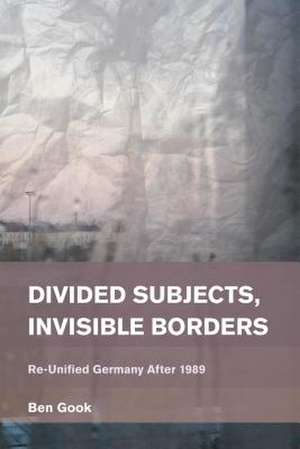
Divided Subjects, Invisible Borders: Re-Unified Germany After 1989: Place, Memory, Affect
Autor Ben Gooken Limba Engleză Paperback – 21 sep 2015
The old identities of East and West, which all but dissolved in joyous embraces as the Berlin Wall fell, emerged once more after formal re-unification a year later in 1990. 2015 marks the twenty-fifth anniversary of that German re-unification. Yet Germany remains divided; a mutual distrust lingers, and national history remains contentious.
The material, social, cultural and psychic effects of re-unification on the lives of eastern and western Germans since 1989 all demand again asking fundamental questions about history, social change and ideology. Divided Subjects, Invisible Borders puts affective life at the centre of these questions, both in the role affect played in mobilizing East Germans to overthrow their regime and as a sign of disappointment after formal reunification. Using contemporary Germany as a lens the book explores broader debates about borders, memory and subjectivity.



Preț: 347.25 lei
Preț vechi: 484.86 lei
-28%
Puncte Express: 521
Carte tipărită la comandă
Livrare economică 28 noiembrie-12 decembrie
Livrare prin curier în România Termenul estimat este afișat lângă disponibilitate.
Transport gratuit de la 400.00 lei Plată online sau ramburs, în funcție de opțiunile comenzii.
Retur gratuit în 14 zile Comandă securizată și suport în română.
Specificații
ISBN-13: 9781783482429
ISBN-10: 1783482427
Pagini: 326
Ilustrații: 8 BW Photos, 1 Table
Dimensiuni: 154 x 228 x 23 mm
Greutate: 0.5 kg
Editura: Bloomsbury Publishing
Colecția Rowman & Littlefield
Seria Place, Memory, Affect
Locul publicării:New York, United States
ISBN-10: 1783482427
Pagini: 326
Ilustrații: 8 BW Photos, 1 Table
Dimensiuni: 154 x 228 x 23 mm
Greutate: 0.5 kg
Editura: Bloomsbury Publishing
Colecția Rowman & Littlefield
Seria Place, Memory, Affect
Locul publicării:New York, United States
V-ar putea interesa
-
 Under Another SkyCharlotte Higgins-30%Preț: 65.35 lei93.75 lei
 -
 Preț: 133.41 lei
 -
 Preț: 415.71 lei
 -
 Scottish IndependenceAlan CochranePreț: 58.50 lei
 -
 GreeceCarol G ThomasPreț: 183.47 lei
 -
 Scottish History For DummiesWilliam KnoxPreț: 139.87 lei
 -
 -27%Preț: 67.60 lei92.17 lei
 -
 BannockburnPeter ReesePreț: 92.44 lei
 -
 S.O.E.M. R. D. FootPreț: 146.84 lei
 -
 Bosworth 1485: Psychology of a BattleMichael Jones-27%Preț: 66.83 lei91.56 lei
Cuprins
Acknowledgements /Introduction - Just another Country in Europe? / Part I: Another New Beginning /1. End of Story: Nachträglichkeit and the German Past / 2. The German Ideology: Identity, Fantasy, Affect /Conclusion: Reconciliation, Reconstruction, Re-unification / Part II: The Past that Outlived Itself /3. Really-Existing Nostalgia: Transitions, Fetishes and Objects / 4. Disintegration and Ambivalence: Berlin and Leipzig /Conclusion: Desired and Denied/ Part III: The Lives of Ossis on Film /5. The Lives of Others -?Imitations of Life /6. Good Bye Lenin! -?Too Soon, Too Late /7. Material -?Something is Left Over /Conclusion / Part IV: Remembering, Commemorating /8. In the Gallery: Aesthetics and Memory Contests /9. In the Street: Commemoration and Interpassivity / Conclusion: In the End. / Conclusion - Another New Ending /Bibliography/ Index
Recenzii
At a moment in which the outlook for the European project seems bleak and representative democracy is in crisis, [...] Divided Subjects, Invisible Borders has much to offer specialists interested in how dissatisfied and disaggregated citizens negotiate the identities they are forced to share, at least superficially, with one another.
The book maps theories of fantasy and collective identity onto the post-transition period and the experience of eastern Germans, adding new dimensions to a burgeoning literature on post-unification identity in Germany. To this end, Gook disentangles complicated theoretical scholarship - from Freud to Zizek - in order to show how the imaginary and the symbolic help to anchor both collective (national) identities and a sense of (the individual) self.
Divided Subjects, Invisible Borders provides a detailed introduction to the complexity of memory and space in Germany (and particularly Berlin) following re-unification, and substantially expands on a number of key and emerging considerations relevant to scholars interested in recent German history. In particular, the combination of media, landscape, history, and politics brings new insight to a field that frequently addresses the problems of re-unified Germany from a limited disciplinary perspective
Gook, an investigator at the ARC Center of Excellence for the History of Emotions at the University of Melbourne, takes a thoroughly interdisciplinary approach, examining East German culture via politics, popular culture, film, and ethnography. . . .Overall, this book provides a fresh analytical approach to the persistent puzzle of divided identities.
This book, situated at the intersections of psychosocial and cultural studies, political science and anthropology, contributes original and important ideas to the discussion of how psychoanalytic theories might be applied to questions of remembrance, commemoration and nostalgia and helps to elucidate how a liberal capitalist nation-state manages crises and disruptions.
Ben Gook shows in his theoretically sophisticated and quietly passionate study that the complacent tale of successful German unification not only forgets the erasure of eastern Germans' experiences and expectations when the wall came down and the future seemed open but also reproduces the inner-German division it sought to heal. Divided Subjects, Invisible Borders is an auspicious debut.
This immensely knowledgeable and elegantly argued study focusses on the fraught process of making sense of German re-unification. By psychoanalytically exploring East and West German fantasies and projections?i.e. the conceptualisation of subjectivity, memorialisation, and nostalgic or fetishist object investments?Gook offers provocative and most intriguing new insights into the affective workings (or impasses) of a post-'Wende' society.
An excellent study of the interrelation between the physical, social and the affective geographies that marked the re-unification of Germany, this book offers a subtle analysis of the subjectivities created through that process. Divided Subjects, Invisible Borders shows how analytically productive - one can even say necessary - a subtle deployment of social theory is when dealing with such complex social processes, and highlights the continuing importance of psychoanalytic theory in making sense of realities characterised by a deep entanglement of memory, affect, fantasies, capitalism and geopolitics.
This book is a timely intervention in the remembrance of recent German history, or what Ben Gook aptly calls the "enigmatic, unfinished business" of the Berlin Wall's breaching and subsequent German re-unification. As Gook so eloquently demonstrates through his eminently readable and masterful theorizing of the disavowed ambivalence of this period, the revolution was a chaotic rupture that has only belatedly come to signify what it does today. He argues that it pays to be reminded of the "fundamental and damaging misrecognition" at the core of these events, to be attentive to their contradictions and complex histories, especially as we come to experience the past increasingly through memory, and a new generation of Germans who has no first-hand experience of the East German past comes of age.
The book maps theories of fantasy and collective identity onto the post-transition period and the experience of eastern Germans, adding new dimensions to a burgeoning literature on post-unification identity in Germany. To this end, Gook disentangles complicated theoretical scholarship - from Freud to Zizek - in order to show how the imaginary and the symbolic help to anchor both collective (national) identities and a sense of (the individual) self.
Divided Subjects, Invisible Borders provides a detailed introduction to the complexity of memory and space in Germany (and particularly Berlin) following re-unification, and substantially expands on a number of key and emerging considerations relevant to scholars interested in recent German history. In particular, the combination of media, landscape, history, and politics brings new insight to a field that frequently addresses the problems of re-unified Germany from a limited disciplinary perspective
Gook, an investigator at the ARC Center of Excellence for the History of Emotions at the University of Melbourne, takes a thoroughly interdisciplinary approach, examining East German culture via politics, popular culture, film, and ethnography. . . .Overall, this book provides a fresh analytical approach to the persistent puzzle of divided identities.
This book, situated at the intersections of psychosocial and cultural studies, political science and anthropology, contributes original and important ideas to the discussion of how psychoanalytic theories might be applied to questions of remembrance, commemoration and nostalgia and helps to elucidate how a liberal capitalist nation-state manages crises and disruptions.
Ben Gook shows in his theoretically sophisticated and quietly passionate study that the complacent tale of successful German unification not only forgets the erasure of eastern Germans' experiences and expectations when the wall came down and the future seemed open but also reproduces the inner-German division it sought to heal. Divided Subjects, Invisible Borders is an auspicious debut.
This immensely knowledgeable and elegantly argued study focusses on the fraught process of making sense of German re-unification. By psychoanalytically exploring East and West German fantasies and projections?i.e. the conceptualisation of subjectivity, memorialisation, and nostalgic or fetishist object investments?Gook offers provocative and most intriguing new insights into the affective workings (or impasses) of a post-'Wende' society.
An excellent study of the interrelation between the physical, social and the affective geographies that marked the re-unification of Germany, this book offers a subtle analysis of the subjectivities created through that process. Divided Subjects, Invisible Borders shows how analytically productive - one can even say necessary - a subtle deployment of social theory is when dealing with such complex social processes, and highlights the continuing importance of psychoanalytic theory in making sense of realities characterised by a deep entanglement of memory, affect, fantasies, capitalism and geopolitics.
This book is a timely intervention in the remembrance of recent German history, or what Ben Gook aptly calls the "enigmatic, unfinished business" of the Berlin Wall's breaching and subsequent German re-unification. As Gook so eloquently demonstrates through his eminently readable and masterful theorizing of the disavowed ambivalence of this period, the revolution was a chaotic rupture that has only belatedly come to signify what it does today. He argues that it pays to be reminded of the "fundamental and damaging misrecognition" at the core of these events, to be attentive to their contradictions and complex histories, especially as we come to experience the past increasingly through memory, and a new generation of Germans who has no first-hand experience of the East German past comes of age.