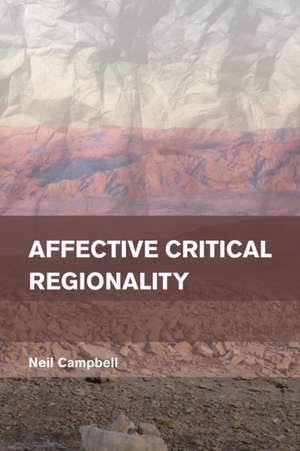
Affective Critical Regionality: Place, Memory, Affect
Autor Neil Campbellen Limba Engleză Paperback – 17 aug 2016
This book uses affective critical regionality to enable a re-valuing of the local as a powerful means to appreciate the everyday and the over-looked as vital elements within a more inclusive understanding of how we live. Exploring a variety of cultural materials including fiction, memoir, theory, poetry and film it demonstrates how this approach can deepen our understanding of, and simultaneously provoke new relations with, place. Moving beyond the US context through its use of international theoretical voices and texts, it will show how the concept is applicable to other cultural spheres.






Preț: 329.49 lei
Preț vechi: 426.44 lei
-23%
Puncte Express: 494
Carte tipărită la comandă
Livrare economică 02-16 decembrie
Livrare prin curier în România Termenul estimat este afișat lângă disponibilitate.
Transport gratuit de la 400.00 lei Plată online sau ramburs, în funcție de opțiunile comenzii.
Retur gratuit în 14 zile Comandă securizată și suport în română.
Specificații
ISBN-13: 9781783480838
ISBN-10: 1783480831
Pagini: 256
Dimensiuni: 153 x 224 x 17 mm
Greutate: 0.36 kg
Editura: Bloomsbury Publishing
Colecția Rowman & Littlefield
Seria Place, Memory, Affect
Locul publicării:New York, United States
ISBN-10: 1783480831
Pagini: 256
Dimensiuni: 153 x 224 x 17 mm
Greutate: 0.36 kg
Editura: Bloomsbury Publishing
Colecția Rowman & Littlefield
Seria Place, Memory, Affect
Locul publicării:New York, United States
V-ar putea interesa
-
 Preț: 439.64 lei
 -
 Sex, Machines and NavelsFred BottingPreț: 214.84 lei
 -
 -37%Preț: 660.59 lei1054.37 lei
 -
 Cultures of ObsolescenceB. Tischleder-18%Preț: 810.77 lei988.74 lei
 -
 -8%Preț: 430.57 lei468.01 lei
 -
 Impact of China's Rise on the Mekong RegionYos SantasombatPreț: 407.29 lei
 -
 -18%Preț: 1022.09 lei1246.45 lei
 -
 Preț: 475.67 lei
 -
 Pilgrimage in TibetAlex McKayPreț: 310.56 lei
 -
 Mental CausationNeil Campbell-19%Preț: 612.41 lei756.05 lei
 -
 -33%Preț: 964.85 lei1440.74 lei
 -
 Rebels and TyrantsNicholas Rzhevsky-19%Preț: 722.03 lei891.40 lei
 -
 The Cosmopolitan Ideal: Challenges and OpportunitiesSybille De La Rosa-23%Preț: 336.32 lei435.64 lei
 -
 Pictures from HopperNeil CampbellPreț: 84.33 lei
 -
 In the Gemini CaféNeil CampbellPreț: 81.59 lei
 -
 Preț: 255.49 lei
Cuprins
Introduction: An Expanded Critical Regionalism / 1. From Regionalism to Regionality / 2. Charles Olson: 'the motion which we call life' / 3. D.J. Waldie: Suburban Regionality / 4. Kathleen Stewart: Fictocritical Regionality / 5. Rebecca Solnit: A New Atlas of Emotion / 6. Willy Vlautin's Northline: Fugitive Work / 7. Karen Tei Yamashita: Border Cartographies, Border Refrains / 8. Conclusion: 'not so much a deficiency as a resource' / Bibliography / Index
Recenzii
Reaching across a diversity of writings Campbell brings the idea of the region into life in a newly human way, situating it amongst the variety of what makes up being alive. The text persistently inspires and enriches. He meshes the variety of key sources and with unusual clarity unpacks the idea of how affect works; the writing affective in itself.
This book is a powerful intervention of a singular kind in the work of configuring possibilities for knowledge and action. It arrays the intensities and infusions of regionality across a vast arc of zones, genres and ways of being, catching up not the boundaries and traces of place but its unfolding, its alchemy, in difference, edging, agitations and intricate infrastructures of surprise. In Campbell's cartographic mapping, affective regionalities are made of knots, speeds, loops, gestures, sonorities and muscle. They whisper a minor language for remaking the world.
Like the concept of "regionality" itself, Campbell's prose, both in its theoretical brilliance and scintillating close readings of diverse texts, fractures the totalizing frame of regionalism with an affective intensity that is contagious as well as entirely persuasive. In addition to its many local insights, this book is remarkable for its re-imagining of the political possibilities of regionality "as an energized sense of care." A scintillating, ultimately humane achievement, Affective Critical Regionality further solidifies Campbell's status as a groundbreaking scholar not only of the U.S. West but also of critical regionalist studies more generally.
This book is a powerful intervention of a singular kind in the work of configuring possibilities for knowledge and action. It arrays the intensities and infusions of regionality across a vast arc of zones, genres and ways of being, catching up not the boundaries and traces of place but its unfolding, its alchemy, in difference, edging, agitations and intricate infrastructures of surprise. In Campbell's cartographic mapping, affective regionalities are made of knots, speeds, loops, gestures, sonorities and muscle. They whisper a minor language for remaking the world.
Like the concept of "regionality" itself, Campbell's prose, both in its theoretical brilliance and scintillating close readings of diverse texts, fractures the totalizing frame of regionalism with an affective intensity that is contagious as well as entirely persuasive. In addition to its many local insights, this book is remarkable for its re-imagining of the political possibilities of regionality "as an energized sense of care." A scintillating, ultimately humane achievement, Affective Critical Regionality further solidifies Campbell's status as a groundbreaking scholar not only of the U.S. West but also of critical regionalist studies more generally.