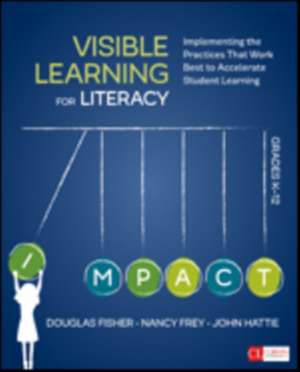
Visible Learning for Literacy, Grades K-12
Autor Douglas Fisher, Nancy Frey, John Hattieen Limba Engleză Paperback – 29 mar 2016
Prezentat sub formă de manual de perfecționare profesională, Visible Learning for Literacy, Grades K-12 reprezintă transpunerea practică a cercetărilor vaste coordonate de John Hattie în domeniul alfabetizării. Apreciem rigoarea cu care autorii, Douglas Fisher, Nancy Frey și John Hattie, transformă datele statistice în strategii concrete de predare, pornind de la premisa că succesul elevului trebuie să fie rezultatul unui design pedagogic intenționat, nu al hazardului. Suntem de părere că elementul distinctiv al acestei lucrări este segmentarea învățării în etape de suprafață, profunzime și transfer. Această structură ajută cadrele didactice să identifice momentul optim pentru aplicarea fiecărei rutine, evitând utilizarea prematură a tehnicilor complexe sau stagnarea în acumularea de informații factuale. Cartea extinde cadrul propus de Visible Learning for Teachers cu date noi din sfera specifică a alfabetizării, oferind instrumente precum hărțile conceptuale, adnotarea textelor și învățarea reciprocă, toate validate prin dimensiunea efectului (effect size). În contextul operei autorilor, volumul face parte din seria Corwin Literacy și rafinează conceptele explorate în Engagement by Design sau How Feedback Works, punând accent pe vizibilitatea impactului pe care profesorul îl are asupra elevului. Structura pe capitole ghidează cititorul de la fundamentele teoretice și stabilirea credibilității profesorului, până la consolidarea învățării prin practică distribuită și monitorizarea progresului, oferind un parcurs coerent pentru orice nivel de școlarizare, de la grădiniță până la liceu.
Preț: 282.27 lei
Carte disponibilă
Livrare economică 15-29 mai
Livrare express 30 aprilie-06 mai pentru 67.76 lei
Specificații
ISBN-10: 1506332358
Pagini: 216
Dimensiuni: 191 x 235 x 12 mm
Greutate: 0.41 kg
Ediția:First Edition
Editura: Corwin
Locul publicării:Thousand Oaks, United States
V-ar putea interesa
-
 -15%Preț: 398.69 lei469.04 lei
 -
 Learning and Literacy over Time: Longitudinal PerspectivesJulian Sefton-Green-15%Preț: 400.73 lei471.45 lei
 -
 Time and Space in Literacy ResearchCatherine Compton-LillyPreț: 324.29 lei
 -
 -18%Preț: 1201.50 lei1465.24 lei
 -
 Preț: 372.03 lei
 -
 LiteraciesMary Kalantzis-8%Preț: 578.18 lei628.45 lei
 -
 Improvising the Curriculum: Alternatives to Scripted SchoolingMichael Corbett-18%Preț: 1194.14 lei1456.26 lei
 -
 Preț: 403.65 lei
 -
 -15%Preț: 568.19 lei668.45 lei
 -
 Better Than Carrots or SticksDominique SmithPreț: 174.77 lei
 -
 The Literacy Leader's ToolkitGraham Tyrer-42%Preț: 112.73 lei193.22 lei
 -
 -24%Preț: 271.49 lei358.93 lei
 -
 -25%Preț: 270.04 lei358.69 lei
 -
 -14%Preț: 711.08 lei826.83 lei
De ce să citești această carte
Recomandăm această carte oricărui cadru didactic care dorește să își fundamenteze metodele de predare pe dovezi științifice solide, nu pe intuiție. Cititorul câștigă o înțelegere clară a momentului în care o anumită strategie de alfabetizare va produce impact maxim. Este un instrument esențial pentru planificarea curriculumului, oferind scenarii replicabile care transformă teoria meta-analizelor în realitate de clasă palpabilă.
Despre autor
Douglas Fisher este un expert recunoscut în domeniul educației, profesor de leadership educațional la Universitatea de Stat din San Diego. Alături de colaboratoarea sa de lungă durată, Nancy Frey, a publicat numeroase lucrări de referință despre vocabular și alfabetizare. John Hattie, renumit pentru proiectul său 'Visible Learning', aduce în această colaborare rigoarea statistică a celei mai mari baze de date de cercetare educațională din lume. Împreună, cei trei autori formează una dintre cele mai influente echipe în pedagogia contemporană, concentrându-se pe optimizarea învățării prin design instrucțional.
Descriere scurtă
What if someone slipped you a piece of paper listing the literacy practices that ensure students demonstrate more than a year’s worth of learning for a year spent in school? Would you keep the paper or throw it away?
We think you’d keep it. And that’s precisely why acclaimed educators Douglas Fisher, Nancy Frey, and John Hattie wrote Visible Learning for Literacy. They know teachers will want to apply Hattie’s head-turning synthesis of more than 15 years of research involving millions of students, which he used to identify the instructional routines that have the biggest impact on student learning.
These practices are “visible” for teachers and students to see, because their purpose has been made clear, they are implemented at the right moment in a student’s learning, and their effect is tangible. Yes, the “aha” moments made visible by design.
With their trademark clarity and command of the research, and dozens of classroom scenarios to make it all replicable, these authors apply Hattie’s research, and show you:
- How to use the right approach at the right time, so that you can more intentionally design classroom experiences that hit the surface, deep, and transfer phases of learning, and more expertly see when a student is ready to dive from surface to deep.
- Which routines are most effective at specific phases of learning, including word sorts, concept mapping, close reading, annotating, discussion, formative assessment, feedback, collaborative learning, reciprocal teaching, and many more.
- Why the 8 mind frames for teachers apply so well to curriculum planning and can inspire you to be a change agent in students’ lives—and part of a faculty that embraces the idea that visible teaching is a continual evaluation of one’s impact on student’s learning.
Cuprins
Preface
Acknowledgments
Chapter 1. Laying the Groundwork for Visible Learning for Literacy
The Evidence Base
Meta-Analyses
Effect Sizes
Noticing What Works
Learning From What Works, Not Limited to Literacy
Teacher Credibility
Teacher–Student Relationships
Teacher Expectations
General Literacy Learning Practices
1. Challenge
2. Self-Efficacy
3. Learning Intentions With Success Criteria
Conclusion
Chapter 2. Surface Literacy Learning
Why Surface Literacy Learning Is Essential
Acquisition and Consolidation
Acquisition of Literacy Learning Made Visible
Leveraging Prior Knowledge
Phonics Instruction and Direct Instruction in Context
Vocabulary Instruction
Mnemonics
Word Cards
Modeling Word Solving
Word and Concept Sorts
Wide Reading
Reading Comprehension Instruction in Context
Summarizing
Annotating Text
Note-Taking
Consolidation of Literacy Learning Made Visible
Rehearsal and Memorization Through Spaced Practice
Repeated Reading
Receiving Feedback
Collaborative Learning With Peers
Conclusion
Chapter 3. Deep Literacy Learning
Moving From Surface to Deep
Deep Acquisition and Deep Consolidation
Deep Acquisition of Literacy Learning Made Visible
Concept Mapping
Discussion and Questioning
Close Reading
Deep Consolidation of Literacy Learning Made Visible
Metacognitive Strategies
Reciprocal Teaching
Feedback to the Learner
Conclusion
Chapter 4. Teaching Literacy for Transfer
Moving From Deep Learning to Transfer
Types of Transfer: Near and Far
The Paths for Transfer: Low-Road Hugging and High-Road Bridging
Setting the Conditions for Transfer of Learning
Teaching Students to Organize Conceptual Knowledge
Students Identify Analogies
Peer Tutoring
Reading Across Documents
Problem-Solving Teaching
Teaching Students to Transform Conceptual Knowledge
Socratic Seminar
Extended Writing
Time to Investigate and Produce
Conclusion
Chapter 5. Determining Impact, Responding When the Impact Is Insufficient, and Knowing What Does Not Work
Determining Impact
Preassessment
Postassessment
Responding When There Is Insufficient Impact
Response to Intervention
Screening
Quality Core Instruction
Progress Monitoring
Supplemental and Intensive Interventions
Learning From What Doesn’t Work
Grade-Level Retention
Ability Grouping
Matching Learning Styles With Instruction
Test Prep
Homework
Conclusion
Appendix: Effect Sizes
References
Index