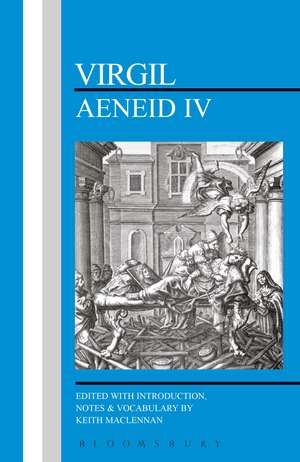
Virgil: Aeneid IV: Latin Texts
Editat de Dr Keith Maclennan Autor Virgilen Limba Engleză Paperback – 7 sep 2007
This classic edition of the Latin text of Book IV replaces the long-serving edition by Gould and Whiteley, making this book more accessible to today's students and taking account of the most recent scholarship and critical approaches to Virgil. It includes a substantial introduction, annotation to explain language and content, and a comprehensive vocabulary.
Din seria Latin Texts
- 17%
 Preț: 176.72 lei
 - 17%
 Preț: 162.48 lei
 - 17%
 Preț: 185.44 lei
 - 10%
 Preț: 176.63 lei
 - 17%
 Preț: 162.67 lei
 - 17%
 Preț: 162.91 lei
 - 17%
 Preț: 161.85 lei
 - 17%
 Preț: 179.15 lei
 - 17%
 Preț: 213.46 lei
 - 21%
 Preț: 164.50 lei
 -
 Preț: 167.73 lei
 - 17%
 Preț: 161.97 lei
 - 19%
 Preț: 169.79 lei
 - 5%
 Preț: 161.22 lei
 - 16%
 Preț: 216.16 lei
 - 21%
 Preț: 143.32 lei
 - 17%
 Preț: 177.79 lei
 - 17%
 Preț: 161.85 lei
 - 16%
 Preț: 167.70 lei
 - 17%
 Preț: 162.07 lei
 - 17%
 Preț: 162.07 lei
 -
 Preț: 183.88 lei
 - 16%
 Preț: 216.26 lei
 - 16%
 Preț: 189.58 lei
 - 10%
 Preț: 216.91 lei
 - 22%
 Preț: 136.31 lei
 - 17%
 Preț: 178.27 lei
 - 20%
 Preț: 182.60 lei
Preț: 177.53 lei
Preț vechi: 239.74 lei
-26%
Puncte Express: 266
Carte tipărită la comandă
Livrare economică 20 noiembrie-04 decembrie
Livrare prin curier în România Termenul estimat este afișat lângă disponibilitate.
Transport gratuit de la 400.00 lei Plată online sau ramburs, în funcție de opțiunile comenzii.
Retur gratuit în 14 zile Comandă securizată și suport în română.
Specificații
ISBN-13: 9781853997051
ISBN-10: 1853997056
Pagini: 200
Dimensiuni: 134 x 214 x 14 mm
Greutate: 0.26 kg
Editura: Bloomsbury Publishing
Colecția Bristol Classical Press
Seria Latin Texts
Locul publicării:London, United Kingdom
ISBN-10: 1853997056
Pagini: 200
Dimensiuni: 134 x 214 x 14 mm
Greutate: 0.26 kg
Editura: Bloomsbury Publishing
Colecția Bristol Classical Press
Seria Latin Texts
Locul publicării:London, United Kingdom
V-ar putea interesa
-
 These Were the RomansG I F TingayPreț: 157.70 lei
 -
 An Introduction to Language and LinguisticsRalph W. Fasold-8%Preț: 436.36 lei474.30 lei
 -
 -18%Preț: 1260.05 lei1536.64 lei
 -
 Virgil'S AeneidVirgilPreț: 287.90 lei
 -
 Preț: 142.29 lei
 -
 Preț: 139.25 lei
 -
 Logisch! A1 - Kursbuch A1Ute KoithanPreț: 183.83 lei
 -
 Preț: 79.24 lei
 -
 Preț: 241.67 lei
 -
 Das neue Deutschmobil 2. Lehrbuch mit Audio-CDJutta Douvitsas-GamstPreț: 238.14 lei
 -
 Preț: 174.55 lei
 -
 Planet 2 / ArbeitsbuchGabriele KoppPreț: 169.50 lei
Cuprins
Introduction
1. Historical background
2. Virgil's life and writing
3. The Aeneid
4. Books 1-4: the Carthaginian episode
5. Virgil's predecessors
6. Rome and Carthage
7. Dido and Aeneas
8. The gods
9. Similes in Book 4
10. Humour
11. Summary of books 5-12
12. Dido and Aeneas after Virgil
13. Metre general
14. Virgil's use of metre and language
Some reading
Notes
Aeneid IV: The Latin text
Notes on the text
Index I: Literary, grammatical and metrical terms
Index II: Names in the text
Index III: Other names
Vocabulary
Abbreviations
1. Historical background
2. Virgil's life and writing
3. The Aeneid
4. Books 1-4: the Carthaginian episode
5. Virgil's predecessors
6. Rome and Carthage
7. Dido and Aeneas
8. The gods
9. Similes in Book 4
10. Humour
11. Summary of books 5-12
12. Dido and Aeneas after Virgil
13. Metre general
14. Virgil's use of metre and language
Some reading
Notes
Aeneid IV: The Latin text
Notes on the text
Index I: Literary, grammatical and metrical terms
Index II: Names in the text
Index III: Other names
Vocabulary
Abbreviations
Notă biografică
Virgil (Publius Vergilius Maro, 70-19 BC) was born in the north of Italy and completed his education in Rome. Generally considered Rome's greatest poet, he wrote Eclogues, 37 BC, and Georgics, 29 BC. He then devoted the rest of his life to the composition of his greatest work, the epic poem the Aeneid.
Virgil (Publius Vergilius Maro, 70-19 BC) was born in the north of Italy and completed his education in Rome. Generally considered Rome's greatest poet, he wrote Eclogues, 37 BC, and Georgics, 29 BC. He then devoted the rest of his life to the composition of his greatest work, the epic poem the Aeneid.
Recenzii
"...an altogether admirable commentary....really first-rate, distinguished work....Exemplary use of how parallels, borrowings and influences work..." Nicholas Horsfall, Vergilius
"The same piercing intelligence, command of Greek and Latin literature, and refusal to be satisfied with tired old formulations that are apparent in his earlier books and his numerous articles make this commentary a most valuable contribution, and I look forward eagerly to further discussions by Hardie of the issues raised by Aeneid 9. As much as anyone working on Latin poetry today Hardie is unpredictable, with a rare tendency simply to go in the direction the evidence before him indicates on any issue. When you see his name in a table of contents or card catalogue, take and read." Bryn Mawr Classical Review
"Hardie successfully incorporates the most valuable ancient and contemporary materials on Vergil to produce a more literary approach reflecting the insights and biases of critical work of recent decades. This edition will br appreciated by students and scholars alike." Classical World
"The same piercing intelligence, command of Greek and Latin literature, and refusal to be satisfied with tired old formulations that are apparent in his earlier books and his numerous articles make this commentary a most valuable contribution, and I look forward eagerly to further discussions by Hardie of the issues raised by Aeneid 9. As much as anyone working on Latin poetry today Hardie is unpredictable, with a rare tendency simply to go in the direction the evidence before him indicates on any issue. When you see his name in a table of contents or card catalogue, take and read." Bryn Mawr Classical Review
"Hardie successfully incorporates the most valuable ancient and contemporary materials on Vergil to produce a more literary approach reflecting the insights and biases of critical work of recent decades. This edition will br appreciated by students and scholars alike." Classical World