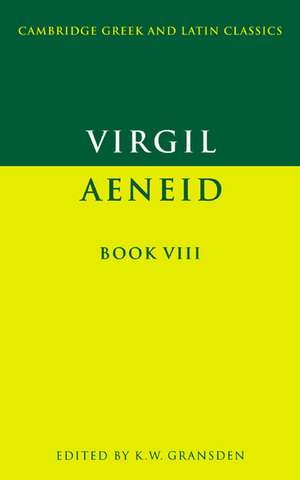
Virgil: Aeneid Book VIII: Cambridge Greek and Latin Classics
Autor Virgil Editat de K. W. Gransdenen Limba Engleză Paperback – 7 iul 1976
Din seria Cambridge Greek and Latin Classics
-
 Preț: 360.68 lei
 -
 Preț: 378.23 lei
 -
 Preț: 343.03 lei
 -
 Preț: 240.46 lei
 - 13%
 Preț: 201.07 lei
 -
 Preț: 330.40 lei
 -
 Preț: 287.11 lei
 -
 Preț: 338.72 lei
 -
 Preț: 376.36 lei
 -
 Preț: 241.04 lei
 -
 Preț: 231.81 lei
 -
 Preț: 238.75 lei
 -
 Preț: 341.57 lei
 -
 Preț: 360.11 lei
 -
 Preț: 336.87 lei
 -
 Preț: 230.71 lei
 -
 Preț: 341.78 lei
 -
 Preț: 269.22 lei
 -
 Preț: 239.43 lei
 -
 Preț: 239.82 lei
 -
 Preț: 330.15 lei
 -
 Preț: 375.25 lei
 -
 Preț: 344.34 lei
 -
 Preț: 374.51 lei
 -
 Preț: 363.99 lei
 -
 Preț: 337.61 lei
 -
 Preț: 334.27 lei
 -
 Preț: 347.73 lei
Preț: 338.44 lei
Puncte Express: 508
Carte tipărită la comandă
Livrare economică 03-17 iunie
Specificații
ISBN-13: 9780521290470
ISBN-10: 0521290473
Pagini: 212
Ilustrații: 1 map
Dimensiuni: 127 x 203 x 12 mm
Greutate: 0.24 kg
Editura: Cambridge University Press
Colecția Cambridge University Press
Seria Cambridge Greek and Latin Classics
Locul publicării:Cambridge, United Kingdom
ISBN-10: 0521290473
Pagini: 212
Ilustrații: 1 map
Dimensiuni: 127 x 203 x 12 mm
Greutate: 0.24 kg
Editura: Cambridge University Press
Colecția Cambridge University Press
Seria Cambridge Greek and Latin Classics
Locul publicării:Cambridge, United Kingdom
V-ar putea interesa
-
 These Were the RomansG I F TingayPreț: 151.55 lei
 -
 An Introduction to Language and LinguisticsRalph W. FasoldPreț: 435.28 lei
 -
 -18%Preț: 1212.14 lei1478.22 lei
 -
 Preț: 272.95 lei
 -
 Preț: 142.29 lei
 -
 Preț: 134.95 lei
 -
 Logisch! A1 - Kursbuch A1Ute KoithanPreț: 175.15 lei
 -
 Preț: 76.56 lei
 -
 Preț: 230.61 lei
 -
 Preț: 168.41 lei
 -
 Planet 2 / ArbeitsbuchGabriele KoppPreț: 164.38 lei
Cuprins
Preface; Map of the site of Rome; introduction; 1. Virgil's career and reputation; 2. The Aeneid; 3. Book VIII; 4. The poetry; Commentary; Appendices; Bibliography; Indexes to the commentary.
Descriere
This is primarily a textbook for university students and sixth-formers, but it also contains material which may be of interest to students of English and comparative literature.
Recenzii
"...an altogether admirable commentary....really first-rate, distinguished work....Exemplary use of how parallels, borrowings and influences work..." Nicholas Horsfall, Vergilius
"The same piercing intelligence, command of Greek and Latin literature, and refusal to be satisfied with tired old formulations that are apparent in his earlier books and his numerous articles make this commentary a most valuable contribution, and I look forward eagerly to further discussions by Hardie of the issues raised by Aeneid 9. As much as anyone working on Latin poetry today Hardie is unpredictable, with a rare tendency simply to go in the direction the evidence before him indicates on any issue. When you see his name in a table of contents or card catalogue, take and read." Bryn Mawr Classical Review
"Hardie successfully incorporates the most valuable ancient and contemporary materials on Vergil to produce a more literary approach reflecting the insights and biases of critical work of recent decades. This edition will br appreciated by students and scholars alike." Classical World
"The same piercing intelligence, command of Greek and Latin literature, and refusal to be satisfied with tired old formulations that are apparent in his earlier books and his numerous articles make this commentary a most valuable contribution, and I look forward eagerly to further discussions by Hardie of the issues raised by Aeneid 9. As much as anyone working on Latin poetry today Hardie is unpredictable, with a rare tendency simply to go in the direction the evidence before him indicates on any issue. When you see his name in a table of contents or card catalogue, take and read." Bryn Mawr Classical Review
"Hardie successfully incorporates the most valuable ancient and contemporary materials on Vergil to produce a more literary approach reflecting the insights and biases of critical work of recent decades. This edition will br appreciated by students and scholars alike." Classical World