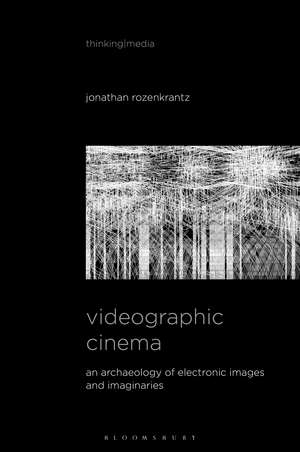
Videographic Cinema: An Archaeology of Electronic Images and Imaginaries: Thinking Media
Autor Jonathan Rozenkrantzen Limba Engleză Paperback – 21 apr 2022
Rediscovering forgotten films like Anti-Clock (1979) and reassessing ones like Lost Highway (1997), Jonathan Rozenkrantz charts neglected chapters of video history, including self-confrontation techniques in psychiatry, their complex relation with surveillance, and the invention/discovery of the "videographic psyche" by artists, therapists and filmmakers. Spanning six decades, Videographic Cinema discovers an epistemic shift from prospective imaginaries of surveillance and control conditioned on video as a medium for live transmission, to retrospective ones concerned with videotape as a recording memory. It ends by considering videographic filmmaking itself as a form of archaeology in the age of analogue obsolescence.
Din seria Thinking Media
- nou
 Preț: 595.77 lei
 - 46%
 Preț: 906.77 lei
 - 16%
 Preț: 278.45 lei
 - 25%
 Preț: 279.08 lei
 - 24%
 Preț: 258.84 lei
 - 24%
 Preț: 186.96 lei
 -
![Eigenvalue: On the Gradual Contraction of Media in Movement; Contemplating Media in Art [Sound Image Sense]](https://i2.books-express.ro/bs/9781501363177/eigenvalue.jpg) Preț: 241.24 lei
Preț: 241.24 lei - 26%
 Preț: 246.35 lei
 - 24%
 Preț: 233.22 lei
 - 26%
 Preț: 211.93 lei
 - 25%
 Preț: 215.77 lei
 - 31%
 Preț: 210.27 lei
 - 25%
 Preț: 215.96 lei
 - 26%
 Preț: 210.06 lei
 - 25%
 Preț: 209.30 lei
 - 28%
 Preț: 207.60 lei
 - 25%
 Preț: 210.16 lei
 - 28%
 Preț: 207.60 lei
 - 36%
 Preț: 583.98 lei
 - 32%
 Preț: 603.45 lei
 - 26%
 Preț: 205.24 lei
 - 26%
 Preț: 204.56 lei
 - 33%
 Preț: 582.43 lei
 - 32%
 Preț: 595.89 lei
 - 32%
 Preț: 628.64 lei
 - nou
 Preț: 595.66 lei
Preț: 212.38 lei
Preț vechi: 306.26 lei
-31%
Puncte Express: 319
Carte tipărită la comandă
Livrare economică 26 noiembrie-10 decembrie
Livrare prin curier în România Termenul estimat este afișat lângă disponibilitate.
Transport gratuit de la 400.00 lei Plată online sau ramburs, în funcție de opțiunile comenzii.
Retur gratuit în 14 zile Comandă securizată și suport în română.
Specificații
ISBN-13: 9781501369315
ISBN-10: 1501369318
Pagini: 228
Dimensiuni: 138 x 214 x 12 mm
Greutate: 0.28 kg
Editura: Bloomsbury Publishing
Colecția Bloomsbury Academic
Seria Thinking Media
Locul publicării:New York, United States
ISBN-10: 1501369318
Pagini: 228
Dimensiuni: 138 x 214 x 12 mm
Greutate: 0.28 kg
Editura: Bloomsbury Publishing
Colecția Bloomsbury Academic
Seria Thinking Media
Locul publicării:New York, United States
Cuprins
Conditions
1. What is Videographic Cinema?
2. Archaeology How?
Part 1 - Emergence
1. Futurity Effects: The Emergence of Videographic Cinema
2. Canned Life: Imagining Reality TV
3. Autopticon: Video Therapy and/as Surveillance
Part 2 - Remanence
4. Mnemopticon: Creative Treatment of Psychic Reality
5. Vilified Videophiles: Nightmares of Video's Home Invasion
6. Arrière-Garde: Videographic Cinema as Media Archaeology
Conclusions
Bibliography
Index
1. What is Videographic Cinema?
2. Archaeology How?
Part 1 - Emergence
1. Futurity Effects: The Emergence of Videographic Cinema
2. Canned Life: Imagining Reality TV
3. Autopticon: Video Therapy and/as Surveillance
Part 2 - Remanence
4. Mnemopticon: Creative Treatment of Psychic Reality
5. Vilified Videophiles: Nightmares of Video's Home Invasion
6. Arrière-Garde: Videographic Cinema as Media Archaeology
Conclusions
Bibliography
Index
Recenzii
This take on expanded video offers a compelling scholarly approach to the other of cinema - or more accurately, as Rozenkrantz demonstrates: we need to pay attention to the media archaeological ties and remediations that define the materiality of moving images. Videographic Cinema maps those material aesthetics, but also the second-order echoes of the medium. Rozenkrantz skilfully maps how cinema, video, and TV have contaminated each other; this mingle defines their dynamic transformations. A joy to read.
In traditional media history, video enters the scene in the late 1970s with commercial home video. Jonathan Rozenkrantz' highly original study proposes an alternative history of the cinema vis-à-vis its bastard rival-video. With an eclectic mix of films which burst apart the tired canon and a refreshingly unorthodox grasp of theory, Videographic Cinema formulates a different view of media as epistemologically unstable entities. This brilliant study will be valuable to many fields such as media archaeology, post-cinema, intermediality, media philosophy, and film studies.
Videographic Cinema is a deeply inventive, multi-layered probe into the lifeblood of a specific set of analogue video images from the 1950s to the mid-2010s. Rather than read these images in terms of their media affects (what do we see and how do we experience what appears on the screen?), Jonathan Rozenkrantz insteads shows us what it means to read them in terms of their media conditions (what are the unique affordances, techniques, and even larger institutional contexts that produce these images?). This book shows us, with remarkable clarity, that the obscolesence of video provides us with an opportunity to see that it has always been, as Rozenkrantz deftly puts it, "inherently heterogeneous, historically shifting, and epistemically unstable".
In this wonderfully eye-opening book, Jonathan Rozenkrantz seizes on the video image in cinema not just as a set of recurring narrative and visual tropes, but as a way of conceptualizing the medium of video itself. He combines sharp analysis of videographic films with theoretical insight into these two intersecting media. And he brings together some familiar and some more obscure films in a way that will both help us both to see videographic film classics in a new light, and to set an agenda for new discoveries.
In traditional media history, video enters the scene in the late 1970s with commercial home video. Jonathan Rozenkrantz' highly original study proposes an alternative history of the cinema vis-à-vis its bastard rival-video. With an eclectic mix of films which burst apart the tired canon and a refreshingly unorthodox grasp of theory, Videographic Cinema formulates a different view of media as epistemologically unstable entities. This brilliant study will be valuable to many fields such as media archaeology, post-cinema, intermediality, media philosophy, and film studies.
Videographic Cinema is a deeply inventive, multi-layered probe into the lifeblood of a specific set of analogue video images from the 1950s to the mid-2010s. Rather than read these images in terms of their media affects (what do we see and how do we experience what appears on the screen?), Jonathan Rozenkrantz insteads shows us what it means to read them in terms of their media conditions (what are the unique affordances, techniques, and even larger institutional contexts that produce these images?). This book shows us, with remarkable clarity, that the obscolesence of video provides us with an opportunity to see that it has always been, as Rozenkrantz deftly puts it, "inherently heterogeneous, historically shifting, and epistemically unstable".
In this wonderfully eye-opening book, Jonathan Rozenkrantz seizes on the video image in cinema not just as a set of recurring narrative and visual tropes, but as a way of conceptualizing the medium of video itself. He combines sharp analysis of videographic films with theoretical insight into these two intersecting media. And he brings together some familiar and some more obscure films in a way that will both help us both to see videographic film classics in a new light, and to set an agenda for new discoveries.