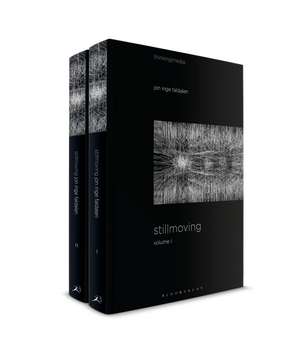
Stillmoving: Thinking Media
Autor Jon Inge Faldalenen Limba Engleză – 19 feb 2026
Jon Inge Faldalen's volumes are a theoretical exploration of the concept of Einstellung. The author keeps the original German term, capitalizing on the ambiguity inherent in this type of image phenomenon; in this case, the long take, or at least a continuous unbroken take, effected by an immobile camera whose captured content could potentially contain perceptible movements produced by entities within the composition framed. The author embraces neologisms in order to capture specific aesthetic-technical phenomena more accurately than has hitherto been possible.
Stillmoving I is a theoretical exploration of the concept of Einstellung. The author asks whether this image is a still image, or a moving image, or both, or neither, or, finally, what Faldalen terms stillmoving. Underlying these deliberations is the question of how cinema represents or mediates stillness. It unfolds over three chapters that examine the concept of still Einstellung in relation to slow cinema scholarship throughout the last two decades, in relation to approaches referred to as stillmoving scholarship, and in relation to reflections and shadows.
Stillmoving II continues the work of the first volume, exploring the concept of Einstellung through a small set of specific case studies, including Louis Lumière's Quai de l'Archevêché (Lumière operator, 1896), André Bazin's analysis of the kitchen scene in The Magnificent Ambersons (Orson Welles, 1942), and James Benning's Stemple Pass (2012), as well as what the author calls "digital imagenesis," which concerns the MPEG compression codec.
Din seria Thinking Media
- nou
 Preț: 595.77 lei
 - 16%
 Preț: 278.45 lei
 - 25%
 Preț: 279.08 lei
 - 24%
 Preț: 258.84 lei
 - 24%
 Preț: 186.96 lei
 -
![Eigenvalue: On the Gradual Contraction of Media in Movement; Contemplating Media in Art [Sound Image Sense]](https://i2.books-express.ro/bs/9781501363177/eigenvalue.jpg) Preț: 241.24 lei
Preț: 241.24 lei - 26%
 Preț: 246.35 lei
 - 24%
 Preț: 233.22 lei
 - 26%
 Preț: 211.93 lei
 - 31%
 Preț: 212.38 lei
 - 25%
 Preț: 215.77 lei
 - 31%
 Preț: 210.27 lei
 - 25%
 Preț: 215.96 lei
 - 26%
 Preț: 210.06 lei
 - 25%
 Preț: 209.30 lei
 - 28%
 Preț: 207.60 lei
 - 25%
 Preț: 210.16 lei
 - 28%
 Preț: 207.60 lei
 - 36%
 Preț: 583.98 lei
 - 32%
 Preț: 603.45 lei
 - 26%
 Preț: 205.24 lei
 - 26%
 Preț: 204.56 lei
 - 33%
 Preț: 582.43 lei
 - 32%
 Preț: 595.89 lei
 - 32%
 Preț: 628.64 lei
 - nou
 Preț: 595.66 lei
Preț: 906.77 lei
Preț vechi: 1671.01 lei
-46%
Puncte Express: 1360
Disponibil
Livrare economică 05-19 noiembrie
Livrare prin curier în România Termenul estimat este afișat lângă disponibilitate.
Transport gratuit pentru acest produs Plată online sau ramburs, în funcție de opțiunile comenzii.
Retur gratuit în 14 zile Comandă securizată și suport în română.
Specificații
ISBN-13: 9798765129012
Ilustrații: 78 bw illus
Dimensiuni: 160 x 236 x 44 mm
Greutate: 1.16 kg
Editura: Bloomsbury Publishing
Colecția Bloomsbury Academic
Seria Thinking Media
Locul publicării:New York, United States
Ilustrații: 78 bw illus
Dimensiuni: 160 x 236 x 44 mm
Greutate: 1.16 kg
Editura: Bloomsbury Publishing
Colecția Bloomsbury Academic
Seria Thinking Media
Locul publicării:New York, United States
Cuprins
Stillmoving I
Acknowledgments
Ten theses learnt from a foundational figure of style
Introduction: Still Einstellung
Interlude: Einstellung
1. STILL STILL AT STAKE: FROM SLOW CINEMAS TO A STILL CINEMA
Still Einstellung In Slow Cinema Scholarship (2000-2020) - And What Is Still At Stake?
2. A BOTH/NEITHER BENEATH BETWEENS? FROM STILL MOVING TO STILLMOVING (Part 1)
Still Einstellung In Still Moving Scholarship (2000-2020) - And What Is Still At Stake?
3. STILL EINSTELLUNG: STILLMOVING IMAGENESIS (DISCOURSE, 2014) A First Contribution
Index
Stillmoving II
Acknowledgements
Foreword: Disarming of the Eye-And Camera
(Still) Einstellung And/As Ethics Of Recognition
1. A BOTH/NEITHER BENEATH BETWEENS? FROM STILL MOVING TO STILLMOVING (Part 2)
Still Einstellung In Still moving Scholarship (2011-2020) - And What Is Still At Stake?
2. THE FIRST EINSTELLUNG OF FILM WAS STILL
Louis Lumière And Film Frames That "Coincide Exactly" And Are "Rigorously Identical"
Case Study I: Quai de l'Archevêché (Lumière Operator, 1896) Early Contemplative Film
3. AS IF SWADDLING STILLNESS: WHAT CINEMA IS AS WELL
Case study II: The Magnificent Ambersons (Orson Welles, 1942) André Bazin And "The Immobility Of The Sequence Shot"
The Magnificent Ambersons Beyond Bazin
Conclusion: STILLMOVING - A DIFFERENT KIND OF IMAGE
Case Study III: The MPEG Compression Codec
Index
Acknowledgments
Ten theses learnt from a foundational figure of style
Introduction: Still Einstellung
Interlude: Einstellung
1. STILL STILL AT STAKE: FROM SLOW CINEMAS TO A STILL CINEMA
Still Einstellung In Slow Cinema Scholarship (2000-2020) - And What Is Still At Stake?
2. A BOTH/NEITHER BENEATH BETWEENS? FROM STILL MOVING TO STILLMOVING (Part 1)
Still Einstellung In Still Moving Scholarship (2000-2020) - And What Is Still At Stake?
3. STILL EINSTELLUNG: STILLMOVING IMAGENESIS (DISCOURSE, 2014) A First Contribution
Index
Stillmoving II
Acknowledgements
Foreword: Disarming of the Eye-And Camera
(Still) Einstellung And/As Ethics Of Recognition
1. A BOTH/NEITHER BENEATH BETWEENS? FROM STILL MOVING TO STILLMOVING (Part 2)
Still Einstellung In Still moving Scholarship (2011-2020) - And What Is Still At Stake?
2. THE FIRST EINSTELLUNG OF FILM WAS STILL
Louis Lumière And Film Frames That "Coincide Exactly" And Are "Rigorously Identical"
Case Study I: Quai de l'Archevêché (Lumière Operator, 1896) Early Contemplative Film
3. AS IF SWADDLING STILLNESS: WHAT CINEMA IS AS WELL
Case study II: The Magnificent Ambersons (Orson Welles, 1942) André Bazin And "The Immobility Of The Sequence Shot"
The Magnificent Ambersons Beyond Bazin
Conclusion: STILLMOVING - A DIFFERENT KIND OF IMAGE
Case Study III: The MPEG Compression Codec
Index
Recenzii
Theoretically ambitious and analytically astute, the two volumes of Stillmoving represent a major work of film theory. Bristling with sharp observations, the books demonstrate a remarkable range through their engagements with filmmakers from Louis Lumière to James Benning. Through their impressive scope, persistent inquisitiveness and richly fraternizing attitude toward the history of film theory, the volumes promise to be an indispensable contribution to the tradition of serious cinema scholarship.
What do we see, what do we perceive in aesthetic practices of moving images?
Faldalen's two volumes courageously propose new terms for the processes of perception: Stillmoving and Imagenesis. While Stillmoving reflects the ongoing movement in a still, Imagenesis reflects the kind of image that rises from a stillmoving shot. With this conceptual framework, Faldalen unlocks new views and readings of major filmic, as well as digital, work - challenging both former notions and readings of film theorists like Balàzs and Bazin and artistic works from William Wyler to James Benning.
What do we see, what do we perceive in aesthetic practices of moving images?
Faldalen's two volumes courageously propose new terms for the processes of perception: Stillmoving and Imagenesis. While Stillmoving reflects the ongoing movement in a still, Imagenesis reflects the kind of image that rises from a stillmoving shot. With this conceptual framework, Faldalen unlocks new views and readings of major filmic, as well as digital, work - challenging both former notions and readings of film theorists like Balàzs and Bazin and artistic works from William Wyler to James Benning.