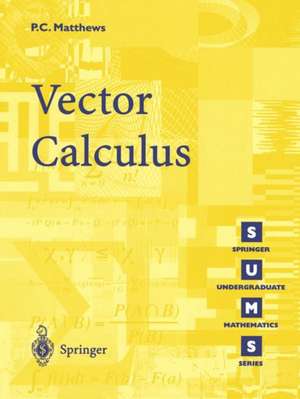
Vector Calculus: Springer Undergraduate Mathematics Series
Autor Paul C. Matthewsen Limba Engleză Paperback – 14 ian 1998
Evoluția fizicii matematice moderne a impus calculul vectorial ca limbaj fundamental pentru descrierea fenomenelor în spațiul tridimensional. Vector Calculus reflectă această necesitate, transformând o disciplină adesea percepută ca abstractă într-un instrument de lucru indispensabil pentru dinamica fluidelor, mecanică sau electromagnetism. În cadrul seriei Springer Undergraduate Mathematics Series, această lucrare se distinge printr-o rigoare matematică dublată de o intuiție fizică remarcabilă, fiind structurată special pentru studiul individual. Observăm că abordarea lui Paul C. Matthews este una incrementală. Primele capitole pun bazele algebrei vectoriale, trecând rapid către metode de integrare pe linie, suprafață și volum. Un punct forte al structurii este capitolul dedicat notației cu indici (suffix notation), un instrument tehnic esențial pentru manipularea operatorilor grad, div și curl, care pregătește terenul pentru teoremele fundamentale ale lui Stokes și Gauss. Comparativ cu Elementary Vector Calculus and Its Applications with MATLAB Programming de Nita H. Shah, care mizează pe suport computațional, volumul de față rămâne fidel metodei analitice clasice, fiind mai apropiat ca spirit de Vector Analysis de N. Kemmer prin modul în care fundamentează conceptele pe modele fizice concrete. Poziționând lucrarea în contextul operei autorului, notăm o continuitate metodologică între acest volum și Differential Equations, Bifurcations and Chaos. Dacă în studiul haosului Paul C. Matthews punea accent pe metode calitative, aici el prioritizează claritatea geometrică și vizuală, utilizând peste 60 de diagrame pentru a explica variația cantităților scalare și vectoriale. Este o resursă care nu doar prezintă formule, ci construiește o înțelegere structurală a modului în care matematica descrie lumea fizică.
Din seria Springer Undergraduate Mathematics Series
-
 Preț: 373.88 lei
 -
 Preț: 366.50 lei
 - 13%
 Preț: 403.14 lei
 -
 Preț: 422.57 lei
 -
 Preț: 265.98 lei
 -
 Preț: 413.31 lei
 -
 Preț: 390.50 lei
 -
 Preț: 414.81 lei
 -
 Preț: 333.42 lei
 -
 Preț: 377.08 lei
 - 20%
 Preț: 374.59 lei
 -
 Preț: 404.72 lei
 -
 Preț: 432.38 lei
 -
 Preț: 360.97 lei
 -
 Preț: 275.01 lei
 -
 Preț: 301.31 lei
 -
 Preț: 261.80 lei
 -
 Preț: 269.23 lei
 -
 Preț: 267.01 lei
 -
 Preț: 362.56 lei
 -
 Preț: 270.56 lei
 -
 Preț: 276.73 lei
 -
 Preț: 275.18 lei
 -
 Preț: 273.62 lei
 -
 Preț: 254.58 lei
 -
 Preț: 267.93 lei
 -
 Preț: 260.53 lei
 -
 Preț: 356.95 lei
 -
 Preț: 353.46 lei
 -
 Preț: 271.48 lei
 - 15%
 Preț: 506.44 lei
 -
 Preț: 272.80 lei
 -
 Preț: 265.85 lei
 -
 Preț: 275.65 lei
 -
 Preț: 280.67 lei
 -
 Preț: 259.16 lei
 -
 Preț: 274.44 lei
 -
 Preț: 323.68 lei
 -
 Preț: 281.19 lei
 -
 Preț: 274.20 lei
 -
 Preț: 272.46 lei
 -
 Preț: 265.55 lei
 -
 Preț: 271.25 lei
 -
 Preț: 269.79 lei
 -
 Preț: 257.69 lei
 -
 Preț: 254.70 lei
 -
 Preț: 270.73 lei
 -
 Preț: 266.17 lei
 -
 Preț: 274.71 lei
Preț: 267.95 lei
Carte tipărită la comandă
Livrare economică 09-23 noiembrie
Specificații
ISBN-10: 3540761802
Pagini: 196
Ilustrații: X, 182 p. 1 illus.
Dimensiuni: 178 x 235 x 11 mm
Greutate: 0.35 kg
Ediția:1998
Editura: Springer
Colecția Springer Undergraduate Mathematics Series
Seria Springer Undergraduate Mathematics Series
Locul publicării:London, United Kingdom
V-ar putea interesa
-
 -15%Preț: 710.49 lei835.86 lei
 -
 Fundamentals of CalculusCarla C. Morris-27%Preț: 825.48 lei1130.80 lei
 -
 -23%Preț: 634.58 lei824.12 lei
 -
 -9%Preț: 751.86 lei826.22 lei
 -
 Calculus For DummiesMark RyanPreț: 108.40 lei
 -
 Calculus: Early TranscendentalsWilliam Briggs-15%Preț: 576.28 lei679.82 lei
 -
 Numerical Methods For Simulationde Saporta-9%Preț: 987.44 lei1085.10 lei
Public țintă
Lower undergraduateDe ce să citești această carte
Această carte este ideală pentru studenții la matematică sau fizică care au nevoie de o introducere concisă, dar riguroasă, în calculul vectorial. Cititorul câștigă o înțelegere clară a teoremelor integrale și a operatorilor diferențiali, sprijinită de numeroase exemple lucrate și diagrame. Este recomandată datorită modului în care face tranziția de la calculul multivariat de bază la aplicațiile complexe din electromagnetism și mecanica fluidelor.
Descriere scurtă
Cuprins
Recenzii
Vector Calculus
"Written for undergraduate students in mathematics, the book covers the material in a comprehensive but concise manner, combining mathematical rigor with physical insight. There are many diagrams to illustrate the physical meaning of the mathematical concepts, which essential for a full understanding of the subject." — ZENTRALBLATT MATH