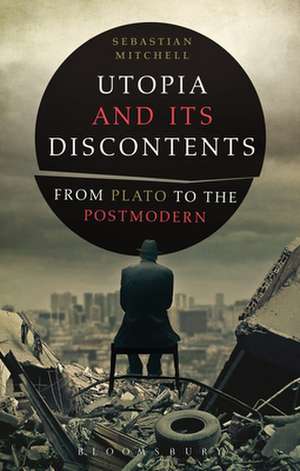
Utopia and Its Discontents: Plato to Atwood
Autor Dr Sebastian Mitchellen Limba Engleză Paperback – 24 mar 2022
Utopia and Its Discontents traces literary representations of ideal communities from Plato to the 21st century. Each chapter offers close readings of key utopian and anti-utopian texts to demonstrate how they construct, challenge and explore the ideas and forms of earlier utopian writings and the social and political ideals of their own periods. In this original and insightful study, Sebastian Mitchell demonstrates how literary utopias are often as much about the past as they are about the present and the future. Utopia and Its Discontents concludes by arguing against the idea that the utopian has been eclipsed by the dystopian in contemporary culture.
Topics covered include: - Early political and philosophical authors, such as Plato and Thomas More- Literary works, from Jonathan Swift's Gulliver's Travels to George Orwell's Nineteen Eighty-Four
- Speculative-fiction writers such as H.G. Wells, Aldous Huxley and Margaret Atwood
- Ecological and feminist texts by Ernest Callenbach, Ursula Le Guin and Marge Piercy
> This is an essential study for scholars and students of utopian literature.
Preț: 222.88 lei
Preț vechi: 314.36 lei
-29%
Puncte Express: 334
Carte tipărită la comandă
Livrare economică 04-18 decembrie
Livrare prin curier în România Termenul estimat este afișat lângă disponibilitate.
Transport gratuit de la 400.00 lei Plată online sau ramburs, în funcție de opțiunile comenzii.
Retur gratuit în 14 zile Comandă securizată și suport în română.
Specificații
ISBN-13: 9781441109637
ISBN-10: 1441109633
Pagini: 266
Ilustrații: 2 bw illus
Dimensiuni: 152 x 232 x 18 mm
Greutate: 0.5 kg
Ediția:annotated ed.
Editura: Bloomsbury Publishing
Colecția Bloomsbury Academic
Locul publicării:London, United Kingdom
ISBN-10: 1441109633
Pagini: 266
Ilustrații: 2 bw illus
Dimensiuni: 152 x 232 x 18 mm
Greutate: 0.5 kg
Ediția:annotated ed.
Editura: Bloomsbury Publishing
Colecția Bloomsbury Academic
Locul publicării:London, United Kingdom
V-ar putea interesa
-
 Reading Constellations: Urban Modernity in Victorian FictionPatricia McKee-29%Preț: 470.60 lei658.54 lei
 -
 Gothic HauntingsChristine BerthinPreț: 399.29 lei
 -
 Imagining Transatlantic SlaveryC. KaplanPreț: 401.09 lei
 -
 The Long and the Short of ItJoseph A. DanePreț: 201.01 lei
 -
 Preț: 495.18 lei
 -
 The NovelMichael SchmidtPreț: 342.59 lei
 -
 Preț: 220.17 lei
 -
 Great AcceleratorPaul VirilioPreț: 127.38 lei
 -
 Literary CriticismGary Day-15%Preț: 209.05 lei246.03 lei
 -
 Preț: 381.84 lei
 -
 Preț: 153.68 lei
 -
 MythologiesRoland BarthesPreț: 100.77 lei
 -
 I Think I Am: Philip K. DickLaurence A. RickelsPreț: 233.81 lei
 -
 The Feeling of KinshipDavid L. EngPreț: 210.97 lei
 -
 Dictionary of Cultural and CriMichael PaynePreț: 432.07 lei
 -
 A Companion to Comparative LiteratureAli BehdadPreț: 434.01 lei
 -
 Literary Criticism in the 21st Century: Theory RenaissanceVincent B. Leitch-17%Preț: 205.33 lei247.25 lei
 -
 -22%Preț: 273.26 lei349.00 lei
 -
 Distant ReadingFranco MorettiPreț: 142.34 lei
 -
 An Ecology of World LiteratureAlexander BeecroftPreț: 213.80 lei
 -
 Against World LiteratureEmily ApterPreț: 254.61 lei
 -
 -20%Preț: 185.03 lei232.35 lei
 -
 The Household Tips of the Great WritersMark CrickPreț: 98.17 lei
Descriere
Utopia and its Discontents traces literary representations of ideal communities from Plato to the 21st century. Each chapter offers close readings of key utopian and anti-utopian texts to demonstrate how they construct, challenge and explore the ideas and forms of earlier utopian writings and the social and political ideals of their own periods. The book explores how literary utopias are often as much about the past as they are about the present and the future.
Utopia and Its Discontents covers such topics as:
- Early political and philosophical writers, such as Aristotle and Thomas More
- Literary works, from Voltaire's Candide to George Orwell's 1984
- Science fiction writers such as H.G. Wells, Aldous Huxley and Brian Aldiss
- Ecological and feminist texts by Ursula Le Guin and Margaret Atwood
- Utopian cinema, from Fritz Lang's Metropolis to Ridley Scott's Blade Runner
With annotated chapter-by-chapter guides to further reading, this is an essential study for students and scholars of utopian literature.
Utopia and Its Discontents covers such topics as:
- Early political and philosophical writers, such as Aristotle and Thomas More
- Literary works, from Voltaire's Candide to George Orwell's 1984
- Science fiction writers such as H.G. Wells, Aldous Huxley and Brian Aldiss
- Ecological and feminist texts by Ursula Le Guin and Margaret Atwood
- Utopian cinema, from Fritz Lang's Metropolis to Ridley Scott's Blade Runner
With annotated chapter-by-chapter guides to further reading, this is an essential study for students and scholars of utopian literature.
Cuprins
Introduction
1. The Republic
2. Utopia and Meta-Utopia
3. Happiness and Optimism
4. Back to the Future
5. English Triptych
6. Ecology and Feminism in the 1970s
7. New Millennium
8. Utopian Cinema
Conclusion
Chapter-by-chapter guide to key works and further reading
Bibliography
Index
1. The Republic
2. Utopia and Meta-Utopia
3. Happiness and Optimism
4. Back to the Future
5. English Triptych
6. Ecology and Feminism in the 1970s
7. New Millennium
8. Utopian Cinema
Conclusion
Chapter-by-chapter guide to key works and further reading
Bibliography
Index
Recenzii
Sharp, committed, and compelling ... a welcome addition to the syllabus of a course on utopian fiction.
[A] rich and engaging study of utopian literature which brings the texts into dialogue with one another in new and productive ways. Utopia and Its Discontents will be essential and rewarding reading not only for scholars and students of utopian literature, but for any reader looking towards utopia, in all its many manifestations, in a dystopian age.
This is a readable but penetrating survey of the main trends in utopian literature from the ancients to the present. Mitchell engages enthusiastically with both the key utopian literary writers and the more intractable and ambiguous contributors to the tradition - the "discontents", some satirists, like Swift, some dystopians. Many of these are conceived as engaging with Plato above all; the tradition itself is glued together by Platonism. Mitchell writes with sympathy as well as authority about its leading authors. The main literary thinkers are all assessed, and there are some unusual but welcome guest appearances in the cast of characters too, notably by Thomas Carlyle, whose Past and Present has remained a long-neglected contribution to utopian ideas. Mitchell controversially suggests that a close proximity exists between utopian and dystopian modes of thought, but modern readers have increasingly warmed to this once-provocative notion. Yet to Mitchell the literary concept still has life and an enchantment about it which still enjoins new generations of readers to reconsider its implications. This is a thoughtful and welcome addition to utopian scholarship.
Utopia and its Discontents is a thoughtful and lucid trans-historical study of literary utopianism from Plato to Margaret Atwood. It successfully explores the formal and generic aesthetics of literary utopias in a variety of case studies of prominent writers. The author reminds us that despite the dystopian turn of the twentieth and twenty-first century, the literary utopian 'expressiveness' is still going strong, if in varied and complex new forms.
From Plato's Republic to Margaret Atwood's MaddAddam trilogy, literary and philosophical visions of the good society have wrestled with the relationship between utopian dream and authoritarian control. Dystopian narratives might be popular right now but, as Mitchell insists in Utopia and Its Discontents, utopia is far from an abandoned mode of literary representation - indeed, it remains a vital imaginative resource in the 21st century.
[A] rich and engaging study of utopian literature which brings the texts into dialogue with one another in new and productive ways. Utopia and Its Discontents will be essential and rewarding reading not only for scholars and students of utopian literature, but for any reader looking towards utopia, in all its many manifestations, in a dystopian age.
This is a readable but penetrating survey of the main trends in utopian literature from the ancients to the present. Mitchell engages enthusiastically with both the key utopian literary writers and the more intractable and ambiguous contributors to the tradition - the "discontents", some satirists, like Swift, some dystopians. Many of these are conceived as engaging with Plato above all; the tradition itself is glued together by Platonism. Mitchell writes with sympathy as well as authority about its leading authors. The main literary thinkers are all assessed, and there are some unusual but welcome guest appearances in the cast of characters too, notably by Thomas Carlyle, whose Past and Present has remained a long-neglected contribution to utopian ideas. Mitchell controversially suggests that a close proximity exists between utopian and dystopian modes of thought, but modern readers have increasingly warmed to this once-provocative notion. Yet to Mitchell the literary concept still has life and an enchantment about it which still enjoins new generations of readers to reconsider its implications. This is a thoughtful and welcome addition to utopian scholarship.
Utopia and its Discontents is a thoughtful and lucid trans-historical study of literary utopianism from Plato to Margaret Atwood. It successfully explores the formal and generic aesthetics of literary utopias in a variety of case studies of prominent writers. The author reminds us that despite the dystopian turn of the twentieth and twenty-first century, the literary utopian 'expressiveness' is still going strong, if in varied and complex new forms.
From Plato's Republic to Margaret Atwood's MaddAddam trilogy, literary and philosophical visions of the good society have wrestled with the relationship between utopian dream and authoritarian control. Dystopian narratives might be popular right now but, as Mitchell insists in Utopia and Its Discontents, utopia is far from an abandoned mode of literary representation - indeed, it remains a vital imaginative resource in the 21st century.