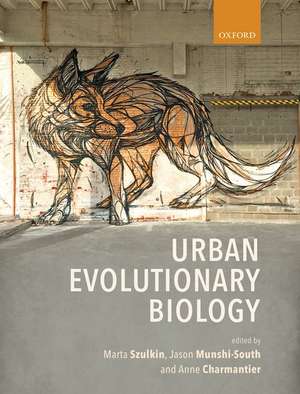
Urban Evolutionary Biology
Editat de Marta Szulkin, Jason Munshi-South, Anne Charmantieren Limba Engleză Paperback – 5 mai 2020
Descoperim în Urban Evolutionary Biology prima lucrare academică de amploare care sintetizează evoluția organismelor sălbatice în mediul construit, un domeniu care a fost mult timp neglijat în favoarea ecosistemelor „naturale”. Subliniem faptul că această apariție editorială marchează maturizarea disciplinei, transformând orașul dintr-o simplă perturbare ecologică într-un laborator experimental riguros. Structura volumului, coordonat de Marta Szulkin, Jason Munshi-South și Anne Charmantier, ghidează cititorul de la fundamentele metodologice — cum cuantificăm exact urbanizarea în studii evolutive — până la mecanisme complexe precum fluxul de gene și genomica adaptării.
Remarcăm o progresie logică a conținutului: după stabilirea cadrului teoretic în primele capitole, textul explorează consecințele specifice ale fenomenelor urbane, cum ar fi „insulele de căldură”, asupra selecției naturale. Lucrarea acoperă o arie similară cu Darwin Comes to Town de Menno Schilthuizen, însă abordarea este fundamental diferită: în timp ce volumul lui Schilthuizen este o introducere narativă pentru publicul larg, Urban Evolutionary Biology este un manual tehnic, interdisciplinar, axat pe metode analitice și date empirice. De asemenea, față de The Biology of Urban Environments de Philip James, care oferă o privire generală asupra ecologiei urbane, acest titlu se concentrează strict pe mecanismele genetice și evolutive care permit speciilor să se transforme sub presiunea activității umane. Este o resursă esențială care demonstrează cum variația mediului urban, ușor de cuantificat, oferă oportunități unice pentru testarea ipotezelor despre evoluția rapidă.
Preț: 397.00 lei
Preț vechi: 501.40 lei
-21%
Carte tipărită la comandă
Livrare economică 10-16 decembrie
Specificații
ISBN-10: 0198836856
Pagini: 320
Dimensiuni: 187 x 255 x 16 mm
Greutate: 0.65 kg
Editura: OUP OXFORD
Colecția OUP Oxford
Locul publicării:Oxford, United Kingdom
V-ar putea interesa
-
 -28%Preț: 436.26 lei605.86 lei
-
 -31%Preț: 886.28 lei1292.48 lei
-
 Biology of AggressionRandy J. Nelson-31%Preț: 828.10 lei1200.35 lei
-
 Bee Pollination in Agricultural Eco-systemsRosalind James-30%Preț: 732.10 lei1047.67 lei
-
 Energy for Animal LifeR. McNeill Alexander-29%Preț: 376.73 lei527.52 lei
-
 Animal InnovationSimon M. Reader-28%Preț: 468.04 lei651.61 lei
-
 How Homo Became Sapiens: On the evolution of thinkingPeter Gärdenfors-27%Preț: 452.39 lei622.89 lei
-
 Observing Animal Behaviour: Design and analysis of quantitative dataMarian Stamp Dawkins-22%Preț: 442.82 lei565.47 lei
-
 Animal Behaviour: A Very Short IntroductionTristram D. Wyatt-19%Preț: 57.46 lei71.12 lei
-
 Plant Behaviour and IntelligenceAnthony Trewavas-20%Preț: 437.54 lei544.64 lei
-
 Sociobiology of Communication: an interdisciplinary perspectivePatrizia d'Ettorre-28%Preț: 381.26 lei526.89 lei
-
 Host Manipulation by ParasitesDavid P. Hughes-25%Preț: 526.66 lei703.68 lei
-
 Quantitative Genetics in the WildAnne Charmantier-20%Preț: 552.55 lei690.36 lei
-
 Zoo Animals: Behaviour, Management, and WelfareGeoff Hosey-18%Preț: 441.88 lei537.53 lei
-
 Patterns of Behavior: Konrad Lorenz, Niko Tinbergen, and the Founding of EthologyRichard W. Burkhardt, Jr.Preț: 456.20 lei
-
 Animal Minds: Beyond Cognition to ConsciousnessDonald R. GriffinPreț: 391.12 lei
-
 Handbook of Clinical Child NeuropsychologyElaine Fletcher-Janzen-20%Preț: 1287.36 lei1609.19 lei
-
 King Solomon's RingKonrad LorenzPreț: 172.13 lei
-
 Behavior Guide to African MammalsRichard Despard EstesPreț: 334.09 lei
-
 Animal HomosexualityAldo PoianiPreț: 482.76 lei
-
 Ecology and Evolution of Cooperative Breeding in BirdsWalter D. Koenig-11%Preț: 598.30 lei672.25 lei
-
 Social BehaviourTamás Székely-5%Preț: 470.16 lei494.90 lei
-
 The Dog's MindBruce Fogle-19%Preț: 99.63 lei122.40 lei
-
 Principles of Animal CommunicationJack W. Bradbury-27%Preț: 1377.35 lei1886.79 lei
-
 Wild ConnectionJennifer L. VerdolinPreț: 156.28 lei
De ce să citești această carte
Această carte se adresează studenților la masterat, cercetătorilor și practicienilor din domeniul ecologiei urbane care doresc să înțeleagă bazele genetice ale adaptării în orașe. Cititorul câștigă o perspectivă riguroasă asupra modului în care selecția naturală operează în timp real sub ochii noștri, beneficiind de un cadru metodologic clar pentru a studia biologia evolutivă într-un context dominat de om.
Despre autor
Volumul este editat de o echipă de experți de renume internațional în ecologia evolutivă. Marta Szulkin este profesor asociat la Centrul de Noi Tehnologii, Universitatea din Varșovia, fiind specializată în studiul selecției naturale în medii antropizate. Jason Munshi-South activează la Universitatea Fordham din New York, unde conduce cercetări de pionierat în genetica peisajului urban, concentrându-se pe modul în care infrastructura orașelor influențează mișcarea și evoluția populațiilor de mamifere. Anne Charmantier este director de cercetare la CNRS în Montpellier, Franța, având o experiență vastă în studiul adaptării păsărilor la medii în schimbare, contribuind esențial la înțelegerea mecanismelor de selecție în habitate urbane.
Descriere
Recenzii
Urban Evolutionary Biology fills an important knowledge gap on wild organismal evolution in the urban environment, whilst offering a novel exploration of the fast-growing new field of evolutionary research.
Notă biografică
Cuprins
- Foreword
- 1: Marta Szulkin, Jason Munshi-South and Anne Charmantier: Introduction
- 2: Marta Szulkin, Colin J. Garroway, Michela Corsini, Andrzej Z. Kotarba and Davide Dominoni: How to quantify urbanisation when testing for urban evolution
- 3: James S. Santangelo, Lindsay S. Miles, Sophie T. Breitbart, David Murray-Stoker, L. Ruth Rivkin, Marc T. J. Johnson and Rob W. Ness: Urban environments as a framework to study parallel evolution
- 4: Jason Munshi-South and Jonathan L. Richardson: Landscape genetic approaches to understanding movement and gene flow in cities
- 5: Charles Perrier, Aude Caizergues and Anne Charmantier: Adaptation genomics in urban environments
- 6: Sarah E. Diamond and Ryan A. Martin: Evolutionary consequences of the urban heat island
- 7: Rebecca E. Irwin, Elsa Youngsteadt, Paige S. Warren and Judith L. Bronstein: The evolutionary ecology of mutualisms in urban landscapes
- 8: P.O. Cheptou and S. Lambrecht: Sidewalk plants as a model for studying adaptation to urban environments
- 9: Amanda J. Gorton, Liana T. Burghardt and Peter Tiffin: Adaptive evolution of plant life history in urban environments
- 10: R. Brian Langerhans and Elizabeth M.A. Kern: Urbanization and evolution in aquatic environments
- 11: Kristien I. Brans, Lynn Govaert and Luc De Meester: Evolutionary dynamics of metacommunities in urbanized landscapes
- 12: Kristin M. Winchell, Andrew C. Battles, Talia Y. Moore: Terrestrial locomotor evolution in urban environments
- 13: Caroline Isaksson and Frances Bonier: Urban evolutionary physiology
- 14: Tuul Sepp, Kevin J. McGraw and Mathieu Giraudeau: Urban sexual selection
- 15: Daniel Sol, Oriol Lapiedra, and Simon Ducatez: Cognition and adaptation to urban environments
- 16: Emmanuel Milot and Stephen C. Stearns: Selection on humans in cities