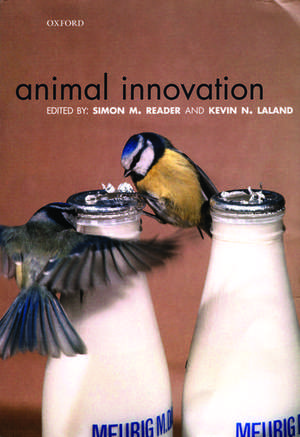
Animal Innovation
Editat de Simon M. Reader, Kevin N. Lalanden Limba Engleză Paperback – 25 sep 2003
Preț: 468.04 lei
Preț vechi: 651.61 lei
-28%
Puncte Express: 702
Carte tipărită la comandă
Livrare economică 10-16 decembrie
Livrare prin curier în România Termenul estimat este afișat lângă disponibilitate.
Transport gratuit pentru acest produs Plată online sau ramburs, în funcție de opțiunile comenzii.
Retur gratuit în 14 zile Comandă securizată și suport în română.
Specificații
ISBN-13: 9780198526223
ISBN-10: 0198526229
Pagini: 354
Ilustrații: numerous figures and halftones
Dimensiuni: 168 x 240 x 19 mm
Greutate: 0.61 kg
Editura: OUP OXFORD
Colecția OUP Oxford
Locul publicării:Oxford, United Kingdom
ISBN-10: 0198526229
Pagini: 354
Ilustrații: numerous figures and halftones
Dimensiuni: 168 x 240 x 19 mm
Greutate: 0.61 kg
Editura: OUP OXFORD
Colecția OUP Oxford
Locul publicării:Oxford, United Kingdom
V-ar putea interesa
-
 Through Our Eyes Only?: The Search for Animal ConsciousnessMarian Stamp Dawkins-27%Preț: 339.79 lei466.01 lei
 -
 Animal ArchitectureMike Hansell-27%Preț: 531.09 lei729.09 lei
 -
 Observing Animal Behaviour: Design and analysis of quantitative dataMarian Stamp Dawkins-22%Preț: 442.82 lei565.47 lei
 -
 Animal Behaviour: A Very Short IntroductionTristram D. Wyatt-19%Preț: 57.46 lei71.12 lei
 -
 Tool Use and Causal CognitionTeresa McCormack-28%Preț: 538.88 lei752.86 lei
 -
 Why Animals Matter: Animal consciousness, animal welfare, and human well-beingMarian Stamp Dawkins-20%Preț: 124.45 lei154.78 lei
 -
 Culture EvolvesAndrew Whiten-31%Preț: 923.98 lei1336.84 lei
 -
 Zoo Animals: Behaviour, Management, and WelfareGeoff Hosey-18%Preț: 441.88 lei537.53 lei
 -
 Behavior Guide to African MammalsRichard Despard EstesPreț: 334.09 lei
 -
 An Introduction to Animal BehaviourAubrey ManningPreț: 436.16 lei
 -
 Social BehaviourTamás Székely-5%Preț: 470.16 lei494.90 lei
 -
 Wild ConnectionJennifer L. VerdolinPreț: 156.28 lei
 -
 Animal BehaviorJohn A ByersPreț: 81.09 lei
 -
 Animal WiseVirginia MorellPreț: 93.91 lei
Recenzii
This interesting collection of chapters seems bound to stimulate further research, and it may well cause researchers to be more alert to the potential importance of phenomena that might previously have been dismissed as one-off events or anecdotes. It is also a thought-provoking and pleasant read . . . Acquire Animal Innovation, and you'll probably get some new and useful ideas for your teaching and research.
I really enjoyed reading this book. The pleasure stemmed from both specific and general features ... All of the chapters are eminently readable, so this could serve as additional reading on an undergraduate course ... I thought this book provided a pile of fun information on animal behavior as well as research challenges for the future. About how many edited volumes can you say the same?
. . . the book provides a state-of-the-art compendium of different approaches to animal innovation, with several chapters neatly summarising the results of several years' work, and is rich in ideas for further work. This should make it invaluable to students, especially post-graduates, interested in the area . . . an informative and stimulating volume.
Probing the relation between development and innovation is one of the 'ten unanswered questions' that Reader and Laland pose in their opening chapter and, having now read Animal Innovation for myself, I can assure tham that their book does indeed 'provide a stimulus to generating answers to . . . these interesting and important questions', even if I am going to try to do so in the lowly baboon and not the groovy guppy.
. . . this book presents a convincing case that innovation is a coherent and exciting topic for biologists. And as such it meets its aim to stimulate awareness in this newly developing field.
The editors have succeeded in putting innovation well and truly on the map as a phenomenon to be reckoned with. They provide a series of outstanding questions that demand answers, and the book will stimulate further research efforts.
Innovation has likely been a significant causal force in the evolution of many species. This book provides a wide-ranging and up-to-date review of an important phenomenon.
Over the past 20 years, as scientists have conducted increasingly detailed, long-term studies of animals, they have come to know their subjects' behaviour so well that they can state with confidence when a truly novel innovation has appeared. Animal Innovation offers the first attempt to analyse such discoveries in a careful, scientific manner. The volume is filled with wonderful examples - strikingly innovative behaviours by species ranging from guppies to chimpanzees ... Observing an animal do something it has never done before is genuinely exciting. Animal Innovation offers the equally exciting prospect of studying such creative behaviour scientifically.
Innovation - the Mother of All Culture - has been curiously neglected for decades, in part because no one really knew how to study it. Now, at last, we do, and this book shows how it should be done and documents the surprising advances that have been made in just a few years.
I thoroughly recommend this book to anyone with an interest in primate behaviour. It describes a fascinating range of innovative behaviours seen in primate and non-primate species alike and is extremely thought-provoking in describing the challenges to be faced by those wishing to drive this area of scientific enquiry forward. All chapters are highly readable and pitched at a level accessible to final year undergraduates, this makes the book an excellent text for courses in primatology or animal bahviour more broadly.
I really enjoyed reading this book. The pleasure stemmed from both specific and general features ... All of the chapters are eminently readable, so this could serve as additional reading on an undergraduate course ... I thought this book provided a pile of fun information on animal behavior as well as research challenges for the future. About how many edited volumes can you say the same?
. . . the book provides a state-of-the-art compendium of different approaches to animal innovation, with several chapters neatly summarising the results of several years' work, and is rich in ideas for further work. This should make it invaluable to students, especially post-graduates, interested in the area . . . an informative and stimulating volume.
Probing the relation between development and innovation is one of the 'ten unanswered questions' that Reader and Laland pose in their opening chapter and, having now read Animal Innovation for myself, I can assure tham that their book does indeed 'provide a stimulus to generating answers to . . . these interesting and important questions', even if I am going to try to do so in the lowly baboon and not the groovy guppy.
. . . this book presents a convincing case that innovation is a coherent and exciting topic for biologists. And as such it meets its aim to stimulate awareness in this newly developing field.
The editors have succeeded in putting innovation well and truly on the map as a phenomenon to be reckoned with. They provide a series of outstanding questions that demand answers, and the book will stimulate further research efforts.
Innovation has likely been a significant causal force in the evolution of many species. This book provides a wide-ranging and up-to-date review of an important phenomenon.
Over the past 20 years, as scientists have conducted increasingly detailed, long-term studies of animals, they have come to know their subjects' behaviour so well that they can state with confidence when a truly novel innovation has appeared. Animal Innovation offers the first attempt to analyse such discoveries in a careful, scientific manner. The volume is filled with wonderful examples - strikingly innovative behaviours by species ranging from guppies to chimpanzees ... Observing an animal do something it has never done before is genuinely exciting. Animal Innovation offers the equally exciting prospect of studying such creative behaviour scientifically.
Innovation - the Mother of All Culture - has been curiously neglected for decades, in part because no one really knew how to study it. Now, at last, we do, and this book shows how it should be done and documents the surprising advances that have been made in just a few years.
I thoroughly recommend this book to anyone with an interest in primate behaviour. It describes a fascinating range of innovative behaviours seen in primate and non-primate species alike and is extremely thought-provoking in describing the challenges to be faced by those wishing to drive this area of scientific enquiry forward. All chapters are highly readable and pitched at a level accessible to final year undergraduates, this makes the book an excellent text for courses in primatology or animal bahviour more broadly.