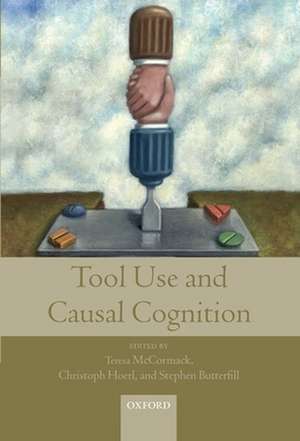
Tool Use and Causal Cognition: Consciousness & Self-Consciousness Series
Editat de Teresa McCormack, Christoph Hoerl, Stephen Butterfillen Limba Engleză Hardback – 25 aug 2011


Preț: 538.88 lei
Preț vechi: 752.86 lei
-28%
Puncte Express: 808
Carte tipărită la comandă
Livrare economică 04-09 decembrie
Livrare prin curier în România Termenul estimat este afișat lângă disponibilitate.
Transport gratuit pentru acest produs Plată online sau ramburs, în funcție de opțiunile comenzii.
Retur gratuit în 14 zile Comandă securizată și suport în română.
Specificații
ISBN-13: 9780199571154
ISBN-10: 0199571155
Pagini: 272
Dimensiuni: 175 x 240 x 36 mm
Greutate: 0.55 kg
Editura: OUP OXFORD
Colecția OUP Oxford
Seria Consciousness & Self-Consciousness Series
Locul publicării:Oxford, United Kingdom
ISBN-10: 0199571155
Pagini: 272
Dimensiuni: 175 x 240 x 36 mm
Greutate: 0.55 kg
Editura: OUP OXFORD
Colecția OUP Oxford
Seria Consciousness & Self-Consciousness Series
Locul publicării:Oxford, United Kingdom
V-ar putea interesa
-
 Time and Memory: Issues in Philosophy and PsychologyChristoph Hoerl-26%Preț: 360.58 lei487.77 lei
 -
 Through Our Eyes Only?: The Search for Animal ConsciousnessMarian Stamp Dawkins-27%Preț: 339.79 lei466.01 lei
 -
 Animal ArchitectureMike Hansell-27%Preț: 531.09 lei729.09 lei
 -
 Animal InnovationSimon M. Reader-28%Preț: 468.04 lei651.61 lei
 -
 Observing Animal Behaviour: Design and analysis of quantitative dataMarian Stamp Dawkins-22%Preț: 442.82 lei565.47 lei
 -
 Animal Behaviour: A Very Short IntroductionTristram D. Wyatt-19%Preț: 57.46 lei71.12 lei
 -
 -28%Preț: 440.28 lei614.23 lei
 -
 Why Animals Matter: Animal consciousness, animal welfare, and human well-beingMarian Stamp Dawkins-20%Preț: 124.45 lei154.78 lei
 -
 -19%Preț: 508.28 lei629.93 lei
 -
 Zoo Animals: Behaviour, Management, and WelfareGeoff Hosey-19%Preț: 437.52 lei537.53 lei
 -
 -10%Preț: 380.12 lei421.98 lei
 -
 Behavior Guide to African MammalsRichard Despard EstesPreț: 334.25 lei
 -
 Animal HomosexualityAldo PoianiPreț: 482.76 lei
 -
 Social BehaviourTamás Székely-5%Preț: 470.16 lei494.90 lei
 -
 Preț: 104.36 lei
 -
 Animal BehaviorJohn A ByersPreț: 70.72 lei
Notă biografică
Teresa McCormack is Professor of Developmental Psychology at the School of Psychology, Queen's University Belfast. She was co-director of the AHRC-funded project on Causal Understanding based at the University of Warwick. Her research primarily addresses issues concerning children's temporal and causal cognition. She has published two co-edited interdisciplinary books: Time and Memory: Perspectives in Philosophy and Psychology (OUP, 2001), with C. Hoerl, and Joint Attention and Communication (OUP, 2005), with N. Eilan, C. Hoerl, and J. Roessler. A further volume entitled Understanding Counterfactuals, Understanding Causation, co-edited with C. Hoerl and S. Beck is forthcoming with OUP.Christoph Hoerl is Associate Professor (Reader) in Philosophy at the University of Warwick. Between 2004 and 2008, he was co-director (with Teresa McCormack and Johannes Roessler) of the interdisciplinary AHRC Research Project 'Causal Understanding: Empirical and Theoretical Foundations for a New Approach'. With Teresa McCormack and Sarah Beck, he is co-editor of Understanding Counterfactuals, Understanding Causation (OUP, forthcoming).Stephen Butterfill is Associate Professor in Philosophy at the University of Warwick. His research focuses on philosophical issues in developmental psychology.