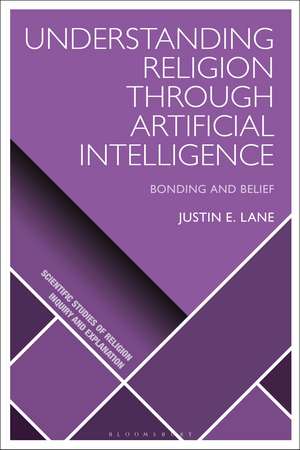
Understanding Religion Through Artificial Intelligence: Bonding and Belief: Scientific Studies of Religion: Inquiry and Explanation
Autor Dr Justin E. Laneen Limba Engleză Hardback – 2 iun 2021
| Toate formatele și edițiile | Preț | Express |
|---|---|---|
| Paperback (1) | 197.38 lei 43-57 zile | |
| Bloomsbury Publishing – 28 dec 2022 | 197.38 lei 43-57 zile | |
| Hardback (1) | 586.22 lei 43-57 zile | |
| Bloomsbury Publishing – 2 iun 2021 | 586.22 lei 43-57 zile |
Din seria Scientific Studies of Religion: Inquiry and Explanation
- 18%
 Preț: 150.27 lei
 - 27%
 Preț: 198.21 lei
 - 27%
 Preț: 198.92 lei
 - 33%
 Preț: 526.79 lei
 - 34%
 Preț: 794.95 lei
 - 26%
 Preț: 244.53 lei
 - 27%
 Preț: 197.01 lei
 - 26%
 Preț: 245.10 lei
 - 26%
 Preț: 238.43 lei
 - 26%
 Preț: 236.15 lei
 - 26%
 Preț: 795.79 lei
 - 34%
 Preț: 795.63 lei
 - 26%
 Preț: 239.65 lei
 - 26%
 Preț: 244.91 lei
 - 18%
 Preț: 199.76 lei
 - 25%
 Preț: 224.20 lei
 - 25%
 Preț: 225.06 lei
 - 25%
 Preț: 224.29 lei
 - 34%
 Preț: 614.44 lei
 - 26%
 Preț: 231.73 lei
 - 25%
 Preț: 224.48 lei
 - 27%
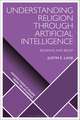 Preț: 197.38 lei
 - 27%
 Preț: 197.01 lei
 - 27%
 Preț: 195.65 lei
 - 27%
 Preț: 197.19 lei
 - 27%
 Preț: 195.65 lei
 - 27%
 Preț: 195.75 lei
 - 33%
 Preț: 527.55 lei
 - 34%
 Preț: 526.23 lei
Preț: 586.22 lei
Preț vechi: 883.42 lei
-34% Nou
Puncte Express: 879
Preț estimativ în valută:
103.74€ • 121.64$ • 91.10£
103.74€ • 121.64$ • 91.10£
Carte tipărită la comandă
Livrare economică 09-23 februarie 26
Preluare comenzi: 021 569.72.76
Specificații
ISBN-13: 9781350103559
ISBN-10: 1350103551
Pagini: 256
Ilustrații: 10 bw illus
Dimensiuni: 156 x 234 x 21 mm
Greutate: 0.53 kg
Editura: Bloomsbury Publishing
Colecția Bloomsbury Academic
Seria Scientific Studies of Religion: Inquiry and Explanation
Locul publicării:London, United Kingdom
ISBN-10: 1350103551
Pagini: 256
Ilustrații: 10 bw illus
Dimensiuni: 156 x 234 x 21 mm
Greutate: 0.53 kg
Editura: Bloomsbury Publishing
Colecția Bloomsbury Academic
Seria Scientific Studies of Religion: Inquiry and Explanation
Locul publicării:London, United Kingdom
Caracteristici
Explores social cohesion in religious groups through real-world examples, such as the influence of 9/11 on religious sermons
Notă biografică
Justin E. Lane is a Research Associate at the Center for Modeling Social Systems, Kristiansand, Norway and the Center for Mind and Culture, Boston, USA. His research focuses on the use of computational approaches to complex social problems. He's also the co-founder and CTO at ALAN Analytics, a data analytics and AI consultancy company.
Cuprins
1. Introduction2. Religions Old and New3. Bonding and Belief4. Identity and Extremism5. Artificial Intelligence and Religions in silico6. From AI in silico, to AI in situ: Creating AI gurus, Birds eye views of Christianity, and using MAAI to study Social Stability7. Schisms and Sacred Values8. The Future of ReligionReferencesIndex
Recenzii
Throughout the book . Lane provides directions for future research . This book has significant inter-disciplinary implications as it widens the scope of the social sciences . it enriches the study of religion by reframing how the subject is approached scientifically and intrigues non-academic minds on how AI could facilitate our understanding of human religiosity.
If you study religion, Justin E. Lane's book will explain how AI is changing what's possible in that endeavor. If you work in AI and computer simulation, you'll discover how those tools can be deployed to deepen our understanding of religion. Either way, you've been warned: you'll never look at AI or religion the same way again.
Justin E. Lane's new book is the most comprehensive and clear introduction to the use of artificial intelligence in the computational science of religion currently available. Both lay readers and experts will benefit from his careful explanations of the various methodologies at work in this rapidly growing field, and his vivid descriptions of the ways in which they are informing our understanding of phenomena such as religious extremism and conflict.
If you study religion, Justin E. Lane's book will explain how AI is changing what's possible in that endeavor. If you work in AI and computer simulation, you'll discover how those tools can be deployed to deepen our understanding of religion. Either way, you've been warned: you'll never look at AI or religion the same way again.
Justin E. Lane's new book is the most comprehensive and clear introduction to the use of artificial intelligence in the computational science of religion currently available. Both lay readers and experts will benefit from his careful explanations of the various methodologies at work in this rapidly growing field, and his vivid descriptions of the ways in which they are informing our understanding of phenomena such as religious extremism and conflict.