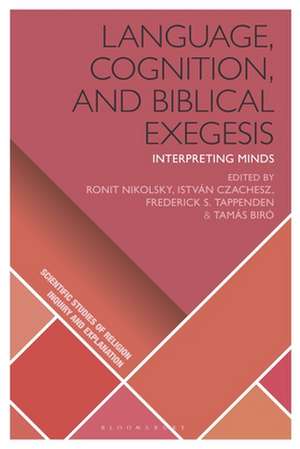
Language, Cognition, and Biblical Exegesis: Interpreting Minds: Scientific Studies of Religion: Inquiry and Explanation
Editat de Ronit Nikolsky, István Czachesz, Frederick S. Tappenden, Tamás Biróen Limba Engleză Paperback – 24 dec 2020
The study of ancient religions and biblical studies are dominated by textual evidence. However, the cognitive science of religion is lacking significant research on the language and textual interpretation of this literature. This book presents a systematic attempt to redefine the interpretation of religious texts in a cognitive framework, providing concrete textual analysis on a broad selection of biblical passages. It explores the ways that cognitive approaches to language and textual interpretation expand the disciplines of the cognitive science of religion and biblical studies.
This book brings together methodology from the cognitive sciences, linguistics, philology, biblical studies, and religious studies, to offer a new perspective for biblical studies and cognitive sciences. It presents a renewed vision of textual interpretation - one that aligns hermeneutical reflection with our cognitive capacities.
Din seria Scientific Studies of Religion: Inquiry and Explanation
- 22%
 Preț: 155.70 lei
 - 18%
 Preț: 215.67 lei
 - 25%
 Preț: 224.99 lei
 - 28%
 Preț: 208.89 lei
 - 27%
 Preț: 240.63 lei
 - 27%
 Preț: 247.84 lei
 - 27%
 Preț: 257.24 lei
 - 33%
 Preț: 645.60 lei
 - 27%
 Preț: 235.86 lei
 - 26%
 Preț: 264.42 lei
 - 30%
 Preț: 196.16 lei
 - 27%
 Preț: 250.23 lei
 - 28%
 Preț: 205.93 lei
 - 28%
 Preț: 207.19 lei
 - 25%
 Preț: 212.76 lei
 - 27%
 Preț: 276.77 lei
 - 26%
 Preț: 251.68 lei
 - 27%
 Preț: 240.17 lei
 - 26%
 Preț: 265.47 lei
 - 28%
 Preț: 210.36 lei
 - 28%
 Preț: 210.57 lei
 - 27%
 Preț: 276.19 lei
 - 32%
 Preț: 553.43 lei
 - 27%
 Preț: 277.68 lei
 - 36%
 Preț: 565.49 lei
 - 32%
 Preț: 798.01 lei
Preț: 236.32 lei
Preț vechi: 322.71 lei
-27%
Puncte Express: 354
Carte tipărită la comandă
Livrare economică 07-21 decembrie
Livrare prin curier în România Termenul estimat este afișat lângă disponibilitate.
Transport gratuit de la 400.00 lei Plată online sau ramburs, în funcție de opțiunile comenzii.
Retur gratuit în 14 zile Comandă securizată și suport în română.
Specificații
ISBN-13: 9781350225404
ISBN-10: 1350225401
Pagini: 256
Ilustrații: 9 bw illus
Dimensiuni: 154 x 232 x 16 mm
Greutate: 0.4 kg
Editura: Bloomsbury Publishing
Colecția Bloomsbury Academic
Seria Scientific Studies of Religion: Inquiry and Explanation
Locul publicării:London, United Kingdom
ISBN-10: 1350225401
Pagini: 256
Ilustrații: 9 bw illus
Dimensiuni: 154 x 232 x 16 mm
Greutate: 0.4 kg
Editura: Bloomsbury Publishing
Colecția Bloomsbury Academic
Seria Scientific Studies of Religion: Inquiry and Explanation
Locul publicării:London, United Kingdom
Cuprins
Notes on Contributors
Preface
Introduction: Cognition, Evolution, and Biblical Exegesis, István Czachesz
1. Cognitive Science and Biblical Interpretation, István Czachesz (University of Tromsø, Norway) and Gerd Theissen (University of Heidelberg, Germany)
2. Emotional Fear in Pentateuchal Legal Collections, Thomas Kazen (Stockholm School of Theology, Sweden)
3. Liquid Life: Blood, Life, and Conceptual Metaphors In the Hebrew Bible and the Ancient Near East, Anne Katrine De Hemmer Gudme (University of Copenhagen, Denmark)
4. "To Love" in the Bible: a Cognitive-Evolutionary Approach, Ronit Nikolsky (University of Groningen, The Netherlands)
5. "The Glory of the Lord Has Risen Upon You": Some Observations on the "Glory"-Language of Isaiah 56-66 Based on a Cognitive Semantic Approach, Marilyn E. Burton (Independent Researcher, UK)
6. The Influence of Categorization on Translation Meaning, Shelley Ashdown (Dallas International University, USA)
7. Imaging Resurrection: Toward an Image Schematic Understanding of Resurrection Beliefs in Second Temple Judaism, Frederick S. Tappenden (University of Alberta, Canada)
8. Liturgical Linguistics: Towards the Syntax of Communicating with the Super-Human Agent in Judaism, Tamás Biró (Eötvös Loránd University, Hungary and University of Jewish
Studies, Hungary)
9. Forgiveness of the Sinless: A Classic Contradiction in 1 John in the Light of Contemporary Forgiveness Research, Rikard Roitto (Stockholm School of Theology, Sweden)
10. Christian Beginnings and Cultural Evolution, István Czachesz (University of Tromsø, Norway)
Notes
Bibliography
Index
Preface
Introduction: Cognition, Evolution, and Biblical Exegesis, István Czachesz
1. Cognitive Science and Biblical Interpretation, István Czachesz (University of Tromsø, Norway) and Gerd Theissen (University of Heidelberg, Germany)
2. Emotional Fear in Pentateuchal Legal Collections, Thomas Kazen (Stockholm School of Theology, Sweden)
3. Liquid Life: Blood, Life, and Conceptual Metaphors In the Hebrew Bible and the Ancient Near East, Anne Katrine De Hemmer Gudme (University of Copenhagen, Denmark)
4. "To Love" in the Bible: a Cognitive-Evolutionary Approach, Ronit Nikolsky (University of Groningen, The Netherlands)
5. "The Glory of the Lord Has Risen Upon You": Some Observations on the "Glory"-Language of Isaiah 56-66 Based on a Cognitive Semantic Approach, Marilyn E. Burton (Independent Researcher, UK)
6. The Influence of Categorization on Translation Meaning, Shelley Ashdown (Dallas International University, USA)
7. Imaging Resurrection: Toward an Image Schematic Understanding of Resurrection Beliefs in Second Temple Judaism, Frederick S. Tappenden (University of Alberta, Canada)
8. Liturgical Linguistics: Towards the Syntax of Communicating with the Super-Human Agent in Judaism, Tamás Biró (Eötvös Loránd University, Hungary and University of Jewish
Studies, Hungary)
9. Forgiveness of the Sinless: A Classic Contradiction in 1 John in the Light of Contemporary Forgiveness Research, Rikard Roitto (Stockholm School of Theology, Sweden)
10. Christian Beginnings and Cultural Evolution, István Czachesz (University of Tromsø, Norway)
Notes
Bibliography
Index
Recenzii
The editors of Language, Cognition, and Biblical Exegesis enlist an outstanding group of scholars-fluent in both the relevant religious and scientific literatures and languages-to assemble a splendid collection of essays that variously recruit the many methodological, theoretical, and empirical resources of cognitive linguistics, of conceptual metaphor theory, and of the cognitive and evolutionary sciences of religion to insightfully illuminate biblical texts-both Hebrew and Christian--and the cultural settings from which they arose.
This book is a significant contribution to the new discipline called cognitive philology. It draws on the combined competences of the cognitive and humanistic sciences to understand the minds behind ancient and biblical texts. It is a treasure trove of studies and applications of cutting-edge science by leading biblical and cognitive science of religion scholars. This is a must-read for all interested in new approaches to ancient texts.
In this book, we are confronted with the cognitive turn. The authors challenge us to understand the mental processes that affect the creation, use, transmission, and reception of biblical texts. Their work provides us with a whole new meaning of the word exegesis. Without replacing conventional literary, linguistic, historical, and social scientific outlooks, each author sees the text through the cognitive looking glass. Such a new look helps us to see, like Alice, that what we thought we knew might need to be revised.
This book is a significant contribution to the new discipline called cognitive philology. It draws on the combined competences of the cognitive and humanistic sciences to understand the minds behind ancient and biblical texts. It is a treasure trove of studies and applications of cutting-edge science by leading biblical and cognitive science of religion scholars. This is a must-read for all interested in new approaches to ancient texts.
In this book, we are confronted with the cognitive turn. The authors challenge us to understand the mental processes that affect the creation, use, transmission, and reception of biblical texts. Their work provides us with a whole new meaning of the word exegesis. Without replacing conventional literary, linguistic, historical, and social scientific outlooks, each author sees the text through the cognitive looking glass. Such a new look helps us to see, like Alice, that what we thought we knew might need to be revised.