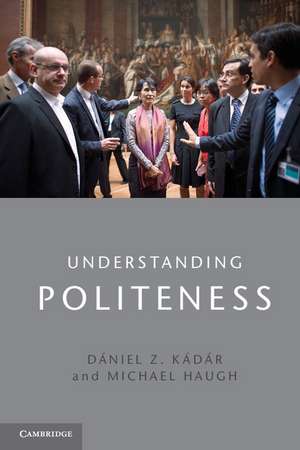
Understanding Politeness
Autor Dániel Z. Kádár, Michael Haughen Limba Engleză Paperback – 29 aug 2013
Adresată cu precădere studenților la nivel postuniversitar și cercetătorilor din domeniile pragmaticii și sociolingvisticii, Understanding Politeness reprezintă o resursă esențială pentru înțelegerea modului în care interacțiunile umane sunt modelate de norme sociale complexe. Considerăm că volumul reușește să depășească viziunea tradițională a politeții ca simplă etichetă lingvistică, propunând în schimb o analiză a comportamentului interpersonal prin care ne definim identitatea și gestionăm relațiile sociale. Structura este riguros organizată în trei secțiuni fundamentale. Prima parte stabilește cadrul teoretic, trecând în revistă rădăcinile cercetării în domeniu și evoluțiile recente. Partea a doua explorează „Politețea și Timpul”, analizând interacțiunea, ritualitatea și dimensiunea istorică, în timp ce ultima parte se concentrează pe „Spațiul Social”, de la mecanisme cognitive și emoții, până la metapragmatică și identitate culturală. Comparabilă cu Politeness de Richard J. Watts în ceea ce privește rigoarea academică, această lucrare este actualizată pentru a include perspective moderne despre practica socială și dinamica interculturală. În contextul operei autorilor, Dániel Z. Kádár și Michael Haugh continuă explorările din lucrări precum Politeness, Impoliteness and Ritual sau Cross-Cultural Pragmatics, rafinând modelele de analiză a datelor lingvistice. Reținem că includerea celor 6 exerciții practice și a glosarului face ca acest text să fie nu doar o monografie teoretică, ci și un instrument de lucru didactic valoros, facilitând aplicarea conceptelor în analize concrete de discurs și comunicare interculturală.
Preț: 391.44 lei
Carte tipărită la comandă
Livrare economică 07-21 decembrie
Specificații
ISBN-10: 1107626943
Pagini: 310
Ilustrații: 25 b/w illus. 4 tables 6 exercises
Dimensiuni: 170 x 244 x 17 mm
Greutate: 0.54 kg
Editura: Cambridge University Press
Locul publicării:New York, United States
V-ar putea interesa
-
 The Subtle Art of Not Giving a F*ck UKMark MansonPreț: 92.74 lei
 -
 -32%Preț: 544.63 lei806.73 lei
 -
 PragmaticsSiobhan Chapman-24%Preț: 267.09 lei353.41 lei
 -
 When Everyone Knows That Everyone Knows...Steven PinkerPreț: 137.96 lei
 -
 Mind Your MannersSara Jane HoPreț: 108.76 lei
 -
 -25%Preț: 277.98 lei369.49 lei
 -
 -24%Preț: 95.74 lei125.20 lei
 -
 -25%Preț: 70.03 lei93.87 lei
 -
 -15%Preț: 201.23 lei237.83 lei
 -
 -24%Preț: 787.18 lei1040.63 lei
 -
 Community TranslationMustapha Taibi-16%Preț: 284.79 lei337.78 lei
 -
 Retranslation: Translation, Literature and ReinterpretationDr Sharon Deane-Cox-25%Preț: 277.20 lei369.09 lei
 -
 Beyond DialogueCraig ConsidinePreț: 156.87 lei
 -
 Time and WorldHartmut RosaPreț: 142.10 lei
 -
 A Subjective Approach to International RelationsBertrand BadiePreț: 99.10 lei
 -
 Watch Your WordsGerald GaruttiPreț: 137.23 lei
 -
 Empathy and ResistanceKristina LunzPreț: 109.62 lei
 -
 -26%Preț: 69.31 lei93.67 lei
 -
 Just Good MannersWilliam HansonPreț: 79.09 lei
 -
 LighthousesDavid Ross-17%Preț: 60.47 lei72.95 lei
 -
 OracyNeil MercerPreț: 135.90 lei
 -
 The School of Life Guide to Modern MannersThe School Of Life-20%Preț: 56.39 lei70.83 lei
De ce să citești această carte
Această carte este ideală pentru cei care doresc să înțeleagă mecanismele invizibile ale comunicării cotidiene. Cititorul câștigă un cadru teoretic solid pentru a analiza cum politețea influențează succesul relațiilor sociale și profesionale. Este un instrument indispensabil pentru masteranzi și doctoranzi, oferind atât fundamentarea istorică a domeniului, cât și exerciții aplicate pentru cercetarea contemporană în sociolingvistică.
Despre autor
Dániel Z. Kádár și Michael Haugh sunt cercetători de renume internațional în domeniul pragmaticii și sociolingvisticii. Kádár este cunoscut pentru lucrările sale care analizează legătura dintre limbaj și politică, precum și pentru studiile asupra ritualului și politeții în diverse culturi. Haugh a contribuit semnificativ la înțelegerea interacțiunii umane și a modului în care semnificația este negociată social. Colaborarea lor sub egida Cambridge University Press reflectă o expertiză vastă în pragmatica interculturală, autorii fiind recunoscuți pentru capacitatea de a integra date empirice din diverse limbi și culturi în modele teoretice coerente.
Cuprins
1. Introduction; Part I. Theoretical Framework: 2. The roots of politeness research; 3. Recent developments in politeness research; 4. Politeness as social practice; 5. Understandings of politeness; Part II. Politeness and Time: 6. Politeness in interaction; 7. Politeness, convention and rituality; 8. Politeness and history; Part III. Politeness and Social Space: From Mind to Society: 9. Politeness and metapragmatics; 10. Politeness, cognition and emotion; 11. Culture, identity and politeness; 12. Conclusion.
Recenzii
'Understanding Politeness focuses on politeness as social practice, and sets politeness within a social, historical and evaluative context. It constitutes an excellent engagement with past and current politeness research, describes key concepts in politeness clearly, and also provides many illustrative examples from a range of different media.' Sara Mills, Research Professor in Linguistics, Sheffield Hallam University
'The authors present their innovative approach to studying interaction, focusing on (im)politeness through time and social space. Understanding Politeness can be used as a study book for students majoring in pragmatics and is a must-read for politeness researchers.' Ekaterina Rudneva, Antropologicheskij Forum
Descriere
Politeness is key to all of our relationships and plays a fundamental part in the way we communicate with each other and the way we define ourselves. It is not limited only to conventional aspects of linguistic etiquette, but encompasses all types of interpersonal behaviour through which we explore and maintain our relationships. This groundbreaking exploration navigates the reader through this fascinating area and introduces them to a variety of new insights. The book is divided into three parts and is based on an innovative framework which relies on the concepts of social practice, time and space. In this multidisciplinary approach, the authors capture a range of user and observer understandings and provide a variety of examples from different languages and cultures. With its reader-friendly style, carefully constructed exercises and useful glossary, Understanding Politeness will be welcomed by both researchers and postgraduate students working on politeness, pragmatics and sociolinguistics more broadly.