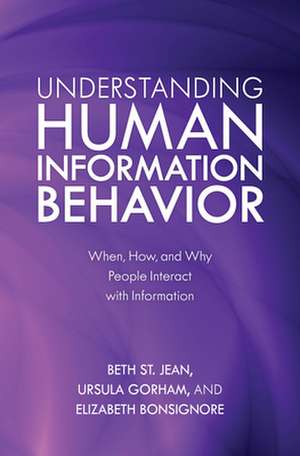
Understanding Human Information Behavior: When, How, and Why People Interact with Information
Autor Beth St. Jean, Ursula Gorham, Elizabeth Bonsignoreen Limba Engleză Paperback – 25 mar 2021
The first six chapters of the book provide students with the fundamental building blocks of information behavior, introduce them to important related concepts, and provide a deep dive into information literacy, digital literacy, the digital divide and digital inclusion.
Chapters 7 through 12 introduce students to the scholarly communication system, providing guidance on how to find, read, and critically evaluate information behavior studies. Also explored in these chapters are the various methods used to investigate and understand people's information behaviors. Topics covered include research design, research methods, research ethics, user needs assessment, and human-computer interaction and associated design methods. This part of the book also covers some of the major information behavior models and theories that have been developed to describe, predict, and/or explain people's information behaviors.
In chapters 13 through 16, the authors provide an in-depth look into their own information behavior research areas, including consumer health information behavior and health justice; youth information behavior; legal information behavior and access to justice; and information behavior in libraries.
In the final chapter, students are first introduced to a wide range of careers within the information professions and then taken along on a deep dive into 10 specific jobs, with a special focus on the thread of information behavior that pervades the roles and responsibilities commonly associated with these positions.
Each chapter begins with one or more scenarios illustrating concepts covered in the chapter and ends with discussion questions.
Preț: 382.42 lei
Preț vechi: 554.35 lei
-31%
Puncte Express: 574
Carte tipărită la comandă
Livrare economică 20 noiembrie-04 decembrie
Livrare prin curier în România Termenul estimat este afișat lângă disponibilitate.
Transport gratuit de la 400.00 lei Plată online sau ramburs, în funcție de opțiunile comenzii.
Retur gratuit în 14 zile Comandă securizată și suport în română.
Specificații
ISBN-13: 9781538119136
ISBN-10: 1538119137
Pagini: 336
Ilustrații: 28 b/w photos; 14 tables
Dimensiuni: 172 x 252 x 20 mm
Greutate: 0.57 kg
Editura: Bloomsbury Publishing
Colecția Rowman & Littlefield
Locul publicării:New York, United States
ISBN-10: 1538119137
Pagini: 336
Ilustrații: 28 b/w photos; 14 tables
Dimensiuni: 172 x 252 x 20 mm
Greutate: 0.57 kg
Editura: Bloomsbury Publishing
Colecția Rowman & Littlefield
Locul publicării:New York, United States
V-ar putea interesa
-
 Owning Memory: How a Caribbean Community Lost Its Archives and Found Its HistoryJeannette A. Bastian-30%Preț: 455.73 lei653.27 lei
 -
 -25%Preț: 272.36 lei360.84 lei
 -
 -30%Preț: 449.81 lei641.54 lei
 -
 Preț: 232.96 lei
 -
 Preț: 346.93 lei
 -
 The Hipster Librarian's Guide to Teen Craft ProjectsTina ColemanPreț: 337.52 lei
 -
 Read Me a Rhyme in Spanish and English/Leame Una Rima En Espanol E InglesRose Zertuche TrevinoPreț: 334.70 lei
 -
 Licensing Digital ContentLesley Ellen HarrisPreț: 439.05 lei
 -
 Countdown to a New LibraryJeannette Woodward-23%Preț: 437.23 lei567.83 lei
 -
 Writing Reviews for Readers' AdvisoryBrad HooperPreț: 344.01 lei
 -
 State Library Services and Issues: Facing Future ChallengesCharles R. McClure-42%Preț: 553.43 lei949.17 lei
 -
 -18%Preț: 1259.74 lei1536.27 lei
 -
 Game On!Beth Gallaway-20%Preț: 402.06 lei502.59 lei
 -
 Role of Standards in Sci-Tech LibrariesEllis Mount-18%Preț: 997.71 lei1216.73 lei
 -
 Learning and Libraries in an Information Age: Principles and PracticeBarbara K. Stripling-24%Preț: 296.09 lei390.54 lei
 -
 -26%Preț: 278.67 lei376.76 lei
 -
 -22%Preț: 310.84 lei397.05 lei
 -
 Information Literacy: Essential Skills for the Information AgeMichael B. Eisenberg-16%Preț: 341.44 lei405.77 lei
 -
 Guide to Reference Materials for School Library Media CentersBarbara Ripp Safford-31%Preț: 387.13 lei561.33 lei
 -
 The Author Event Primer: How to Plan, Execute and Enjoy Author EventsChapple Langemack-26%Preț: 236.81 lei321.03 lei
 -
 Doing Things with Information: Beyond Indexing and AbstractingRichard L. Anderson-16%Preț: 385.49 lei459.44 lei
 -
 -25%Preț: 256.41 lei341.01 lei
 -
 21st-Century Learning in School LibrariesKristin Fontichiaro-16%Preț: 341.78 lei405.59 lei
 -
 Story Times Good Enough to Eat!: Thematic Programs with Edible Story CraftsMelissa Rossetti Folini-26%Preț: 272.32 lei367.85 lei
 -
 -15%Preț: 591.65 lei696.06 lei
Cuprins
Lists of Figures and Tables
Preface
Chapter 1: Introduction to Information Behavior
Chapter 2: Fundamental Concepts
Chapter 3: Historical Development of the Field
Chapter 4: Related Concepts
Chapter 5: Information Literacy
Chapter 6: Digital Divide and Digital Inclusion
Chapter 7: Finding, Reading, and Critiquing Information Behavior Studies
Chapter 8: Research Methods
Chapter 9: Assessing User Information-Related Preferences and Information Needs
Chapter 10: Investigating User Information Behavior
Chapter 11: Connecting Information Behavior and Human Computer Interaction: User Experience, Accessibility, and Usability
Chapter 12: Information Behavior Models and Theories
Chapter 13: Consumer Health Information Behavior and Health Justice
Chapter 14: Youth Information Behavior
Chapter 15: Legal Information Behavior and Access to Justice
Chapter 16: Information Behavior in Libraries
Chapter 17: The Information-Related Professions: The Underlying Thread of Information Behavior
Acronyms
Glossary
About the Authors
Preface
Chapter 1: Introduction to Information Behavior
Chapter 2: Fundamental Concepts
Chapter 3: Historical Development of the Field
Chapter 4: Related Concepts
Chapter 5: Information Literacy
Chapter 6: Digital Divide and Digital Inclusion
Chapter 7: Finding, Reading, and Critiquing Information Behavior Studies
Chapter 8: Research Methods
Chapter 9: Assessing User Information-Related Preferences and Information Needs
Chapter 10: Investigating User Information Behavior
Chapter 11: Connecting Information Behavior and Human Computer Interaction: User Experience, Accessibility, and Usability
Chapter 12: Information Behavior Models and Theories
Chapter 13: Consumer Health Information Behavior and Health Justice
Chapter 14: Youth Information Behavior
Chapter 15: Legal Information Behavior and Access to Justice
Chapter 16: Information Behavior in Libraries
Chapter 17: The Information-Related Professions: The Underlying Thread of Information Behavior
Acronyms
Glossary
About the Authors
Recenzii
Extremely accessible, comprehensive, and useful, Understanding Human Information Behavior: When, How, and Why People Interact with Information discusses the relevance and significance of its subject to our work and everyday life and is well-positioned to empower students to become helpful information and technology professionals.
This comprehensive text is the ideal resource for teaching human information behavior to undergraduate students. The text is organized in a thoughtful way to address all the most important aspects in an easy to digest manner, with the latter part of the book focusing on key areas of study within the information behavior field. The real world examples included in the text will appeal to undergraduate students and help them connect to what information behavior looks like in practice. The authors write in a winningly approachable style that will help students connect with the key concepts. I particularly like the inclusion of Discussion Questions which can be used by instructors as either homework or in class discussion points to foster a rich dialogue about each of the chapters. Applicable research studies are introduced in the text in an approachable way which will facilitate undergraduate engagement with the ongoing work in the discipline. The acronyms list and glossary at the back of the book are two additional, helpful resources for undergraduates to get caught up to speed on the most important topics under the umbrella of human information behavior.
This comprehensive text is the ideal resource for teaching human information behavior to undergraduate students. The text is organized in a thoughtful way to address all the most important aspects in an easy to digest manner, with the latter part of the book focusing on key areas of study within the information behavior field. The real world examples included in the text will appeal to undergraduate students and help them connect to what information behavior looks like in practice. The authors write in a winningly approachable style that will help students connect with the key concepts. I particularly like the inclusion of Discussion Questions which can be used by instructors as either homework or in class discussion points to foster a rich dialogue about each of the chapters. Applicable research studies are introduced in the text in an approachable way which will facilitate undergraduate engagement with the ongoing work in the discipline. The acronyms list and glossary at the back of the book are two additional, helpful resources for undergraduates to get caught up to speed on the most important topics under the umbrella of human information behavior.