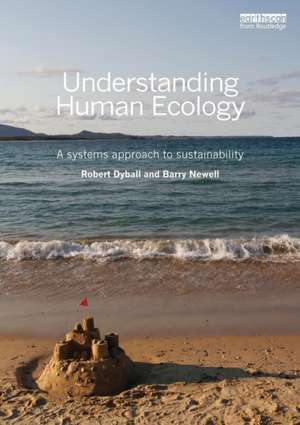
Understanding Human Ecology: A systems approach to sustainability
Autor Barry Newell, Robert Dyballen Limba Engleză Paperback – 11 noi 2014
Nivel de studiu: Licență avansată și Master. În contextul actual al crizei climatice, Understanding Human Ecology propune un cadru conceptual coerent pentru gestionarea problemelor complexe prin prisma sustenabilității. Subliniem faptul că această a doua ediție, publicată de Routledge, rafinează metodologia autorilor Robert Dyball și Barry Newell, introducând elemente noi despre ierarhiile sistemice, menite să sprijine deciziile practice de politică publică.
Ne-a atras atenția structura riguroasă a volumului, împărțită în trei secțiuni logice. Prima parte definește ecologia umană ca perspectivă evolutivă, folosind studiul de caz al Munților Snowy pentru a ilustra conflictele de mediu. Partea a doua, „Building shared understanding”, reprezintă nucleul tehnic al lucrării, unde sunt explicate conceptele de „stocks and flows” (stocuri și fluxuri) și mecanismele de feedback. Ultima parte ancorează teoria în realitatea Antropocenului, analizând sistemele alimentare globale și rolul omului ca administrator al planetei. Cititorii familiarizați cu Human Ecology de Gerald G. Marten vor aprecia aici profunzimea analizei sistemice; în timp ce Marten oferă o introducere accesibilă, Dyball și Newell avansează către o sinteză transdisciplinară între științele cognitive și dinamica sistemelor.
Textul se distinge prin claritatea vizuală, cele 75 de ilustrații și diagrame fiind fundamentale pentru înțelegerea non-liniarității proceselor ecologice. Notăm cu interes modul în care autorii reușesc să transforme teoria sistemelor dintr-un concept abstract într-un instrument de lucru pentru studenți și practicieni, oferind o bază solidă pentru tranziția către sustenabilitate.
Preț: 347.52 lei
Carte disponibilă
Livrare economică 09-23 noiembrie
Livrare express 23-29 octombrie pentru 37.08 lei
Specificații
ISBN-10: 1849713839
Pagini: 234
Ilustrații: 80 black & white illustrations, 11 black & white tables, 10 black & white halftones, 69 black & white line drawings
Dimensiuni: 176 x 244 x 17 mm
Greutate: 0.44 kg
Ediția:New.
Editura: Taylor & Francis Ltd.
V-ar putea interesa
-
 Human Geography: A Very Short IntroductionPatricia Daley-20%Preț: 57.15 lei71.12 lei
 -
 Sustainability: A Very Short IntroductionSaleem H. Ali-19%Preț: 57.46 lei71.30 lei
 -
 Ecology: A Very Short IntroductionJaboury Ghazoul-20%Preț: 57.15 lei71.12 lei
 -
 Fundamental Processes in Ecology: An Earth Systems ApproachDavid M. Wilkinson-21%Preț: 293.37 lei370.30 lei
 -
 -13%Preț: 131.16 lei151.45 lei
 -
 New Directions in Sustainable DesignAdrian Parr-8%Preț: 491.73 lei534.49 lei
 -
 Preț: 341.70 lei
 -
 Resilience: Why Things Bounce BackAndrew Zolli-7%Preț: 73.88 lei79.56 lei
 -
 Sustainability ScienceBert J. M. De VriesPreț: 465.70 lei
 -
 Preț: 357.35 lei
 -
 Environmental Systems and Societies for the IB DiplomaVirginia D'Britto-26%Preț: 440.89 lei598.30 lei
 -
 The New Environmental EconomicsEloi LaurentPreț: 160.16 lei
 -
 -20%Preț: 216.17 lei269.24 lei
 -
 Panarchy: Understanding Transformations in Human and Natural SystemsLance H. GundersonPreț: 404.51 lei
 -
 Resilience ThinkingBrian WalkerPreț: 242.35 lei
 -
 Thinking in SystemsDonella MeadowsPreț: 121.76 lei
 -
 Thinking through Archaeological ComplexityStefani A. CrabtreePreț: 386.07 lei
 -
 The Nature of NatureVandana ShivaPreț: 105.71 lei
 -
 Human NatureKate MarvelPreț: 136.91 lei
 -
 Sustainable Action in Economy and SocietyMalte Faber-15%Preț: 604.64 lei711.34 lei
De ce să citești această carte
Această carte este esențială pentru studenții de la master și profesioniștii din domeniul mediului care doresc să treacă de la intuiție la rigoare analitică. Cititorul câștigă un set de instrumente de „thinking together” pentru a descifra complexitatea sistemelor socio-ecologice. Este un ghid practic pentru oricine dorește să înțeleagă mecanismele schimbării în Antropocen și să aplice teoria sistemelor în politici publice reale.
Despre autor
Robert Dyball și Barry Newell sunt cadre didactice și cercetători recunoscuți, afiliați universităților de prestigiu, specializați în dinamica sistemelor și ecologie umană. Robert Dyball are o experiență vastă în predarea sustenabilității, fiind implicat activ în dezvoltarea curriculumului de ecologie umană. Barry Newell aduce expertiza din domeniul modelării sistemelor complexe. Împreună, cei doi autori au rafinat cadrul teoretic prezentat în acest volum pe parcursul a peste zece ani de cursuri universitare și ateliere de lucru internaționale, asigurându-se că metodele lor sunt atât riguroase din punct de vedere academic, cât și aplicabile în managementul problemelor de mediu contemporane.
Notă biografică
Dr Barry Newell is Visiting Fellow at the Fenner School and Adjunct Associate Professor in the College of Engineering and Computer Science, both at ANU.
Descriere scurtă
Cuprins
Recenzii
Robert Costanza, Institute for Global Prosperity, University College London, UK, and Editor in Chief of The Anthropocene Review
"Understanding Human Ecology by Dyball and Newell is an important book for human ecology and sustainability. The book’s success, from the first to this current edition, is based on a three-fold feature: wide-ranging application of the systems-based transdisciplinary model to critical social–ecological systems of food, health, and livelihoods; far-reaching contexts of cases from the Asia Pacific and Europe; transdisciplinary alignment of theory, concepts and application that makes it accessible not only to academics but also to sustainability and development practitioners including policymakers."
Jennifer Marie S. Amparo, Associate Professor, College of Human Ecology, University of the Philippines Los Baños, The Philippines
"A central challenge for enhancing human wellbeing is to establish a sustainable society in harmony with nature across all regions of the world. Integrating rigorous research, education, and policymaking to meet this challenge is urgently needed. Understanding Human Ecology provides an insightful guide to how this might be achieved."
Kazuhiko Takeuchi, President, Institute for Global Environmental Strategies, Japan
"Understanding Human Ecology provides a coherent and lucid discussion of the topic, is user-friendly for university students (a rarity for a textbook), and makes clear connections to key issues such as sustainability, food security, and ethical issues of justice and fairness in environmental planning that are of serious and urgent concern. I consider it a foundational book in the field."
Annie Booth, Professor Environmental & Sustainability Studies, University of North British Columbia, Canada
"It is time to move beyond the simplistic approaches of cause–effect logic and the triple bottom line that typify many attempts to meet the sustainability challenge. This timely textbook brings the powerful approach of systems thinking to the most pressing, seemingly intractable problems that face humanity in the twenty-first century."
Will Steffen, Emeritus Professor, Fenner School of Environment and Society, Australian National University
"From the Prologue to the concluding chapters, this work has resonated with my students in both introductory and graduate-level classes. Dyball and Newell use a mix of anecdotes, historical references, and scientific research to weave a narrative that captivates the reader and addresses why human ecology is needed, what it is, and how it can be applied. A perfect text to help students understand a most complex topic."
Kenneth E. Hill, Provost, College of the Atlantic, USA
"Understanding Human Ecology by Dyball and Newell provides a novel and transdisciplinary framework for understanding sustainability. This ‘must-read’ book explains why people have historically made such a mess of the environment and provides a convincing case for why we must and can switch from a paradigm of limitless growth to one of ethical living, content with sufficiency."
Terry Chapin, University of Alaska Fairbanks, USA, and Past President, Ecological Society of America
"This important book helps to elucidate the interplay between planetary change and human health, with profound implications for our understanding of the dynamics of contemporary health problems such as the global obesity epidemic and pandemic infectious diseases."
Anthony Capon, Director, Sustainable Development Institute, Monash University, Australia
"Understanding Human Ecology provides a sophisticated yet accessible discussion of the complex systems driving human health and wellbeing in the past, present, and for the future. The authors present methods that can be applied by those interested in the diverse settings of physical, psychosocial, and socioeconomic sectors. Such attempts of analysis and integration often require interdisciplinary skills, however, these authors have paid great attention to the techniques of communication necessary to ensure the effective use of the concepts by a wide-ranging audience from policy workers, researchers, and the public."
Ivan Hanigan, Senior Lecturer in Climate Change and Health, School of Population Health, Curtin University, Australia
"Understanding Human Ecology provides an accessible introduction to the field and to the essential tool of systems analysis. It is an invaluable resource for teachers in human ecology and sustainability science as it reveals how individual everyday experiences and dilemmas are rooted in wider human–environment relations, and helps students appreciate the importance of systemic and historical perspectives on ‘how did we get to this?’ – and equally important, ‘where can we go from here?’"
Ellinor Isgren, Lecturer in Human Ecology, Department of Global Studies, University of Gothenburg, Sweden
Descriere
This key text offers a coherent conceptual framework for human ecology – a clear approach for understanding the many systems we are part of and for how we frame and understand the problems we face. Essential reading for students and scholars of human ecology, environmental ethics, and sustainability studies.