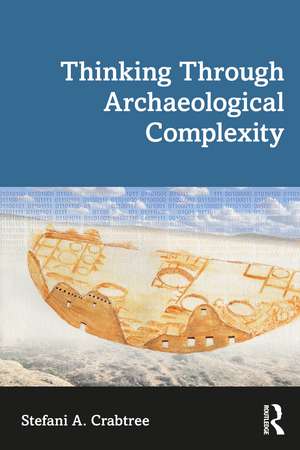
Thinking through Archaeological Complexity
Autor Stefani A. Crabtreeen Limba Engleză Paperback – 30 oct 2025
This volume bridges archaeology and complexity science, offering a transdisciplinary framework for understanding long-term socio-ecological dynamics. It provides a substantive overview of how complex adaptive systems science is used in archaeology. Drawing from case studies in the Ancestral Pueblo Southwest, it demonstrates how tools like agent-based modeling, ecological and social network analysis, and settlement scaling reveal emergent patterns in the archaeological record. The book critically examines concepts such as resilience, adaptation, innovation, and transformation, offering alternatives to overly linear narratives. Emphasizing methodological transparency, it provides practical guidance for scholars interested in modeling, data integration, and working across disciplinary boundaries while grounding in theoretical pluralism. By situating archaeological knowledge within broader scientific conversations, the book encourages readers to reimagine the past not as static or collapsed, but as complex, entangled, and instructive for contemporary challenges.
This book is essential reading for students, researchers, and practitioners in archaeology as well as complexity science. It will also appeal to scholars in anthropology, environmental studies, geography, and network science interested in long-term human-environmental dynamics and the application of complex systems approaches in historical contexts.
Preț: 386.07 lei
Puncte Express: 579
Carte disponibilă
Livrare economică 05-19 noiembrie
Livrare express 21-27 octombrie pentru 28.64 lei
Livrare prin curier în România Termenul estimat este afișat lângă disponibilitate.
Transport gratuit de la 400.00 lei Plată online sau ramburs, în funcție de opțiunile comenzii.
Retur gratuit în 14 zile Comandă securizată și suport în română.
Specificații
ISBN-13: 9781629585550
ISBN-10: 1629585556
Pagini: 170
Ilustrații: 42
Dimensiuni: 156 x 234 x 10 mm
Greutate: 0.3 kg
Ediția:1
Editura: Taylor & Francis
Colecția Routledge
Locul publicării:Oxford, United Kingdom
ISBN-10: 1629585556
Pagini: 170
Ilustrații: 42
Dimensiuni: 156 x 234 x 10 mm
Greutate: 0.3 kg
Ediția:1
Editura: Taylor & Francis
Colecția Routledge
Locul publicării:Oxford, United Kingdom
Public țintă
GeneralCuprins
Acknowledgements; Chapter 1: Introduction; Chapter 2: Scaling Theory and Archaeology; Chapter Three: Agent-based modeling and archaeology; Chapter 4: Network Analysis and Archaeology; Chapter 5.1: Settlement Scaling And Agent-Based Modeling; Chapter 5.2 How to Make a Polity (in the central Mesa Verde region); Chapter 6.1: Network Analysis and Food Webs Case Study; Chapter 6.2 Reconstructing Ancestral Pueblo Food Webs in the Southwestern United States; Chapter 7 Conclusion; Glossary; Index.
Notă biografică
Stefani A. Crabtree is Associate Professor in Social-Environmental Modeling in the Department of Environment and Society at the S.J. and Jessie E. Quinney College of Agriculture and Natural Resources at Utah State University. She is also an External Professor at the Santa Fe Institute.
Recenzii
"The environment, culture, and human cognition – the subject matter of archaeology – are the three most complicated systems of which we have tangible knowledge. Stefani Crabtree offers a wonderfully readable introduction to complexity science as a way to think about the emergence of order in the archaeological record."
Steve Lansing, External Professor, Complexity Science Hub Vienna and the Santa Fe Institute, USA
“Stefani Crabtree has brought the best of SFI to archaeology, focusing a complexity lens on the human-environment nexus by bringing in insights from ecology, network science and geography.”
Simon Levin, James S. McDonnell Distinguished University Professor in Ecology and Evolutionary Biology at Princeton University, USA
Steve Lansing, External Professor, Complexity Science Hub Vienna and the Santa Fe Institute, USA
“Stefani Crabtree has brought the best of SFI to archaeology, focusing a complexity lens on the human-environment nexus by bringing in insights from ecology, network science and geography.”
Simon Levin, James S. McDonnell Distinguished University Professor in Ecology and Evolutionary Biology at Princeton University, USA
Descriere
Thinking Through Archaeological Complexity explores how archaeologists can engage with complex adaptive systems, examining dynamic interactions between humans and environments across space and through time. It offers a roadmap for integrating theory, method, and data through a complexity science lens.